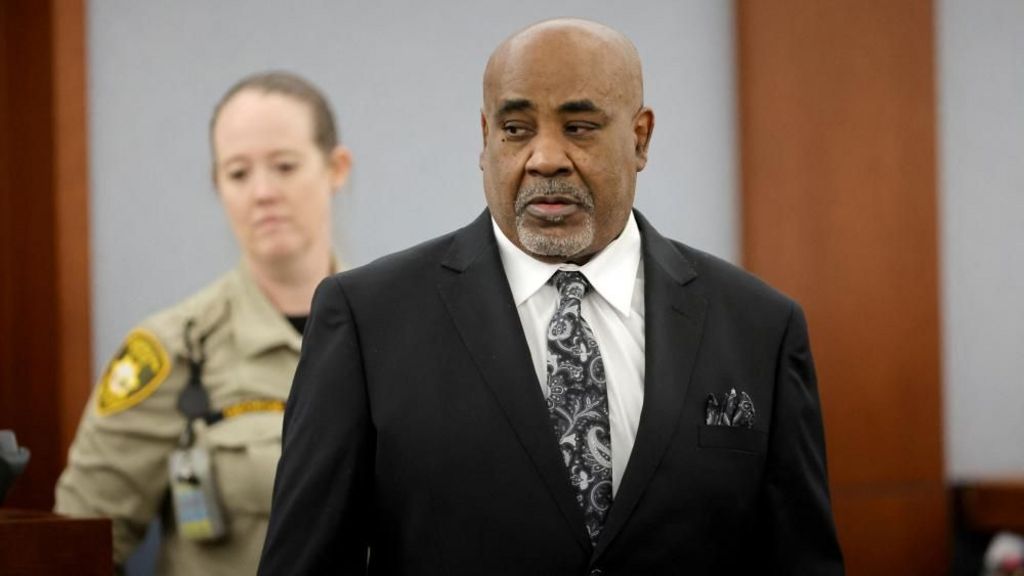
Nearly 30 years after the fatal drive-by shooting that claimed the life of rap icon Tupac Shakur, the long-stalled cold case has finally reached a Las Vegas courtroom, with Duane “Keffe D” Davis standing trial on a single charge of murder with a deadly weapon. The 63-year-old, identified as a founding leader of a notorious Compton-based street gang, has entered a plea of not guilty, setting the stage for a high-stakes trial that has reignited global public fascination with one of the most high-profile unsolved murders in modern pop culture history.
On the fourth day of proceedings, jurors were granted access to a never-before-publicly-heard 2008 police interview recording, which forms the backbone of the prosecution’s case against Davis. The interview was originally conducted by Los Angeles Police Department detectives investigating the 1997 murder of another rap legend, The Notorious B.I.G., when Davis first offered detailed accounts of his role in the Shakur shooting.
Per the prosecution’s narrative, Davis did not pull the trigger the night of September 7, 1996, but orchestrated the attack in retaliation for an earlier casino brawl that left his nephew, Orlando Anderson, beaten by members of Shakur’s entourage. Prosecutors argue Davis believed the assault on his relative could not go unpunished, and that he supplied the murder weapon to carry out the planned attack to advance his gang’s criminal standing.
In the 2008 interview transcript played for the court, Davis described the moments leading up to the shooting, when the Cadillac he was riding in pulled alongside the vehicle carrying Shakur and Death Row Records co-founder Marion “Suge” Knight. “Yeah, if we would’ve been on my side, I would’ve blasted,” Davis told investigators. He went on to explain that he passed his loaded gun back to rear-seat passenger Deandre “Big Dre” Smith, who declined to fire. It was Anderson, Davis said, who took the weapon and unleashed the barrage of gunfire that hit Shakur. Anderson, who long denied any involvement in the murder, was killed in a separate gang-related shooting in 1998, two years before the 2008 interview, meaning he can never testify to defend himself against the claims.
Detective Greg Kading, one of the investigators who led the 2008 interview, told Davis at the time that nothing he shared could be used against him as part of a cooperation agreement for information on the Biggie murder. Prosecutors argue that this immunity agreement was voided after Davis published a 2019 memoir *Compton Street Legend*, in which he publicly repeated his claims about his role in the killing. In the book, Davis wrote that the attack on his nephew gave the group “the ultimate green light to do something to their ass,” and reaffirmed he was in the car during the shooting and disposed of the gun afterward. Davis has since walked back those claims, arguing much of the memoir was fictionalized by his co-author to boost book sales and that he did not approve the final content.
One of the most explosive revelations to emerge from the played interview was Davis’ claim that he repeatedly discussed a plot to kill Shakur with Sean “Diddy” Combs, the founder of Bad Boy Records, a rival label to Shakur’s Death Row Records. When pressed by detectives to confirm where the discussions took place and who was targeted, Davis acknowledged he and Combs had talked about killing both Shakur and Knight. Representatives for Combs have not yet issued a public response to requests for comment on the allegation.
Davis’ defense attorney, Michael Sanft, has launched a full-throated challenge to the prosecution’s case, centering his argument on the unreliability of Davis’ past statements. Sanft asked jurors to question whether uncorroborated claims made years after the killing can be trusted as evidence of guilt. “What facts do you have to support any of what Keffe D said in any of his interviews or the book?” Sanft asked the panel. “If I just say things, is that going to end up being one of those things where I’m going to be handed up for a murder by just repeating that fiction? The answer is no. You have to corroborate everything I say in order for it to be true.”
Sanft has also argued that other prosecution witnesses lack credibility and that the three-decade-old police investigation is marred by critical procedural flaws. Earlier in the week, a retired Las Vegas homicide detective admitted to the jury that no surviving witness has ever been able to positively identify the shooter. However, former Shakur entourage member James “Mob James” McDonald testified that within hours of the shooting, members of the rapper’s inner circle had already identified Anderson as the gunman. “It was a gang war. People were getting hurt. People were being sought,” McDonald told the court. “Orlando (Anderson), him and certain other people were being sought because people wanted to kill them.”
As the trial unfolds, public attention remains fixed on the case that has captivated true crime and music fans alike for three decades, with many hoping the proceedings will finally deliver a definitive answer to one of pop culture’s most enduring unsolved mysteries.