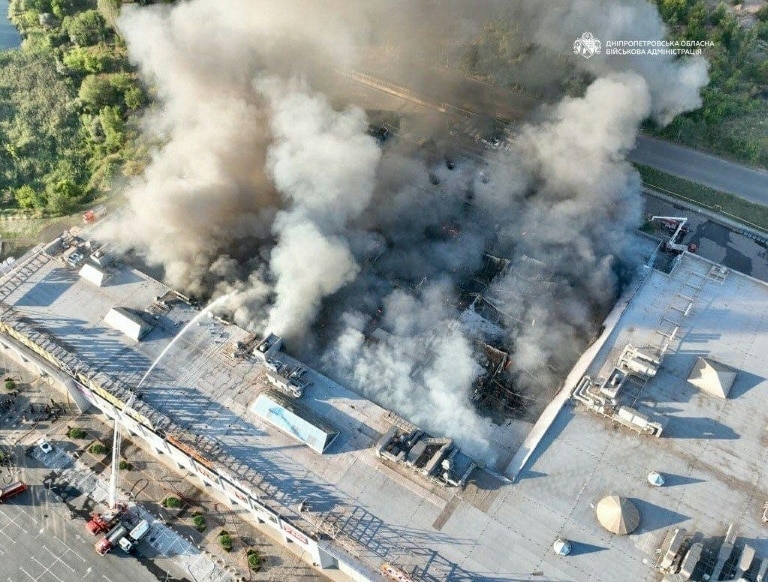
On a recent Friday, two successive Russian drone attacks targeted a crowded civilian shopping center in Kryvyi Rih, Ukrainian President Volodymyr Zelenskyy’s hometown in eastern Ukraine, leaving at least 14 people dead and dozens more injured, in an assault Zelenskyy has denounced as a cynical and morally repugnant act of violence against innocent civilians. Regional military administration head Oleksandr Ganzha confirmed the casualty count, reporting that the strikes ignited large blazes inside the commercial building and left 121 people wounded, many seriously. A separate simultaneous strike in the southern Mykolaiv region claimed four additional lives, including those of three children, Ukraine’s Interior Minister Ivan Vygivsky announced via the messaging platform Telegram.
Social media footage captured from the scene of the Kryvyi Rih attack shows thick black smoke billowing from the shopping center’s structure, with first responders scrambling to pull survivors from the rubble and treat injured civilians on surrounding sidewalks. In a startling escalation, a second drone struck the building’s roof roughly 30 minutes after the first impact—a deliberate secondary attack that Zelenskyy stated was intended to target rescue workers who had rushed to the scene to save lives. Located just 37 miles from active frontline positions, the industrial city of Kryvyi Rih has faced repeated Russian bombardment throughout the full duration of Moscow’s full-scale invasion.
The deadly attack comes amid a months-long trend of intensified Russian airstrikes and drone bombardments across Ukrainian populated areas, a shift that has coincided with a sharp rise in civilian fatalities. The United Nations has recorded that 2026’s civilian death toll has already climbed to its highest point since the opening weeks of the 2022 invasion, highlighting the growing danger to non-combatants as the conflict grinds on. The strike also comes just days before a key meeting of Ukraine’s international backers, scheduled to take place Monday to coincide with Ukraine’s Independence Day, where allied leaders will gather to reaffirm their commitment to supporting Kyiv’s defense efforts.
The gathering, organized under the umbrella of the ‘Coalition of the Willing’, will be co-chaired by French President Emmanuel Macron, participating via video link, German Chancellor Friedrich Merz, and new British Prime Minister Andy Burnham. A senior European Union official confirmed that roughly 10 senior leaders, including European Council President Antonio Costa, will travel to Kyiv to attend the talks in person. In the wake of Friday’s attacks, Zelenskyy has issued an urgent call for unified, forceful action from Ukraine’s international partners, stressing that sustained diplomatic and economic pressure on Moscow is the only path to meaningful peace. “The world must respond to them accordingly—with real pressure on the aggressor. For peace to be possible, Russia must face real accountability,” Zelenskyy wrote in a post on X.
Shortly after the strikes, Zelenskyy held a scheduled call with United Nations Secretary-General António Guterres, where he updated the UN chief on the scope of the attacks and the civilian casualties they caused, according to a statement from the Ukrainian leader on social media. For months, Kyiv has repeatedly lobbied its Western allies for additional air defense systems, as Ukrainian forces struggle to intercept the growing volume of Russian ballistic missile and drone salvos targeting civilian infrastructure across the country. In response to intensified Russian strikes, Ukraine has also stepped up its own retaliatory attacks on Russian territory in recent months, in a bid to alter the conflict’s momentum and pressure Moscow to enter good-faith negotiations to end the war—Europe’s deadliest armed conflict since World War II.
To date, all diplomatic efforts to broker a ceasefire or lasting peace deal have stalled. Moscow continues to demand sweeping territorial concessions and major political concessions from Kyiv, terms Zelenskyy has repeatedly rejected. The Ukrainian president has argued that accepting Russia’s demands would amount to unconditional capitulation, leaving Ukraine permanently vulnerable to future Russian aggression.