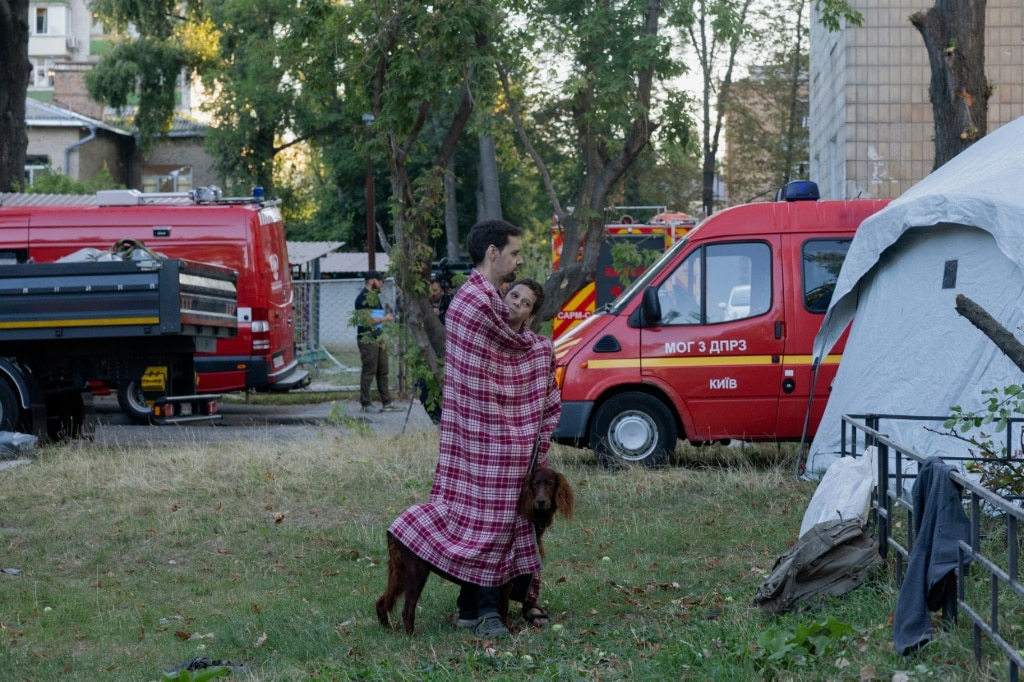
In a deadly escalation of Russia’s four-year full-scale invasion of Ukraine, overnight Russian bombardments killed at least 16 people across Ukraine’s capital Kyiv and its surrounding region, Ukrainian authorities confirmed Thursday. The attack, which Ukrainian President Volodymyr Zelenskyy described as a pre-planned massive offensive, has prompted urgent calls for a stronger unified global response to Moscow’s expanding military aggression.
By early Thursday morning, emergency rescue teams were combing through the smoldering rubble of leveled residential and civilian infrastructure, including a children’s hospital that sustained significant damage. At one damaged apartment block in Kyiv, grieving local families looked on as recovery workers pulled two bodies from the collapsed structure. “There used to be a building here, and now it’s gone,” said 45-year-old Kyiv resident Maria Abramova, whose family narrowly escaped death. Abramova recounted that she had only just reached her children’s room after the air raid alert sounded when explosions rocked the neighborhood, blowing out all her home’s windows and nearly killing her husband.
The speed and destructive power of Russia’s increasingly frequent ballistic missile strikes have left Kyiv’s defense forces stretched thin. These projectiles travel at thousands of kilometers per hour, reaching the capital in mere minutes after an air warning is issued. Wednesday night’s first explosions shook Kyiv less than three minutes after the official alert, leaving almost no time for residents to reach safe shelter. Unlike slower cruise missiles or drones, ballistic missiles can only be reliably intercepted by advanced systems such as the U.S.-made Patriot air defense battery, which Ukraine has in limited supply. Ukraine has repeatedly pleaded with Western allies for additional air defense assets as Russia ramps up its missile campaign: AFP analysis of Ukrainian Air Force data shows Russia fired a record number of missiles at Ukrainian targets in July.
“Unfortunately, while Moscow is investing in ballistic missiles and escalation, the world does not always respond appropriately to such attacks,” Zelenskyy told the international community in the wake of the assault.
Officials confirmed the death toll stood at 15 fatalities within Kyiv city limits, with one additional person killed in the wider Kyiv region. The nine-hour attack also damaged commercial warehouses in Boryspil, a city located just outside the capital that has been on high alert for impending Russian strikes for several days. Zelenskyy noted that Russian forces spent extensive time preparing for the offensive, combining multiple types of weaponry: ballistic missiles, cruise missiles, and Iranian-made Shahed attack drones. The Ukrainian Air Force reported that Russia launched at least 44 projectiles in total, and that Ukrainian air defenses successfully intercepted 39 of them before impact. For its part, the Russian Ministry of Defense claimed the strike only targeted legitimate military sites: “military-industrial facilities, a transportation and logistics centre, and warehouses” in the Kyiv area.
The cross-border ripple effects of the attack quickly triggered security mobilizations in three neighboring countries: NATO members Poland and Romania, and non-aligned Moldova. Poland’s military command announced it had mobilized combat aircraft and activated its national air defense systems to secure its airspace, particularly along the border with Ukraine. In Romania, the defense ministry reported that radar systems detected unidentified aerial targets near the Ukrainian border overnight, prompting authorities to scramble two Spanish fighter jets deployed on NATO air policing missions alongside a Romanian Air Force rescue helicopter. Officials confirmed a Russian-origin drone entered Romanian airspace near the city of Galati before crashing in an unpopulated area of Tulcea county, just kilometers from the Ukrainian border. Moldova also reported that a Russian Shahed-style drone crashed on its territory, sparking a small fire near the Ukrainian border. Unintended and intentional aerial incursions into neighboring countries have grown more frequent in recent months as the conflict deepens.
Separately, Russian authorities reported they had shot down 726 Ukrainian drones launched in overnight retaliatory strikes across Russian territory. While Kyiv endures near-daily Russian air attacks, Ukraine has stepped up its own cross-border retaliatory strikes on Russian military and infrastructure targets in recent months, part of a strategy to increase pressure on Moscow to return to good-faith negotiations to end the conflict, the deadliest armed confrontation in Europe since World War II. So far, all diplomatic efforts to bridge the two sides’ positions have failed. Russia continues to demand sweeping territorial and political concessions from Kyiv as a condition for any ceasefire, terms Zelenskyy has repeatedly rejected, arguing they would amount to unconditional surrender that would leave Ukraine open to future Russian aggression.