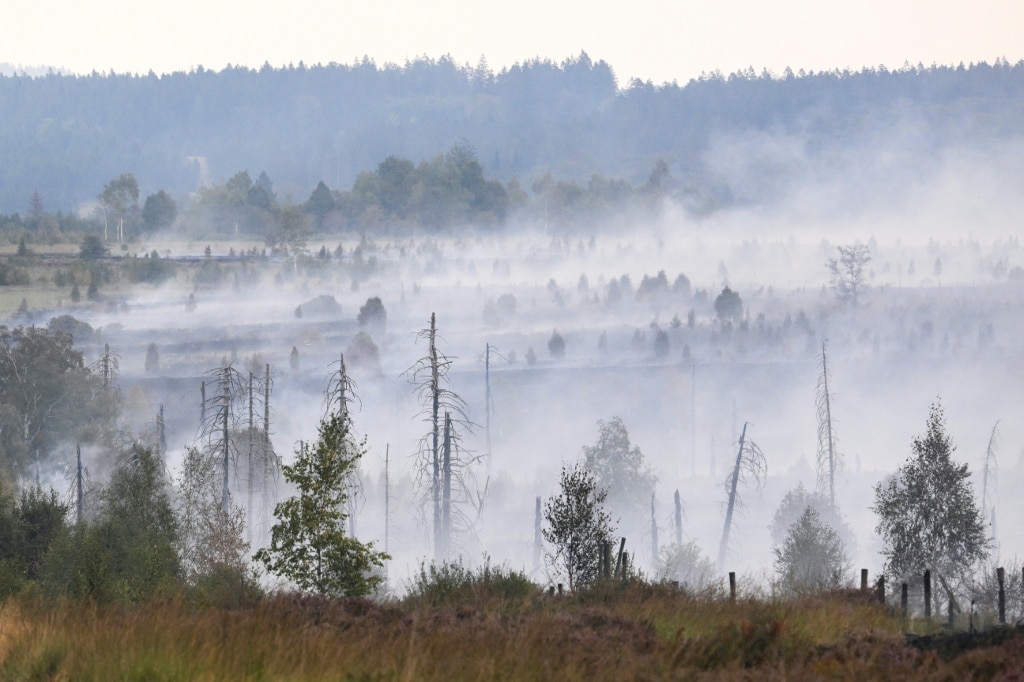
One of the most destructive wildfires in Belgium’s recorded history has reached a critical turning point, but the battle to contain it is far from over, national crisis management authorities confirmed Wednesday. After working through the night under grueling terrain and weather constraints, firefighting crews have successfully established a full containment line around the massive blaze burning in the High Fens nature reserve, the largest wildfire to hit the country in 100 years.
Crisis cell spokesperson Tony Hosmans told reporters that the blaze, which has scorched thousands of hectares of protected landscape, is no longer advancing east toward the German border. With containment now in place, the primary operational goal for the coming 24 hours is to fully bring the fire under control, with additional support from water-bombing aircraft expected if weather conditions allow.
Despite the breakthrough on containment, Hosmans emphasized that the situation on the ground remains highly unstable. Multiple new flare-ups have ignited across different sections of the burned area, keeping hundreds of deployed crews on high alert around the clock. The blaze exploded in size over the past weekend, spreading across 3,000 hectares (7,500 acres) – an area roughly half the size of Manhattan – after breaking out on Friday in the protected wetland and forest reserve. That area was previously hit by a massive wildfire in 1911, during a historic heatwave remarkably similar to the ongoing extreme weather event across Europe.
The final stretch of containment line, located along the hard-to-reach front near the German border, took all night to close. Ground crews advanced from the east and north through difficult terrain to seal the last gap, a feat made more challenging by the unique landscape of the High Fens. The reserve is made up of a patchwork of heathland, deep peat bogs, and narrow raised wooden hiking boardwalks, all of which slow heavy equipment and ground crew movement.
To bolster local and national firefighting efforts, cross-border support has poured in from four neighboring European countries: Norway, Germany, Sweden, and the Netherlands, which deployed water-bombing aircraft to the site. However, poor weather has severely limited the use of these critical resources. Low cloud cover over the fire zone grounded all aerial operations on Tuesday, and intermittent rain that has fallen across the area since Monday has similarly blocked flights – even as that same precipitation has helped slow the fire’s spread by raising humidity and dampening surface fuel.
The High Fens wildfire is just one of dozens of destructive blazes burning across the European continent, where weeks of record-breaking heat and extreme drought have created tinder-dry conditions across vast swathes of land. Major wildfires have also forced mass evacuations and burned thousands of hectares in France, Greece, Portugal, and Spain in recent weeks.
In addition to the operational challenges on the surface, crews face a unique and long-term threat from the peat that makes up much of the High Fens landscape. Unlike surface fires that burn through trees and brush, this blaze is smoldering deep within the underground peat layers, meaning it can reignite unexpectedly weeks or even months after initial containment.
Area fire chief David Covens explained the unique risk during a tour of the fire zone: “The fire is burning in the peat, so it is actually underground, sometimes quite deep. Whenever we disturb the ground, when we cut down a tree and expose the soil, the fire can reignite.” Even with all available resources committed to the operation, Covens acknowledged that full extinguishment will be a months-long process: “We’re doing everything we can with the resources available, but we know this is going to take a long time.”
Thus far, the blaze has triggered mandatory evacuation orders for two Belgian villages and the German border town of Monschae. Residents of the Belgian hamlet of Sourbrodt have already been cleared to return to their homes, but other evacuations remain in place as crews continue to work to secure the area. Officials warned that even after the fire is declared under control, repeated soaking and targeted dousing will be required for weeks to eliminate hidden underground hotspots and prevent reignition.