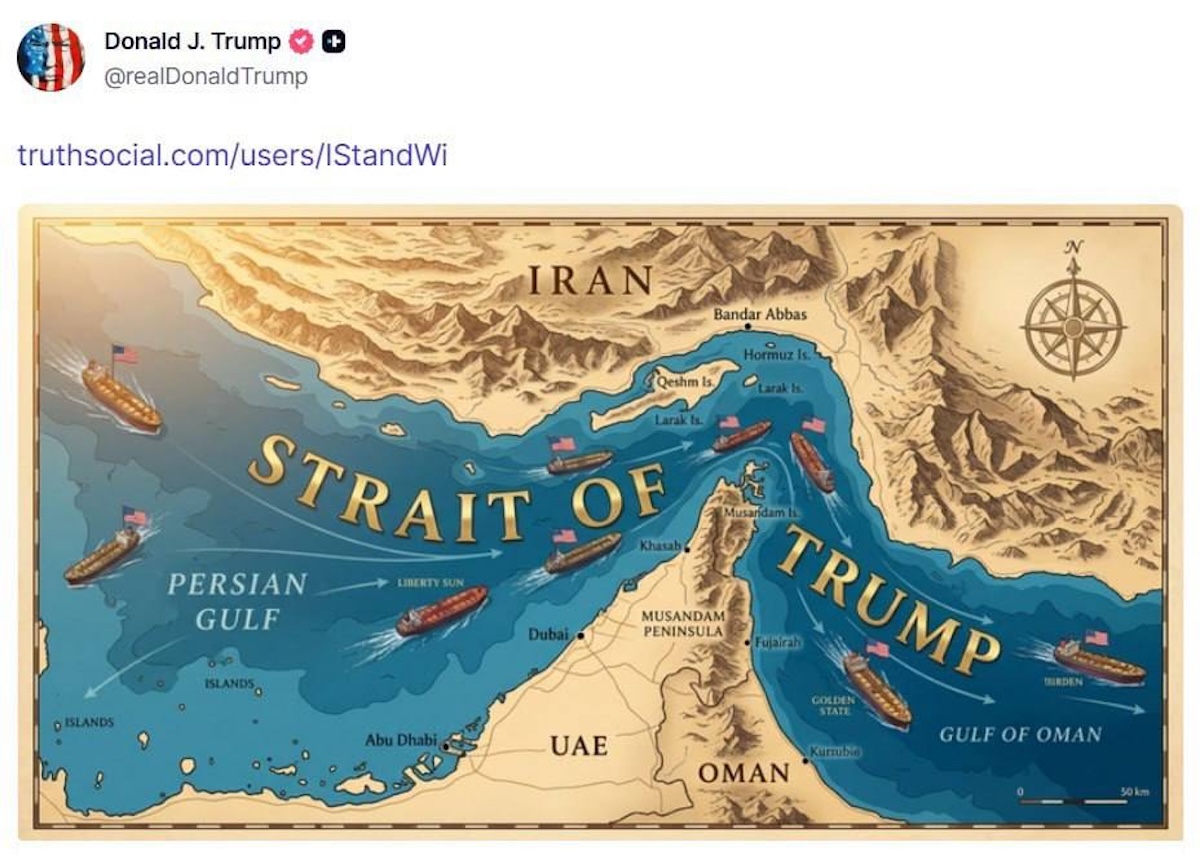
Tensions between the United States and Iran have spiked dramatically after former U.S. President Donald Trump published a map on his Truth Social platform claiming the strategically critical Strait of Hormuz as American territory, drawing immediate and harsh condemnation from senior Iranian officials. The provocative post came just days after Trump first openly threatened to claim the key waterway as U.S. territory, amplifying already heightened hostilities between the two nations amid an ongoing six-month conflict.
Kazem Gharibabadi, Iran’s deputy foreign minister, issued a blistering response to Trump’s map in a post on X (formerly Twitter), writing in Arabic: “Just as Trump incorrectly labeled the Persian Gulf, his fantasy of claiming the Strait of Hormuz will be corrected sooner than later — and if he will not correct this delusion, we will do it for this delusional individual.” Gharibabadi attached a screenshot of Trump’s original post, which showed the mislabeled map marking the narrow passage that sits south of Iran, connecting the Persian Gulf to the Gulf of Oman.
The current standoff over the strait traces back to February 28, when the United States under Trump launched joint military strikes with Israel against Iran. In response to the unprovoked attacks, Iran imposed restrictions on commercial shipping traffic through the strait — one of the world’s most vital chokepoints for global fossil fuel trade. The shipping restrictions have sent ripple effects through energy markets worldwide, driving up fuel prices globally. In the United States, the national average price for a gallon of gasoline has now hit an all-time record high for the mid-August period.
Despite mounting domestic economic pressure from rising energy costs, widespread global criticism, and a plummeting presidential approval rating, Trump has refused to backtrack on his actions. In a public address last Friday on New York’s Long Island, the president doubled down, stating: “I’ll never apologize, I did the right thing.” It was during that same speech that he first issued his threat to claim the Strait of Hormuz as U.S. territory, prompting widespread condemnation from political observers both in the U.S. and abroad. Critics have labeled Trump “completely unhinged” and a “sadistic violent menace to the world” and have renewed calls for a second impeachment.
The escalating conflict comes as a 60-day bilateral ceasefire between the warring parties expired on Monday, with neither side indicating meaningful progress toward new negotiations to end the hostilities. Trump has framed the war as an effort to halt Iran’s alleged nuclear weapons development, a claim that contradicts assessments from U.S. intelligence agencies, which have repeatedly confirmed Iran is not pursuing a nuclear weapons program. This is not the first break in U.S.-Iran nuclear policy: during Trump’s first term in office, he famously withdrew the United States from the Joint Comprehensive Plan of Action, the Obama-era multilateral nuclear deal that placed strict verifiable limits on Iran’s nuclear activities.
Senior Iranian military officials have pushed back on U.S. claims of success in the strikes. Major General Mostafa Izadi, deputy commander-in-chief of the Islamic Revolutionary Guard Corps, stated on Tuesday that “the enemy failed to destroy Iran’s defensive capabilities and nuclear industries.”
For his part, Iranian Parliament Speaker Mohammad Bagher Ghalibaf reaffirmed Tuesday that Iran will keep the strait closed to commercial shipping until the U.S. economic blockade and oil embargo on Iran are fully lifted. He issued a stark warning to any actor that continues aggression or territorial threats against Iran, saying any further escalation would result in a “more severe defeat” for the United States and its allies.