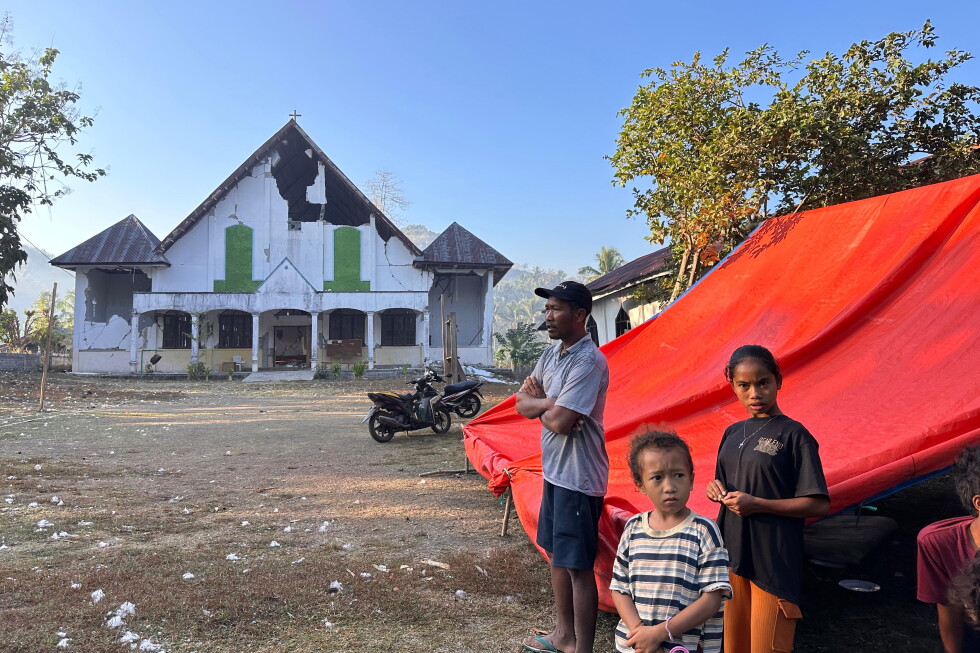
Three days after a powerful seismic event struck the Indonesian island of Flores, thousands of residents remain displaced, with dozens confirmed dead and hundreds injured as recovery efforts begin across the disaster zone. The early Saturday morning quake, which originated off the island’s coast, has left a trail of widespread destruction that extends far beyond crumbled infrastructure, with young survivors grappling with persistent fear and psychological trauma.
Data from Indonesia’s National Disaster Management Agency shows the disaster has claimed at least 68 lives and left 213 people injured. More than 19,000 residents are now taking shelter in a patchwork of tents, government evacuation centers and makeshift informal camps, after at least 4,500 residential properties were damaged or destroyed. The destruction has also decimated critical public infrastructure: 122 health facilities, 252 schools and 84 houses of worship across the island have sustained damage that will require extensive repairs.
According to the U.S. Geological Survey, the earthquake registered a shallow depth of 10 kilometers (6 miles) and struck shortly before 6 a.m. local time. Chaos erupted in the immediate aftermath as authorities issued a tsunami warning that sent panicked residents fleeing for higher ground; the alert was later lifted without a destructive wave forming. By Tuesday, officials had recorded more than 2,100 aftershocks following the initial major quake, though only 70 of these secondary tremors were strong enough to be felt by local communities.
For survivors in hard-hit regions like Lamba Leda, one of the worst-affected villages in East Manggarai regency, the threat of aftershocks remains a constant source of terror. During an on-site interview Tuesday, a fresh aftershock prompted local resident Vincentius Rano and his wife to instinctively duck and cover their heads, while their 5-year-old daughter burst into tears nearby — a visible reminder of the psychological toll that lingers for survivors.
Rano recalled the harrowing moments the initial quake struck, just moments after he and his wife had woken for the day. “Suddenly, we felt a tremor that kept getting stronger,” he said. The couple rushed to pull their sleeping daughter from her bed, but before they could escape their home, a section of the structure collapsed, leaving Rano with injuries to his back and shoulder. His home, a modest timber-built structure rather than a reinforced concrete dwelling, was left completely flattened. “We didn’t have time to get outside. Everything happened so fast. The roof collapsed on us, and all I could do was shield my wife and child with my back,” Rano explained, gesturing to the pile of rubble that was once his home.
In evacuation camps spread across Flores, aid workers and local authorities have begun rolling out support that addresses both the physical and psychological needs of survivors. Alongside distributing critical supplies including food and medical care, teams are providing psychosocial support for survivors, with a specific focus on children, who have been disproportionately impacted by the disaster.
“For many survivors, especially children, the psychological impact has lingered long after the shaking stopped,” said Yudhi Franata, a local police chief who has organized trauma-healing programming for displaced children in Ende regency. In the Ende village of Lokoboko, 17 young survivors have already joined trauma counseling sessions led by police counselors, where they participate in games, guided educational activities and group discussions designed to help them process their fear and anxiety.
Parents at the Lokoboko evacuation centers report many children remain too afraid to return to enclosed indoor spaces, and wake up terrified every time aftershocks rattle the island. “Children are among the groups that need special attention after experiencing a disaster,” Franata noted.
Located along the geologically active Pacific Ring of Fire, Indonesia is an archipelago made up of more than 17,000 islands, making the nation inherently prone to frequent earthquakes and volcanic eruptions. Flores has a history of deadly seismic disasters: in 1992, a major earthquake and subsequent tsunami killed an estimated 2,500 people on the island, marking one of the deadliest natural disasters in Indonesia’s modern history.