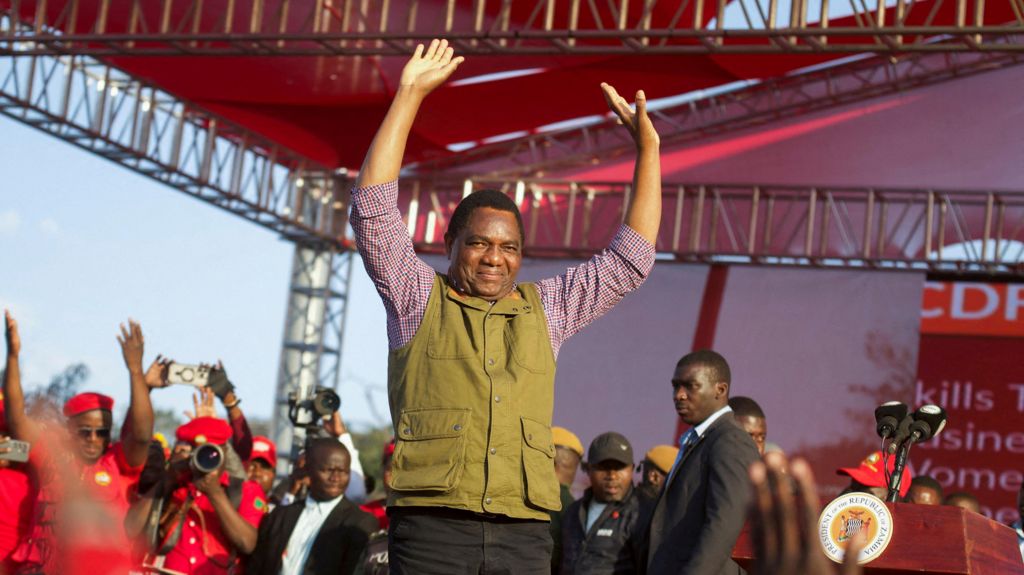
Zambia’s incumbent President Hakainde Hichilema has won a second consecutive five-year term in office, the country’s electoral commission officially announced Friday, after the 64-year-old incumbent captured an absolute majority of valid ballots cast in the nation’s general election. Final results put Hichilema’s vote share at 60%, a comfortable lead that secured him an outright first-round victory under Zambia’s electoral rules, which require candidates to win more than 50% of the vote to avoid a runoff. His closest competitor, opposition leader Brian Mundubile, finished with 38% of the vote, while the 12 other minor candidates on the ballot failed to gain any meaningful traction, trailing far behind the two front-runners. The outcome was widely predicted by pre-election and exit polling, but it capped off a bitterly contested campaign marred by pre- and post-voting tensions. Even before official results were released, 55-year-old Mundubile prematurely claimed victory and leveled unsubstantiated allegations of widespread voting irregularities, claiming discrepancies between local polling station tallies and the final official results, and alleging improper military influence at national vote-counting centers. In response to the opposition’s claims, the Zambian government accused Mundubile of plotting an armed insurrection, charges the opposition candidate has dismissed as a politically motivated fabrication. The fallout from the accusations led to the arrest of 11 people, including multiple senior opposition figures, deepening divides ahead of the result announcement. A day after polls closed, the electoral commission temporarily suspended vote counting and result publication, citing verified reports of violence targeting election workers and the theft of marked ballots in scattered constituencies across the country. The suspension was lifted within hours the same day, but international observers flagged the move as a threat to the process’ credibility. In his first public address after being officially declared the winner, Hichilema struck a unifying tone, acknowledging the widespread public trust that delivered his victory and highlighting Zambia’s longstanding commitment to democratic governance. “We are truly humbled by the trust you have placed in our hands,” he said, emphasizing that the election reaffirmed Zambia’s identity as a peaceful, rule-of-law democracy that resolves political differences at the ballot box rather than through extraconstitutional means. “To those citizens who preferred the ideas presented by our opponents, we hear you, and we will continue to work for you,” he added. Within minutes of the result being made public, hundreds of jubilant Hichilema supporters, clad in the signature red of his United Party for National Development (UPND), poured into the streets of Lusaka, Zambia’s capital, to celebrate the incumbent’s win. Zambia has a long and notable track record of peaceful democratic transitions dating back to the country’s return to multiparty democracy in 1991, with all presidential handovers over the past three decades occurring through legally certified electoral processes. As of the official result announcement, it remains unclear whether Mundubile and the opposition will formally challenge the outcome in court or through other political channels. Regional and international observer missions that monitored the vote largely praised election day as a mostly peaceful and orderly process, and called on all political actors to accept the official outcome and maintain calm. However, observer groups raised a series of concerns about structural flaws in the lead-up to the vote. Delegations flagged incomplete late electoral reforms, uneven media access that favored the incumbent, and ongoing threats to independent media freedom that skewed the playing field. The European Union’s election observation mission warned over the weekend that systemic restrictions on opposition campaigning throughout the pre-election period created an uneven electoral contest that undermined fairness, while the brief suspension of vote counting was singled out as a move that risked eroding public voter confidence in the integrity of the final results.