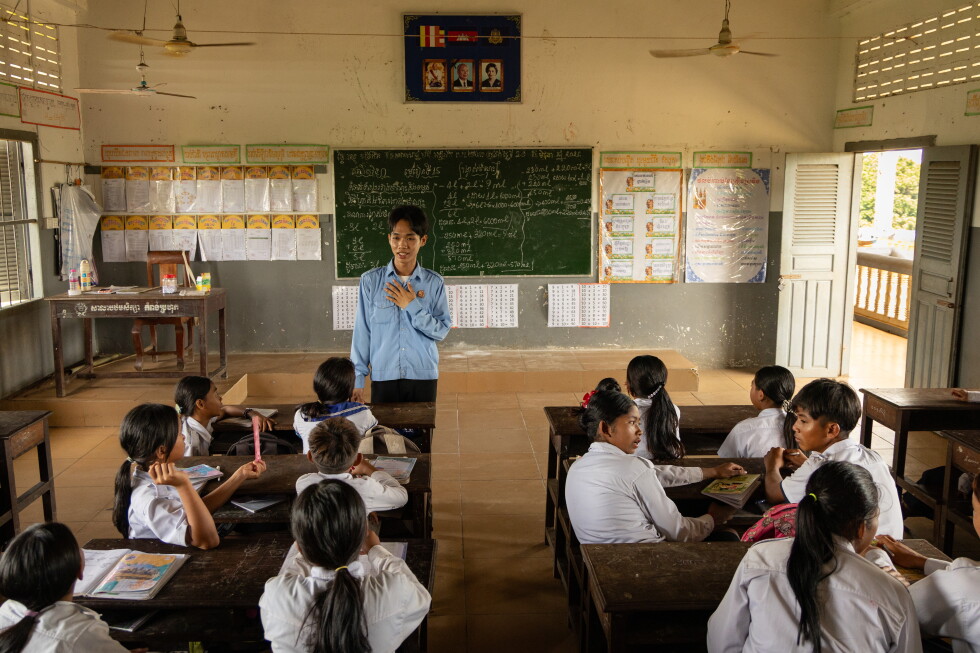
In the floating fishing villages clustered along Cambodia’s Tonle Sap, Southeast Asia’s largest freshwater lake, 13-year-old Sou Sreynich holds tight to one quiet dream: to graduate and become a teacher. For children growing up on these volatile waters, however, reaching that goal has grown far harder in the wake of the Iran war, whose hidden economic shocks are stacking on top of decades of systemic and environmental hardship to derail education for the world’s most vulnerable children. Unlike the sudden, widely documented school closures of the COVID-19 pandemic, the war’s impact on global learning is incremental, invisible to most outside observers, and disproportionately borne by low-income families already teetering on the edge of financial collapse.
Sreynich’s barriers to education began long before the conflict. Her mother delayed enrolling her until she turned 10, years behind most children her age, out of a common fear among Tonle Sap families: the small wooden boat trip to the local school could capsize, and only an older child could swim to safety. Even now, climate change has made lake conditions more unpredictable, with more intense, erratic floods and droughts that raise the risk of fatal travel to school. Teachers at Sreynich’s school confirm 10 students have drowned in transit over the years. Now, the war-driven spike in global gasoline prices has added an overwhelming new burden. For Sreynich’s family, which survives on small earnings from fishing, gutting fish for neighbors, and harvesting chili peppers, higher fuel costs have already cut into their income: they can no longer afford to travel to the deep-water zones of the lake where fish populations are larger and more consistent. When money runs too tight to cover the cost of boat fuel for the daily school commute, Sreynich has no choice but to skip classes to work alongside her parents. Each absence pushes her further behind, and she speaks with quiet urgency about her desire to stay on track: “I want to complete my studies.”
The crisis playing out on Tonle Sap is not unique. A 2022 UNICEF report warns that if the conflict continues, by the end of the year it could push an additional 23.4 million children like Sreynich into extreme poverty globally, with 80% of those children concentrated across Africa and Asia. For households already struggling to cover basic costs, the ripple effects of the war force an agonizing choice: pay for fuel, food, rent and utilities, or keep every child enrolled in school.
In Vietnam, along the country’s rocky northern coast, the same pressure has pushed children out of school and into dangerous child labor. Sixteen-year-old Ly and 13-year-old Nhi, two of nine children from a local fishing family, already bounced in and out of school for years as their parents struggled to make ends meet. When the war sent diesel prices soaring, their father’s employer could no longer afford to send fishing boats out to sea, and he lost his job. Buried under existing debt, the family could not cover the cost of feeding all nine children and keeping them in school. The two girls dropped out and moved to Hanoi, where they worked long, dangerous shifts in a local restaurant, handling sharp knives, hot cooking surfaces, and heavy loads. Nhi’s work was even illegal under Vietnamese child protection laws. It was only after intervention from Blue Dragon Children’s Foundation, a Hanoi-based nonprofit, that the sisters were able to return to class. Michael Brosowski, founder of the organization, says the war’s impact builds slowly but is catastrophic. When families hit a financial breaking point, he explains, they are forced into a kind of triage: they keep one or two children in school while pulling others out to work to support the household. Children out of school are exponentially more vulnerable to exploitation, human trafficking, and long-term homelessness. “It’s the tipping point for a lot of families,” Brosowski says.
Higher energy costs have driven up prices across every part of education delivery, from student and teacher commute costs to the price of basic classroom supplies like pencils and chalk. For remote communities where travel is already a major barrier, it is now even more expensive for teachers and aid workers to reach students. Governments across the developing world, meanwhile, are grappling with skyrocketing domestic food and energy costs, crowding out already limited public funding for education. On Tonle Sap, where all supplies must be transported in by boat, every cost is already higher than the national average. Samphors Vorn, who works for the international nonprofit Aide et Action which supports Sreynich’s school, notes that even the cost of electricity to run the school’s computer lab is 10 times higher than it is on the Cambodian mainland.
Developing countries dependent on imported energy have borne the brunt of the war’s economic shocks, with rising fertilizer costs and falling international remittances adding additional strain to already fragile economies. In Bangladesh, where the economy was already under significant pressure before the conflict, the war threatens to erase decades of slow, steady progress in expanding access to education and reducing childhood poverty. A recent UN Development Programme report warns that pressure on government finances from rising fuel and subsidy costs will leave far less public funding available for both health care and education. Across South Asia, girls are disproportionately affected by these economic shocks, as families facing resource scarcity often prioritize education for sons over daughters. Arshad Malik, of the global nonprofit Save the Children International, says that rising economic hardship can lead to more girls dropping out of school and a surge in child marriage. UNICEF data confirms South Asia accounts for 45% of the world’s child brides, the highest share of any global region.
Even school meal programs, which serve as a critical lifeline to keep 466 million children in school globally, supporting healthy development and consistent learning, are at risk. Conflict-driven disruptions to fertilizer exports and higher transport costs have put these programs under severe pressure, especially in West and Central African nations that rely heavily on imported food, according to Sabrina Hervey, policy advisor with the Qatar-based Education Above All Foundation. Across northern Nigeria, aid and local health workers already report a growing number of children relapsing into malnutrition as costs rise. “I’m really afraid to see what’s going to happen,” Hervey says.
This coverage of climate and environmental issues by The Associated Press receives financial support from multiple private foundations, with The AP retaining full editorial independence over all content. AP’s standards for working with philanthropic partners, a full list of supporters, and funded coverage areas are available at AP.org.