A high-profile Emirati political commentator and one-time aide to United Arab Emirates President Mohammed bin Zayed has sparked widespread outrage across social media after launching a scathing, derogatory attack on Pakistan amid growing tensions over a landmark regional security agreement between Saudi Arabia, Pakistan and Turkey.
Writing on the social platform X on August 15, 2026, Abdulkhaleq Abdulla questioned Pakistan’s role in the new regional security architecture, framing it as one of modern geopolitics’ greatest contradictions. In his viral post, which has amassed more than 1 million views to date, he argued that a nation where a quarter of the population lives in poverty and a third is illiterate, which has battled decades of corrupt military rule, chronic internal unrest, and repeated conflict with its closest neighbors, was acting opportunistically to position itself as a security guarantor for one of the world’s 20 largest economies. Abdulla also pointed to Pakistan’s estimated 170 nuclear warheads, dismissing the arsenal as the country’s only major strategic qualification for its role in the alliance.
His comments were directed at the recently signed Mecca Joint Defence Agreement, a trilateral security pact between Saudi Arabia, Turkey, and Pakistan, as well as a bilateral Strategic Mutual Defence Agreement between Pakistan and Saudi Arabia signed September 17, 2025, which obligates each nation to respond to any act of aggression against the other. Beyond the immediate controversy over his remarks on Pakistan, Abdulla’s post lays bare growing unease in the UAE over the new security bloc, which many regional analysts view as a direct counter to the growing military cooperation between the UAE and Israel.
The backlash to Abdulla’s comments has been swift, particularly given the close economic and social ties between the UAE and Pakistan: roughly 1.6 million Pakistani expatriates live and work in the Emirates, and their remittances form a critical lifeline for Pakistan’s domestic economy. Critics have pushed back on multiple fronts, arguing that Abdulla’s core premise is deeply flawed. “Comparing poverty and the size of the economy with the political stance is misleading,” one X user wrote in response to the viral post. The user added that Pakistan is a fully sovereign nation with the right to forge its own alliances, and its standing in global affairs is not conditional on its national wealth. “Reducing its qualifications to nuclear weapons ignores its demographic and geopolitical weight and its economy, which has exceeded 400 billion dollars,” the user continued.
Other users have exposed apparent contradictions in Abdulla’s past positions, pointing to older tweets that show he once publicly urged Pakistan to join a Saudi-led military intervention in Yemen. In a 2015 post about Operation Decisive Storm, the Saudi-led campaign in Yemen, Abdulla wrote that Gulf and Saudi diplomacy should deploy all its leverage to secure Pakistan’s participation in the operation. Critics also highlighted a previous tweet in which Abdulla condemned Gulf voices calling for normalization with Israel, a position that contrasts with the UAE’s official policy as the first Gulf state to formally normalize ties with Israel.
Abdulla had publicly signaled his skepticism of the Mecca pact within days of its signing. On August 7, the day the agreement was finalized, he wrote: “Congratulations on the establishment of this alliance, but strengthening Gulf military and political cooperation and unifying the Gulf house is far more important than investing in regional military and political cooperation that includes countries whose credibility and ability to confront the Iranian-Israeli threat are not taken seriously.” He also questioned the core foundation of the new bloc, asking, “One of the conditions for the success of any alliance is identifying the common enemy. So who is the enemy for the countries of this alliance?”
Abdulaziz al-Tuwaijri, former head of the Islamic World Educational, Scientific and Cultural Organisation (Isesco), the OIC’s Rabat-based cultural body, was among the most high-profile critics of Abdulla’s latest remarks. Al-Tuwaijri, who previously clashed with Abdulla over the UAE’s ties to Israel, hinting that “anyone who betrays and collaborates with the Zionists will never find security,” responded to the Pakistan tweet by writing, “It seems that the Mecca Agreement syndrome has left you dizzy.”
This public verbal exchange is far more than a social media spat: it lays bare a deepening geopolitical rift between the UAE and Saudi Arabia, two major Gulf powers that have grown increasingly at odds in recent months. Tensions have already soured over Saudi Arabia’s support for southern Yemeni separatist groups, a position that directly conflicts with Emirati interests. The new Mecca defence pact has amplified these frictions, as it is widely interpreted as a counterweight to the growing military cooperation between the UAE and Israel, a partnership that remains deeply unpopular across most of the Middle East outside of Israeli and pro-U.S. circles.
Theodore Singer, a former U.S. intelligence officer, told Middle East Eye that the two competing blocs offer very different value propositions for their members. “At first glance, the UAE-Israel bloc delivers more tangible gains for both parties, but the Mecca pact may ultimately resonate more broadly and less transactionally,” Singer explained.
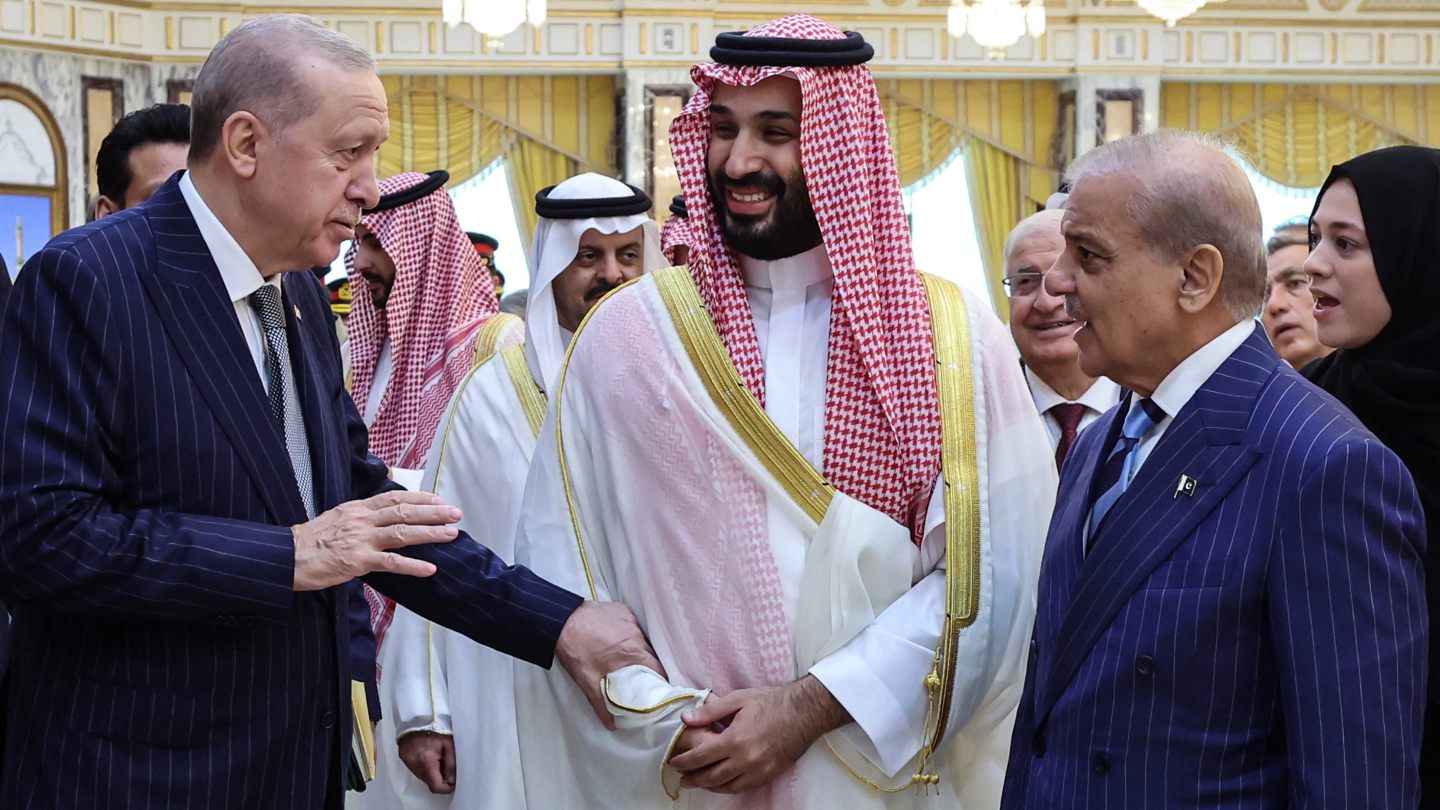
The divide between Riyadh and Abu Dhabi has played out in very public view in recent months. In May 2026, after Israeli Prime Minister Benjamin Netanyahu claimed he had made an official visit to the UAE amid the war on Iran, Abu Dhabi swiftly issued a formal denial of the report. In contrast, the signing of the Mecca pact was accompanied by a high-profile public celebration: Saudi Crown Prince Mohammed bin Salman, Pakistani Prime Minister Shehbaz Sharif, and Turkish President Recep Tayyip Erdogan jointly led Friday prayers in Mecca, Islam’s holiest site, to mark the occasion.
Some regional analysts argue that the public, formal codification of the Mecca pact gives the alliance unique room to grow in ways that the closed, transactional UAE-Israel bloc cannot match. The rivalry between the UAE and Saudi Arabia has also spilled over into debates over membership expansion for the new pact. Saudi Arabia has repeatedly blocked efforts by Egypt to join the bloc, with Riyadh citing growing concerns that Egyptian President Abdel Fattah el-Sisi has aligned too closely with Abu Dhabi.
MEE has previously reported that Egypt has provided substantial military support to the UAE in recent years, deploying air defence systems and fighter jets to the Emirates in response to Iranian attacks, and Sisi has met repeatedly with UAE President Mohammed bin Zayed throughout the ongoing regional conflict. No equivalent support has been extended to Saudi Arabia, a fact that has deepened Riyadh’s mistrust of Cairo. Saudi Arabia also views a range of Emirati policies as directly contrary to Egyptian and Saudi strategic interests: these include the UAE’s deepening engagement with Somaliland, its formal strategic partnership with Israel, its public support for Ethiopia in the long-running dispute over the Grand Ethiopian Renaissance Dam, and its backing of the Rapid Support Forces in Sudan’s ongoing civil war.
To date, Cairo has attempted to maintain neutrality between the two competing emerging blocs: one anchored by Turkey, Saudi Arabia, and Pakistan, and the other by Israel, the UAE, and India. However, Egypt’s existing defence treaty with the UAE and its deployment of fighter jets to Abu Dhabi after Iranian strikes in May have led Saudi Arabia to conclude that Egypt can no longer be counted on as a reliable partner in the region.