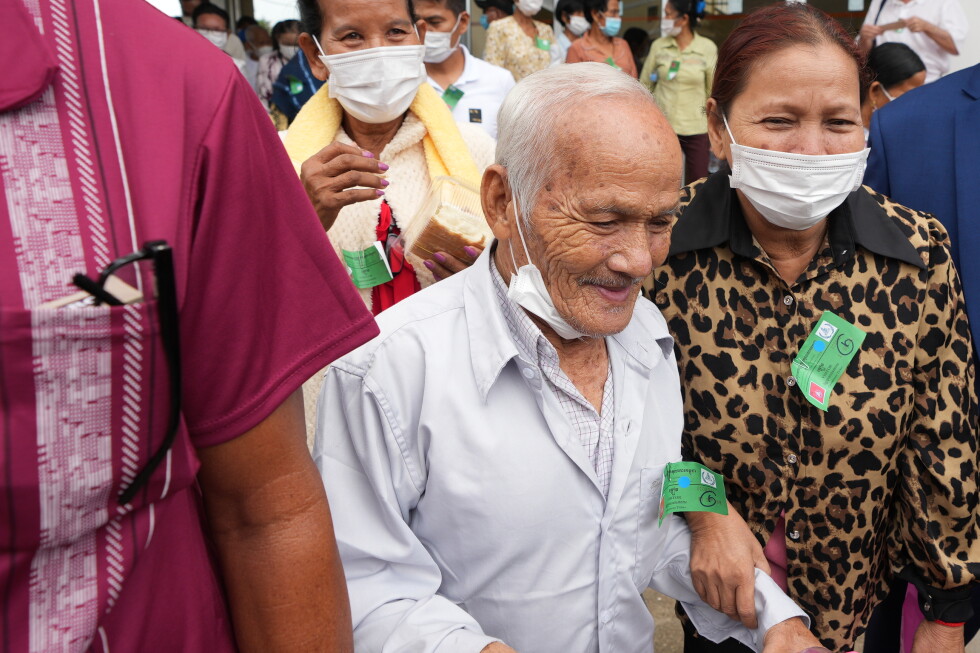
PHNOM PENH, Cambodia – The global community of genocide historians and human rights advocates is mourning the passing of Bou Meng, the last of the seven known survivors of the Khmer Rouge’s notorious S-21 torture and execution center, who died at 85 from age-related complications late last Friday.
Bou Meng’s survival was tied directly to his artistic skill: captured during one of the Khmer Rouge regime’s violent internal purges after the group seized power in 1975, he was spared execution only because his captors realized he could paint propaganda portraits of then-leader Pol Pot and other communist figures. Detained at S-21 – the converted Phnom Penh high school better known today as Tuol Sleng – from 1977 until the regime fell in 1979, Bou Meng spent nearly two years creating propaganda art for his jailers while most of his fellow detainees were tortured and killed.
The Khmer Rouge ruled Cambodia from 1975 to 1979, implementing radical agrarian socialist policies that left an estimated 1.7 million Cambodians dead from mass executions, starvation, forced labor, and systemic medical neglect. Over the nearly four years S-21 operated, roughly 16,000 men, women, and children were held there before being killed; only seven people are confirmed to have survived the facility. Today, the site stands as the Tuol Sleng Genocide Museum, a permanent memorial to the regime’s atrocities.
In 2009, Bou Meng joined two other surviving S-21 detainees – fellow artist Vann Nath and mechanic Chum Mey – to testify before the Extraordinary Chambers in the Courts of Cambodia, a UN-backed special tribunal convened to prosecute senior Khmer Rouge leaders for genocide and crimes against humanity. Their testimony was central to the 2010 conviction of Kaing Guek Eav, better known by his alias Duch, the commandant of S-21. Duch was found guilty of torture, murder, and crimes against humanity, sentenced to life in prison, and died in custody in 2020 at 77.
During his testimony, Bou Meng detailed how his artistic commissions saved his life, describing the large-scale propaganda works he was forced to complete for the regime. “I was ordered to paint a picture of Ho Chi Minh’s head on the body of a dog,” he told the tribunal, referencing the Khmer Rouge’s deep hostility toward neighboring Vietnam, which ultimately invaded in 1979 to oust the regime. His first oversize portrait of Pol Pot took three months to finish, after which Duch ordered additional portraits of Pol Pot, Mao Zedong, Kim Il Sung, and the mocking depiction of Ho Chi Minh.
Bou Meng joined the Khmer Rouge during its 1970–1975 insurgency against the U.S.-backed Cambodian government, but fell victim to the regime’s paranoia-driven internal purges shortly after the group took power. He endured brutal torture before being assigned to his painting duties, and lost his entire first family to the regime’s violence: his first wife was arrested alongside him, disappeared from S-21, and is presumed executed, while his two young children were taken to rural work camps and never seen again, likely killed. After the regime fell, Bou Meng remarried and rebuilt his life.
In a statement Sunday, Youk Chhang, director of the Documentation Center of Cambodia – an organization that has amassed one of the world’s most extensive archives of Khmer Rouge atrocity records – called Bou Meng a critical voice for justice whose legacy will endure. “Bou Meng’s life journey for justice has been documented and will not be forgotten by genocide history around the world,” he wrote in a text message to the Associated Press. He also called for renewed action to preserve the stories of remaining Khmer Rouge survivors, and to expand access to physical and mental health support for the millions who lived through the regime’s rule.
In his final decades, Bou Meng was a regular presence at the Tuol Sleng Genocide Museum, where he greeted visitors and sold copies of his memoir recounting his experience of survival and trauma.