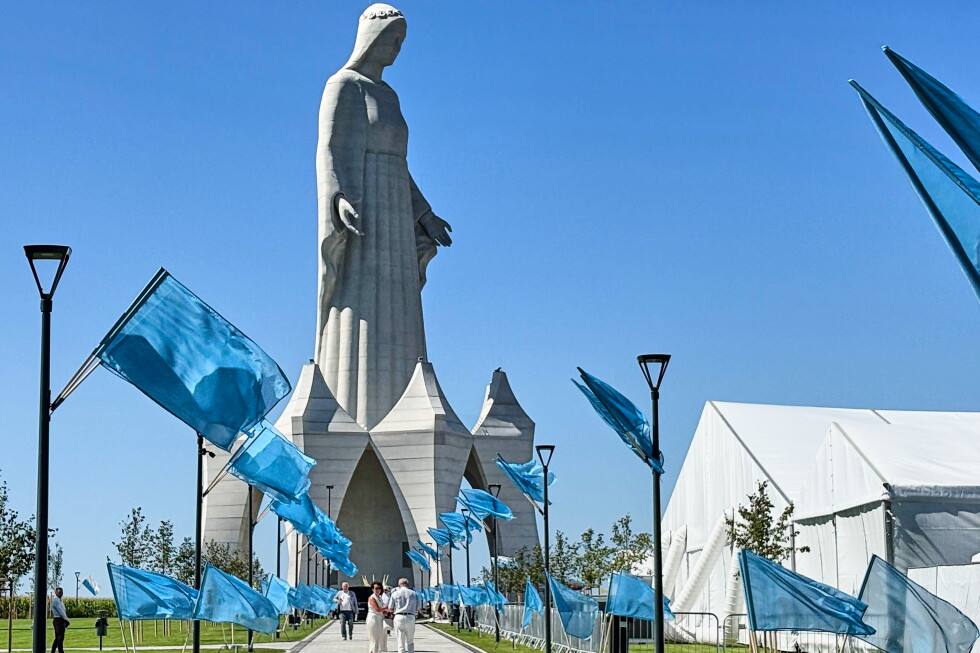
On a Saturday in central Poland, a landmark expected to draw pilgrims and tourists from across the continent debuted in the tiny village of Konotopie, population fewer than 150: a colossal statue of the Virgin Mary, now recognized as the tallest monument of its kind in Europe.
Standing 55.6 meters (182 feet) tall from its base to the tip of its crown-shaped 15-meter pedestal, the new monument out-scales some of the world’s most famous large religious landmarks. It tops Brazil’s iconic Christ the Redeemer in Rio de Janeiro, which reaches just 38 meters including its own pedestal, even if the Brazilian statue holds a more dramatic cliffside location. It also exceeds Poland’s previous record-holding large religious monument, the Christ the King statue in the western town of Swiebodzin. Unveiled in 2010, that monument measures roughly 52 meters from the ground to its peak when including its supporting mound. While a far taller 98-meter Virgin Mary statue stands in the Philippines, the Konotopie monument has claimed the European height title for its category.
The entire project was privately financed by one of Poland’s wealthiest entrepreneurial couples, Roman and Grażyna Karkosik, who reside in a small country palace just a few kilometers from the village. Roman Karkosik built his fortune starting in the 1990s, when he launched a plastic bottle manufacturing business before expanding into large-scale investments on the Warsaw Stock Exchange, growing his net worth to place him among Poland’s richest people. The couple has publicly stated the statue was created as an act of gratitude to God, constructed after Roman recovered from a serious illness.
The inauguration of the monument takes place against a unique religious and cultural landscape in Poland. More than 80% of the country’s population identifies as Roman Catholic, and the Catholic Church has held outsized social and political influence since the collapse of communism in 1989. That influence grew from the church’s widespread prestige earned through its open support for anti-communist opposition movements during the Cold War era. Poland is also the birthplace of St. John Paul II, who served as Pope from 1978 until his death in 2005, and a smaller statue of the beloved Polish pontiff was unveiled in the famous pilgrimage city of Czestochowa more than a decade ago.
In recent years, however, the role of religion in Polish public life has gradually shifted. Religious participation and identification have declined steadily, particularly among younger generations and in major urban centers. Even so, the Catholic Church retains significant social and political clout, especially in rural, small-town communities like Konotopie and among older age groups.
Local civic leaders are already betting on the giant statue’s drawing power, with plans to position it as both a major new Catholic pilgrimage site and a mainstream tourist attraction. To accommodate visitors, the monument includes a public viewing platform built directly into its large pedestal, offering guests panoramic views of the surrounding central Polish countryside.