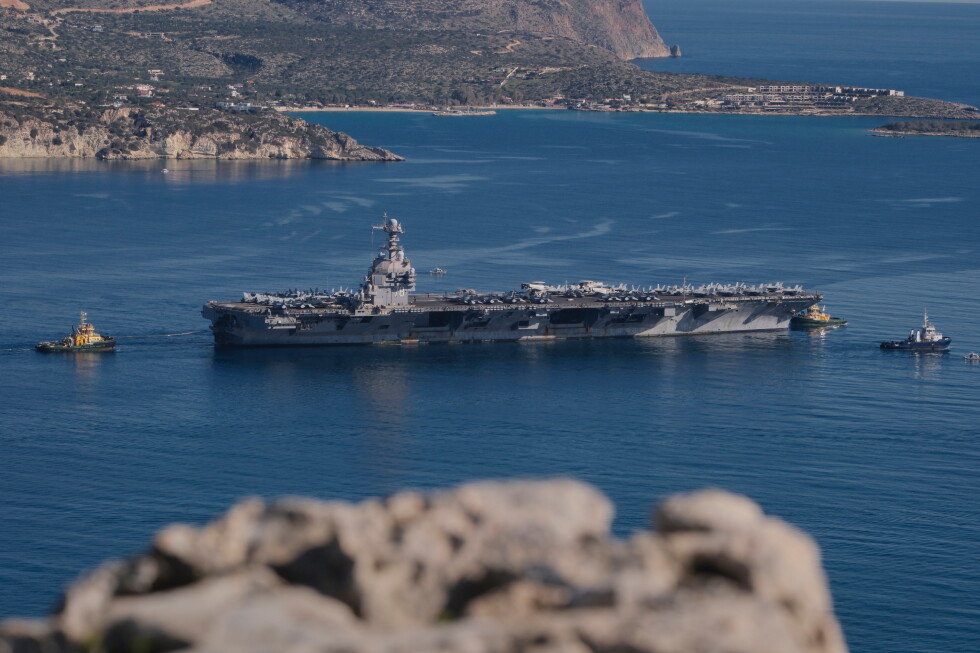
The ongoing confrontational posture of the Trump administration toward Iran has pushed the U.S. Navy’s aircraft carrier fleet to its operational breaking point, leaving the strategically critical Western Pacific without a core American warship at a moment of rising Chinese assertiveness across the region.
The USS George Washington is set to depart the Pacific theater to relieve the USS Abraham Lincoln, which has been anchored in the Middle East to support pressure operations against Iran. The Lincoln’s original scheduled return to homeport in May was extended indefinitely, and mounting concerns over crew mental health outcomes and prolonged supply chain gaps have forced the Navy to reshuffle its global deployment schedule.
While Navy planners could potentially rotate a new carrier into the Pacific within two to three months, resolving the short-term gap, the current absence lays bare a growing strategic contradiction: open-ended commitments against Iran are draining personnel and resources, even as the Trump administration has formally shifted its policy priority to the Western Hemisphere, stepping back from long-standing U.S. engagement in the Asia-Pacific.
Greg Poling, director of the Southeast Asia Program at the Center for Strategic and International Studies, noted that while the administration has framed the Pacific as its second-highest priority after the Western Hemisphere, its actions directly contradict the stated goal of drawing down U.S. military involvement in the Middle East. The unpredictable nature of the Republican administration’s policy shifts has left Pacific U.S. allies deeply unsettled, Poling added, and China has wasted no time capitalizing on American distraction and allied unease.
China views the persistent U.S. military presence in the Western Pacific as a core barrier to its regional ambitions, most notably its long-stated claim to self-governing Taiwan, which Beijing claims as its sovereign territory. For Washington, by contrast, the Pacific remains an economically vital region that the U.S. cannot afford to cede influence over.
Defense analysts do not predict an imminent Chinese invasion of Taiwan following the carrier’s departure, but they warn the gap creates a opening for Beijing to ramp up shows of force to reshape regional perceptions of power. Bryan Clark, a former Navy submariner and defense analyst at the Hudson Institute, explained that China is leveraging the moment to push a narrative among regional nations including the Philippines, Japan, and Indonesia that the U.S. is no longer the dominant security power in the Western Pacific. The end goal, Clark said, is to convince regional states that China is the ascending power and the U.S. can no longer be counted on to guarantee their security.
Recent Chinese military activity bears this out: this month alone, Beijing held large-scale naval exercises near the contested Scarborough Shoal in the South China Sea, a territory claimed by both China and the Philippines. Last month, a Chinese guided-missile destroyer carried out live-fire drills off Japan’s remote southern island of Okinotori, and Beijing just completed joint naval drills with Indonesia amid ongoing territorial frictions. Chinese forces have also stepped up aggressive actions toward both Japan and the Philippines, two key U.S. treaty allies with long-running territorial disputes with Beijing.
Top U.S. military leaders have moved quickly to reassure jittery regional allies. Adm. Frank Bradley, head of U.S. Special Operations Command, met with Filipino defense counterparts in Manila Thursday, where he confirmed U.S. special operations forces are prepared to expand joint training exercises to reinforce the bilateral alliance. He is scheduled to travel to Japan next for similar diplomatic outreach.
Evan Sankey, a China policy analyst at the Cato Institute, noted that aircraft carriers play a key psychological role beyond their military utility, providing tangible reassurance to U.S. allies that Washington remains committed to regional security. The current gap in carrier presence, he said, only amplifies the already widespread perception that the U.S. is fixated on Middle East tensions at the expense of the Indo-Pacific.
Throughout his term, President Trump has leaned heavily on aircraft carriers to execute global military operations. The USS Gerald R. Ford, for example, wrapped up an 11-month deployment in mid-May — the longest U.S. carrier deployment since the Vietnam War — during which it supported counter-Iran operations and was involved in actions related to the capture of former Venezuelan leader Nicolás Maduro. Even that deployment was marred by operational issues: a fire in the carrier’s laundry bay forced an unscheduled stop for repairs in the Mediterranean, leaving hundreds of sailors without temporary accommodation.
For the USS Abraham Lincoln, the extended deployment has pushed the ship and its crew past the usual operational limits, with the carrier logging more than 240 consecutive days at sea — a new record for U.S. carrier deployments. Congressional Democrats have already called for official investigations and increased transparency into working and living conditions aboard the ship.
Robert Farley, a professor of national security and diplomacy at the University of Kentucky who specializes in naval affairs, emphasized that both warships and their crews have hard operational limits. “People don’t get enough rest. It’s psychologically exhausting. And rest and recreation is a core part of keeping a crew healthy,” Farley explained. “Sometimes this is framed as just a matter of people not getting a vacation, but we have well-documented data that crew capacity to operate at peak efficiency declines steadily over time when extended deployments prevent proper recovery.”
Clark added that the current strain on the U.S. carrier fleet stems directly from a lack of advance planning for the prolonged standoff with Iran. “If we had known we would need to maintain this level of deployment for this length of time, we would have adjusted the overall carrier schedule upfront to ensure more vessels were available to cover all global theaters,” he said.
The U.S. Navy currently maintains 11 aircraft carriers, and typically deploys two to three at any given time. If the USS Theodore Roosevelt departs San Diego for the Middle East to allow the USS George Washington to return to the Pacific, the Navy could bump up the number of active deployments to four. But that solution creates a new long-term problem: all carriers require scheduled periodic maintenance, and the U.S. only has two domestic shipyards capable of servicing large carriers, creating an inevitable maintenance bottleneck.
“This will create a maintenance backlog that we will be paying off for years,” Clark said. “Over the next several years, we will almost certainly have less overall carrier presence globally than we have had in recent decades, because multiple carriers will be lined up waiting for access to shipyards for required work.”
Beyond immediate deployment strains, the current crisis has reignited long-running debates over the relevance of large aircraft carriers in modern warfare. Michael Swaine, a senior research fellow in the Quincy Institute’s East Asia Program, argued that rapid changes in military technology are eroding the strategic value of supercarriers. Large, slow carriers are far more vulnerable to modern drone and anti-ship missile attacks, particularly from near-peer adversaries like China, Swaine noted, while smaller surface vessels and submarines can deliver just as much striking power as the fighter jets launched from a carrier.
Even top Navy leadership has signaled a willingness to move away from overreliance on large carriers. In February comments to The Associated Press, Adm. Daryl Caudle, chief of naval operations, said he wants to persuade U.S. military commanders to prioritize smaller, more agile modern ships and other assets, instead of defaulting to deploying massive aircraft carriers for every regional contingency.