LONDON — As the fifth anniversary of the Taliban’s 2021 return to power in Afghanistan approaches, exiled Afghan award-winning journalist and women’s rights advocate Zahra Joya has issued a urgent plea to the international community, warning that Afghan women are “fighting alone” against systemic gender discrimination and feel entirely abandoned by the global community.
In an exclusive interview with Agence France-Presse conducted in London on August 14, 2026, the 34-year-old Hazara ethnic minority founder of Rukhshana Media reflected on the upheaval that has defined her life and the lives of millions of Afghan women since the hardline Islamist movement retook control of Kabul. “I lost everything in my country five years ago,” Joya said, her voice heavy with grief over the irreversible changes that have reshaped her homeland.
Joya first launched Rukhshana Media in 2020, a groundbreaking independent news outlet dedicated to centering unheard voices and untold stories of Afghan women at a time when mainstream media largely sidelined their experiences. Just one year after founding the outlet, as Taliban forces swept across Afghanistan and seized the capital, Joya was forced to flee her home for the United Kingdom. She still recalls the jarring whiplash of those chaotic August days in 2021: a week before the fall of Kabul, she was working freely as a journalist across the capital, sharing lunch with a friend at a local Kabul restaurant. By the next week, she was trapped inside her own home, effectively a prisoner, as the new Taliban administration issued its first edict for women: all women must remain confined to their households.
“I really can’t see or can’t bear how the Taliban are celebrating our sorrow in Afghanistan. It is a heavy day and I wish strength and power to women and girls in Afghanistan,” she said, ahead of the August 15 anniversary of the Taliban’s takeover.
For Joya, life under Taliban rule is not a new experience. She spent part of her childhood during the group’s first period in power between 1996 and 2001, when the regime officially banned all girls from accessing formal education. Even as a child, however, Joya refused to accept that ban: with the help of her mother, she disguised herself as a boy named Muhammad, wearing hand-altered boys’ clothing and cutting her hair short to sneak into classes every day. “The idea came to my mum,” she recalled of that risky gambit. “She made me a boy. She made boy clothes for me. She cut my hair and I went to school.”
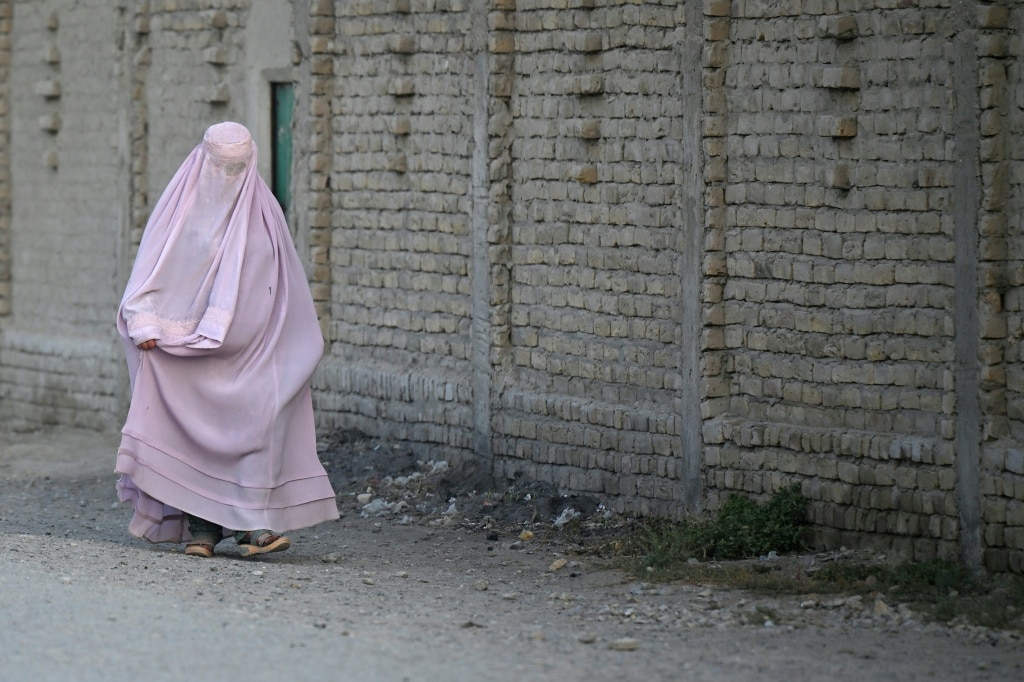
Today, the situation for Afghan women and girls is far more restrictive than it was two decades ago, and unmatched anywhere else in the world. Since returning to power in 2021, the Taliban administration has implemented a sweeping series of laws that bar all girls over the age of 12 from attending high school and university, effectively eliminating access to secondary and higher education for half the population. The regime has also banned women from most forms of employment, restricted their ability to travel independently, and pushed them entirely out of public life.
From her base in the United Kingdom, where she currently serves as a by-fellow at the University of Cambridge, Joya has refused to stop amplifying Afghan women’s voices. She continues to collaborate secretly with journalists who have remained inside Afghanistan, working under extreme security constraints to document conditions on the ground. In a recent project with British national newspaper The Guardian, Joya asked dozens of Afghan women a simple question: what does an ordinary day look like for you now? The overwhelming, unanimous response echoed the isolation the entire community faces: “We’re surrounded by four walls.”
This July, Joya released her long-awaited memoir, *The Vanishing Girl of Kabul*, which traces her own journey from a disguised schoolgirl in Taliban-ruled Afghanistan to an exiled advocate fighting for her community, while chronicling the broader erasure of Afghan women’s rights under the current regime.
For Joya, the crisis of Afghan women is not a regional issue — it is a global “gender war” that demands urgent international solidarity. “Afghan women are fighting alone,” she emphasized to AFP. “They are in a gender war. We need your solidarity. If there is any possibility to help us, share our stories, listen to us, and make your government accountable in terms of engagement with the Taliban.”
As a member of the Hazara community, a historically marginalized and persecuted ethnic group in Afghanistan, Joya says that every part of her identity is considered “wrong” under the Taliban’s ideology: “My dignity, my identity as a woman, my gender, my career as a journalist, and also my ethnicity as a Hazara woman.” It is that overlapping marginalization, she says, that makes her work all the more critical to ensure the world does not turn away from the crisis unfolding in Afghanistan today.