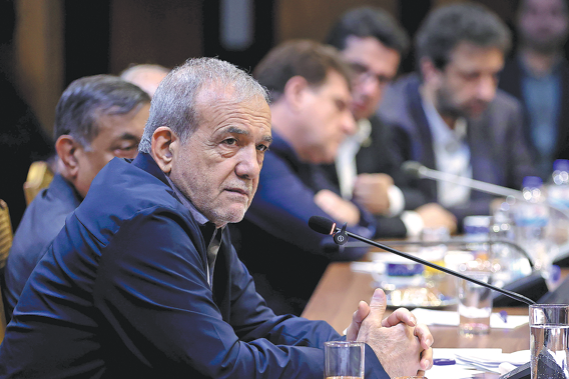
In a candid interview released via his official office website on Wednesday, Iranian President Masoud Pezeshkian has publicly addressed the current state of leadership coordination and national challenges facing the country, just months after a major shift in Iran’s top leadership post.
Pezeshkian made striking remarks confirming that dialogue and communication with Iran’s newly appointed Supreme Leader Mojtaba Khamenei remains very “difficult at the moment.” Even with this noted challenge, he emphasized that the new leader’s tenure serves as a unifying core and significant source of strength for Iran as it navigates ongoing crises.
The president also leveled sharp accusations against the United States and Israel, claiming the two countries deliberately assassinated former Supreme Leader Ali Khamenei, Mojtaba’s father, in a February 28 strike carried out out of “desperation.” Pezeshkian stated that the attack was planned with the explicit expectation that removing the long-serving former leader would trigger the collapse of Iran’s governing system. Contrary to those predictions, he noted, the nation remained stable and moved forward with a smooth leadership transition.
“However, the country continued, and our new beloved leader was selected,” Pezeshkian said in the interview. “Our new dear leader’s presence is a very great strength for us to be able to continue this path, although communication with him is very difficult at the moment.”
Mojtaba Khamenei was formally selected to assume the role of Supreme Leader by Iran’s influential Assembly of Experts in early March, just days after the death of his father. The appointment completed the planned leadership succession process outlined in Iran’s constitutional framework.
Beyond the internal leadership dynamics, Pezeshkian openly acknowledged that Iran is currently grappling with what he described as the most difficult set of circumstances in modern Iranian history. He outlined a range of mounting pressures facing the country, including intensified Western banking sanctions, sweeping restrictions on all foreign financial transactions, an effective naval blockade of Iranian ports, and an ongoing active military conflict in the region that continues to strain national resources.