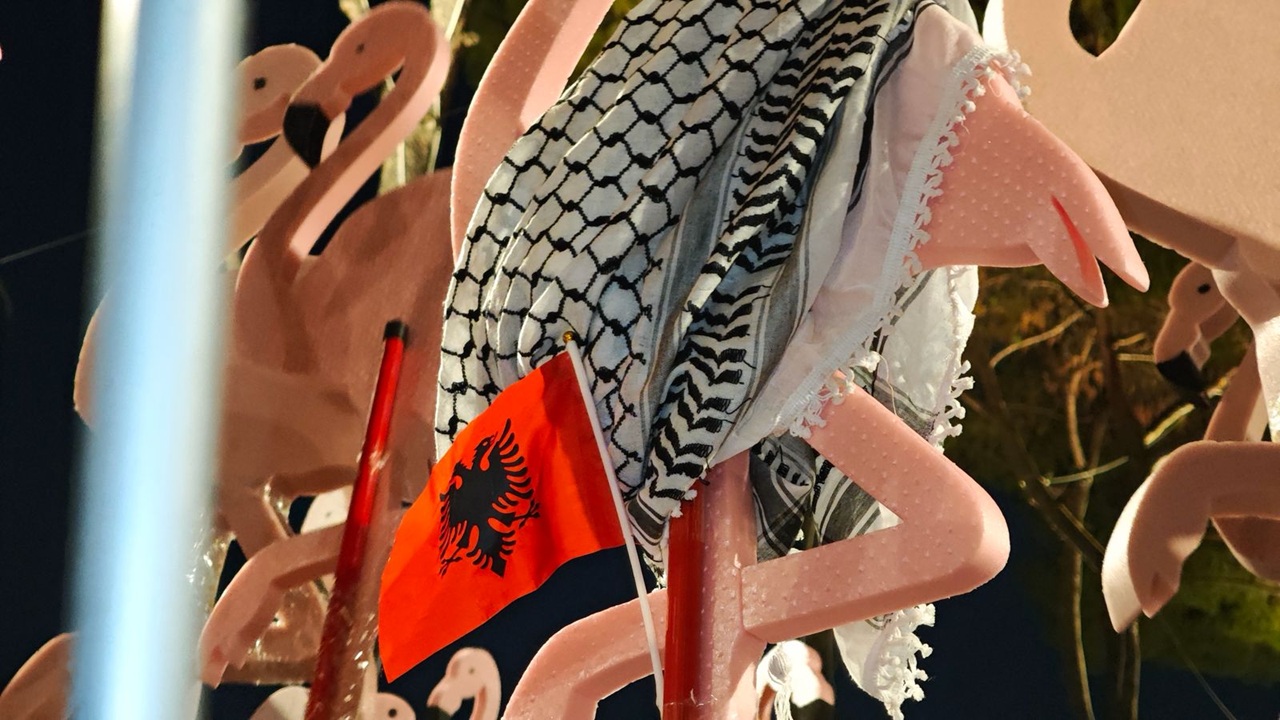
Thirty-two years after a mass wave of Albanian migration crossed the Adriatic Sea to reach southern Italy’s shores, a new journey is preparing to traverse that same body of water in the opposite direction. On August 20, a three-vessel flotilla of activists from the Albanian diaspora in Italy and the Italian branch of Global Sumud Flotilla will depart from the Italian port of Brindisi, bound for Albania, to stand in solidarity with the Flamingo Revolution — a growing grassroots movement opposing foreign-backed luxury tourism projects that threaten ecologically sensitive protected lands.
The upcoming voyage is a joint effort by three organizing groups: Mesdhe, an Italian-Albanian activist collective, Palestina e Lire (Free Palestine), an Albania-based pro-Palestine advocacy group, and Global Sumud Flotilla Italy, the national wing of an international civil society network that works to break Israel’s naval blockade of the Gaza Strip and deliver humanitarian aid to the besieged enclave. For organizers, the voyage is far more than a show of support for on-the-ground Albanian activists; it is an effort to connect overlapping global struggles over land dispossession, ecological destruction, and foreign control of natural resources across the Mediterranean region.
The choice of departure date and location carries deep historical and symbolic weight. Brindisi sits in Italy’s southern Puglia region, the first landing point for hundreds of thousands of Albanians who fled the country following the 1991 collapse of its communist regime. The most infamous of those mass crossings came on August 8, 1991 — exactly 32 years before the voyage’s social media launch — when the cargo ship *Vlora* docked in Bari, Puglia’s capital, carrying roughly 20,000 Albanian refugees crammed into its hold. The arrival triggered one of the fastest, largest repatriation operations in Italian history: more than 17,400 of those refugees were deported within days, after being confined to Bari’s Stadio della Vittoria without adequate food, water, or medical care. Hundreds were hospitalized for dehydration, and violent clashes with police ended with officers opening fire on refugees attempting to escape the overcrowded facility. Tens of thousands more Albanians crossed the Adriatic to southern Italy in the months that followed, reshaping the cultural and social fabric of Puglia forever.
Today, the same systemic corruption that pushed that generation of Albanians to flee their home country is now selling off Albania’s most precious natural assets to foreign investors, organizers argue. As Albanian activists enter their 68th day of continuous protest against the proposed developments, the diaspora is sailing back to stand with the movement demanding the right for Albanians to remain on and control their own land.
The Flamingo Revolution takes its name from the ecologically rich Narta Lagoon, one of the sites targeted for private luxury development. At the center of the controversy is Sazan Island, a former military outpost where Jared Kushner, the son-in-law of former U.S. President Donald Trump and head of investment firm Affinity Partners, is backing a $1.4 billion luxury resort project. A second Kushner-linked development is planned near Zvernec, located within the protected Narta-Vjosa coastal landscape — a living ecosystem that hosts more than 200 species of migratory birds, including the iconic pink flamingos that give the movement its name, and has been home to Indigenous coastal communities for generations.
For diaspora activists, the voyage is a convergence of personal memory and contemporary political struggle. “I am part of the Albanian diaspora in Italy. And our memory is also made of the sea,” explained Clara Osma, an Italian-Albanian organizer with Mesdhe and Palestina e Lire, in an interview with Middle East Eye. “It is the memory of the ships of the 1990s, of the stadiums where Albanians were locked up when they arrived, of deportations and the first systems of administrative detention. The diaspora preserves that history. And this is where, for me, memory meets what is happening today with the Flamingo Revolution and why we decided to sail. Because 30 years later, we see another generation of Albanians asking, essentially, for the right to stay, and we want to come back.”
Enton Nazeraj, an Italian-Albanian artist participating in the mobilization, noted that the protest movement has also helped him reconnect to a fragmented identity shaped by decades of migration. “As the son of immigrants, I feel at home within the revolution. That is why I am taking part in this action. In the revolution I found my identity,” he said.
Tony La Piccirella, an Italian organizer with Global Sumud Flotilla Italy, grew up alongside Albania’s diaspora community in Puglia, and frames the struggle as shared across the Adriatic. “I was born just before the arrival of the Vlora, so I have never known a Puglia without an Albanian presence. They are precisely the friends I grew up with,” he explained. Organizers point to similar fights against destructive luxury development in Puglia itself, where local and environmental groups are challenging a proposed $115 million Four Seasons resort near Ostuni, a project developed by Israeli real estate firm Omnam. The proposal has faced repeated legal challenges from environmental organizations, with the Puglia regional government even joining the opposition — a situation that mirrors long-running fights against destructive coastal development in other parts of Italy, including Sardinia’s Tavolara region.
For activists, these local fights are part of a global pattern of resource dispossession that connects the Albanian coast to the Gaza Strip. Organizers emphasize that the same financial and political actors pushing for the destruction of Albanian ecosystems for luxury profit are also behind controversial plans to reshape Gaza after years of war. Kushner has led a $25 billion initiative to redevelop Gaza into a global commercial and tech hub, a plan widely criticized by activists and scholars for facilitating the forced displacement of Palestinian people and erasing Indigenous Palestinian cultural and political identity.
“The same people who finance the oppression of the Palestinian people, planning to build a tourist hub on the rubble of Gaza, are the ones who aim to bury the ecosystems of Sazan Island under a luxury resort,” Mesdhe wrote in the movement’s official launch statement.
The three vessels being used for the voyage carry their own history of international solidarity. The boats were originally deployed by the Global Sumud Flotilla for aid missions to Gaza, but were damaged and abandoned after Israeli forces attacked the flotilla and captured participating activists earlier this spring. Restored and repurposed for the journey to Albania, the boats now serve as floating symbols of connected resistance, linking the struggle for Palestinian self-determination to the fight to protect Albania’s coasts.
“The fact that a piece of the Albanian diaspora is returning in support of the Flamingo Revolution, using boats born from solidarity with Palestine, is very powerful,” La Piccirella said.
For the Mesdhe collective, the core meaning of the voyage is simple: it reverses the historic flow of displacement that has shaped the Adriatic for three decades. “We are returning not as tourists or investors, but as a diaspora organised around the right of people to remain on their land,” the group said.