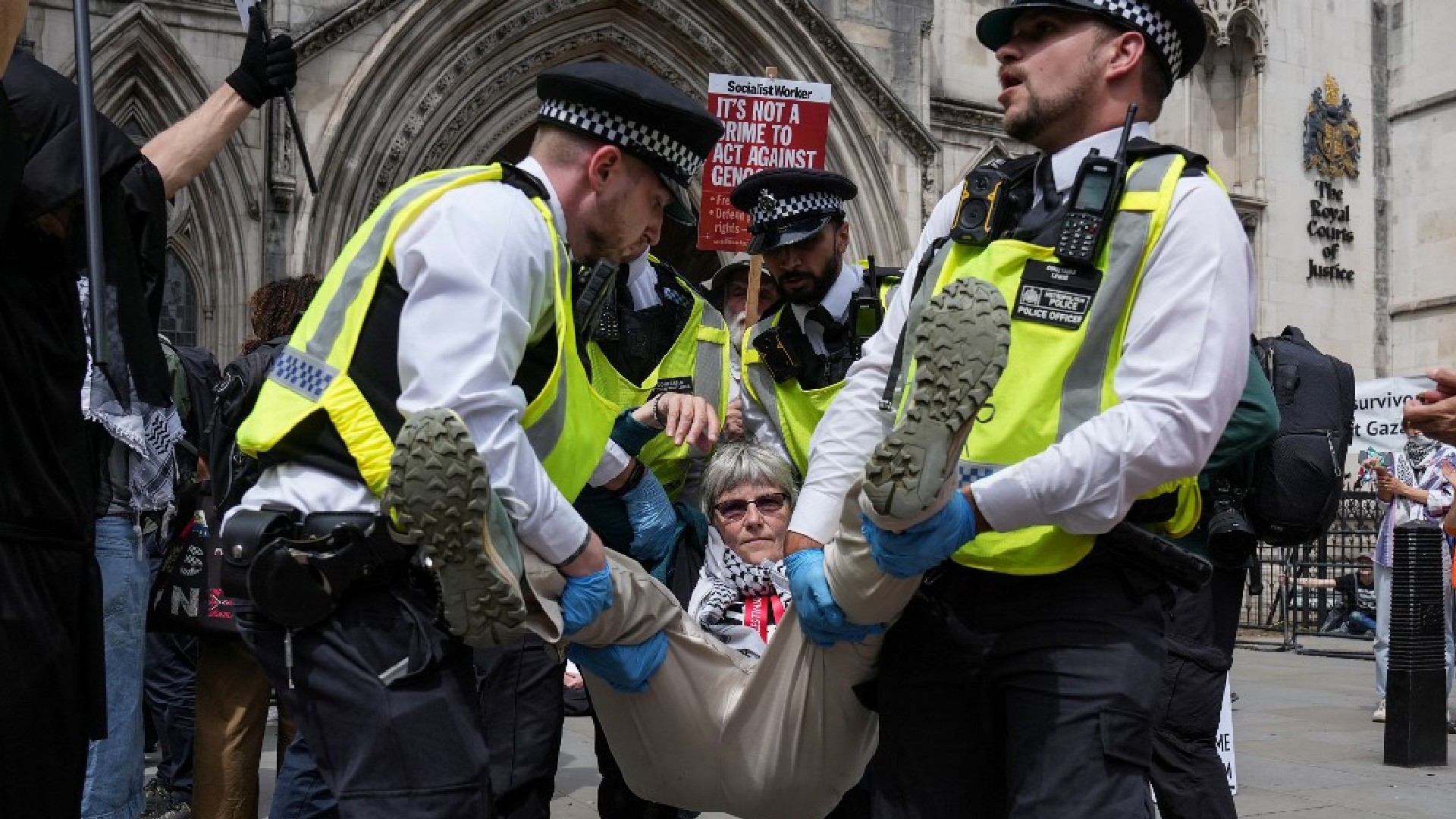
For 70-year-old grandmother Marji Mansfield, every pre-dawn hour between 5 and 7 a.m. brings a wave of crippling fear. Like dozens of other pro-Palestine activists across the United Kingdom, she waits for the knock that British counterterrorism police could leave on her door at any moment, a routine dawn raid that has already upended the lives of nearly 20 peers, many of them elderly.
“It’s been really, really quite scary not knowing when there’s going to be the knock at the door,” Mansfield told independent outlet Middle East Eye in an interview. “This isn’t the Britain that I thought I grew up in at all. We’ve been scared enough to go and sleep elsewhere.” That anxiety spikes whenever her seven grandchildren stay overnight, turning the usually quiet early morning hours into a period of relentless dread.
Mansfield’s ordeal is rooted in a crackdown on Palestine Action, a direct action advocacy group that the UK government formally banned as a proscribed terrorist organization in July 2025. In the months following the proscription, more than 3,000 people have been arrested under the UK Terrorism Act simply for participating in silent vigils held in solidarity with the group. In June of that same year, the Court of Appeal upheld the legality of the ban, overturning an earlier High Court ruling that had questioned the proscription.
Following that ruling, Defend Our Juries (DOJ), the grassroots organization leading the campaign to reverse the ban, called for an escalation of peaceful protest action. The new action encouraged activists to explicitly invite others to support Palestine Action, rather than only voicing personal backing for the group. Under Section 12 of the UK Terrorism Act, this act of invitation can carry a maximum 14-year prison sentence, a far harsher penalty than the Section 13 charge most prior arrestees have faced.
Mansfield was one of roughly 100 activists who answered DOJ’s call, uploading a public video to social media that declared: “Saving lives is not terrorism, I support Palestine Action, and I think you should too.” In the weeks since, 19 of those video uploaders have already been targeted by counterterrorism dawn raids spanning the entire country, from London and the West Midlands to Wales, Scotland, Cornwall and Somerset. Many of those raided are retired seniors.
Activists who have endured the raids describe invasive searches that go far beyond legitimate counterterrorism work. Officers confiscate all personal digital devices, any items bearing Palestinian symbols, and even rifled through private personal diaries. Two activists were handcuffed during their raids, despite official police policy that only permits restraints when officers have objective reason to believe a suspect will attempt escape or cause harm to themselves or others.
For those who have not yet been raided, like Mansfield, the uncertainty of waiting has devastated daily life. Many report persistent insomnia, and activists with ill partners say they avoid leaving their homes out of fear police will raid while they are away. “It really impacts people’s lives. It causes great fear and anxiety,” Mansfield said. Middle East Eye requested comment from UK Counter Terrorism Police ahead of publication, but received no response.
One of those who experienced a raid firsthand is 53-year-old Asghar Ahmad, a former UK government IT worker from Telford, Shropshire. On a late July morning just after 7:30 a.m., he opened his front door to find roughly a dozen officers, one police van, and four police cars parked outside his home.
“I wasn’t challenging anything because I knew what they were going to do. They were going to go through the whole house,” Ahmad recalled. When he asked to put on clothes beyond the shorts he was wearing, an officer followed him upstairs and stayed with him the entire time before he was handcuffed and transported to the local police station. While he was in custody, remaining officers searched every room of his home, seizing all digital devices, old notebooks, and every item connected to Palestine, from flags to wristbands. He was interviewed with his solicitor present and released by 5 p.m. without any charges filed.
Now retired and doing community volunteer work, Ahmad said he spent 38 years focused on his career and building his family, and only felt free to speak out on political issues once he left government service. “I’ve got nothing to hide,” he said. “If they want to put pensioners in prison, it will not go down well.”
Sixty-four-year-old Paul Gravesbrown, a semi-retired archaeologist living in Powys, described a similarly invasive experience that left him deeply disturbed. Some 20 officers searched his home for six and a half hours, even going through his wife’s teenage diary, leaving it out on top of her belongings to make clear they had read its private contents. “They left the diary on the top, highlighting the fact that they’ve been looking through a teenage girl’s diary, which is a bit creepy,” he said.
Gravesbrown was held for eight hours at a local police station and released without charge. The trauma of the raid has lingered, he said, echoing the violation people feel after a home burglary — an experience he and his wife already endured just before the COVID-19 lockdown. “Being raided is quite traumatic, it’s one of those things which hangs around in your mind,” he said. “Our house was burgled just before the first lockdown, so it’s a similar sort of experience – total strangers wandering around your house.”
Even younger activists face deep lasting harm from the crackdown. Thirty-year-old Staffordshire bartender Allie, who spoke to MEE under a pseudonym for privacy, was arrested shortly after returning home from a late work shift. She was woken at 1 a.m. by loud banging on her front door. “I opened the door and I think the first thing I said was, ‘Oh my God, you actually came,’” she recalled.
Both Allie and Ahmad said officers demanded their device passcodes to unlock their personal electronics, a request that requires formal written notice under Section 49 of the UK Investigatory Powers Act. As she was handcuffed, Allie remarked that the response was excessive for her alleged offense, and officers asked her to sign a formal statement noting her comment. She was held for eight to nine hours at a Birmingham-area police station before being released without charges.
For Allie, the harm of the raid extends far beyond the day of arrest. “I think the worst thing for me is that it really shatters any sense of personal safety,” she said. “You go through life with a belief in the systems that are there to protect you. This is such a heinous overreach and abuse of those systems. I don’t think that I’ll ever be able to fully reconcile myself with it. It’s like having to reconstruct a new reality.”