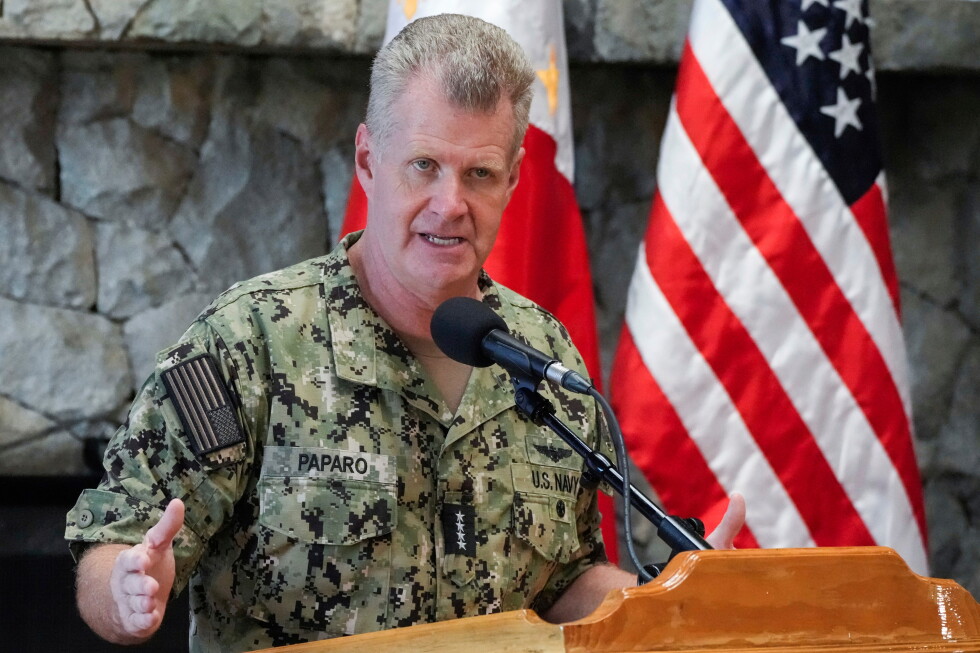
At a regional security conference hosted in Kuala Lumpur, Malaysia by U.S. Pacific Command on Monday, the leader of the U.S. military’s Indo-Pacific command delivered a stark warning that coercive behavior from Beijing and other global actors poses growing threats to Indo-Pacific stability, stressing that Washington will never permit a single power to seize control of the strategic region.
Admiral Samuel Paparo, commander of U.S. Indo-Pacific Command, spoke via video link to the assembled delegates, arguing that some actors are leveraging manufactured claims of legitimacy to enable intimidation and pressure against neighboring states. He drew a sharp conceptual distinction for the current geopolitical moment: “That’s not the rule of law. That’s the rule by law. That distinction between law as a tool of order versus law as a weapon of raw power, is the defining fault line of our time.”
Paparo’s comments arrive against a backdrop of sustained heightened tensions in the South China Sea, where China’s expansive territorial and maritime claims overlap with competing claims from multiple Southeast Asian coastal nations. The Philippines has emerged as the primary site of recent standoffs between Beijing and a regional claimant, with repeated confrontations between Chinese and Philippine maritime vessels centered on a contested shoal. Manila has formally accused Chinese crews of carrying out dangerous navigation maneuvers, deploying water cannons against Philippine vessels, and repeatedly attempting to block government resupply missions to Filipino personnel in the disputed area. China has outright rejected all these accusations, and continues to assert its full territorial sovereignty over the contested waterway.
The United States has repeatedly maintained that it does not take formal sides in the overlapping sovereignty claims in the South China Sea, but affirms its unwavering support for freedom of navigation, adherence to international law, and the right of all nations to operate in accordance with their recognized legal rights. Paparo underlined that open sea access, collective maritime security, and unobstructed global commerce form the foundation of lasting regional stability. He added that peaceful negotiation of disputes and universal respect for national sovereignty are non-negotiable requirements to protect the existing rules-based order in the Indo-Pacific.
“The United States is clear-eyed about the complex security environment in this region. Our posture and our intent are well defined. The United States is deterring China through strength, not through confrontation,” Paparo stated. “We will not let any nation dominate this region or sweep away the hard-fought sovereign rights of independent states.”
The U.S. commander further noted that the Indo-Pacific remains the central global hub of geopolitical and economic activity, but rising instability and evolving security challenges have made closer coordination between U.S. allies and regional partners more critical than ever before.
Opening remarks earlier in the conference came from Philippine Defense Secretary Gilberto Teodoro, who pledged that Manila would continue to resist and push back against what he framed as Chinese aggression in the region. Speaking to reporters after his address, Teodoro expanded on his concerns, noting that Philippine anxiety over China’s actions extends far beyond its activities in the South China Sea. He pointed to Beijing’s recent test of a ballistic missile launched into the Pacific Ocean as clear evidence of China’s expanding regional reach and growing military footprint. “China is everywhere … this is a matter of concern,” he added.
On the sidelines of the security gathering, Association of Southeast Asian Nations (ASEAN) Secretary-General Kao Kim Hourn offered a more optimistic update on long-running negotiations between ASEAN member states and China over a binding code of conduct to govern interactions in the South China Sea and de-escalate long-running tensions. According to Kao, talks have advanced dramatically in recent months, with negotiators now far closer to finalizing the text than ever before. “The pace has picked up dramatically and I think we are much closer to finalizing the code of conduct,” Kao said. “I have full confidence that we will get it done within this year.”