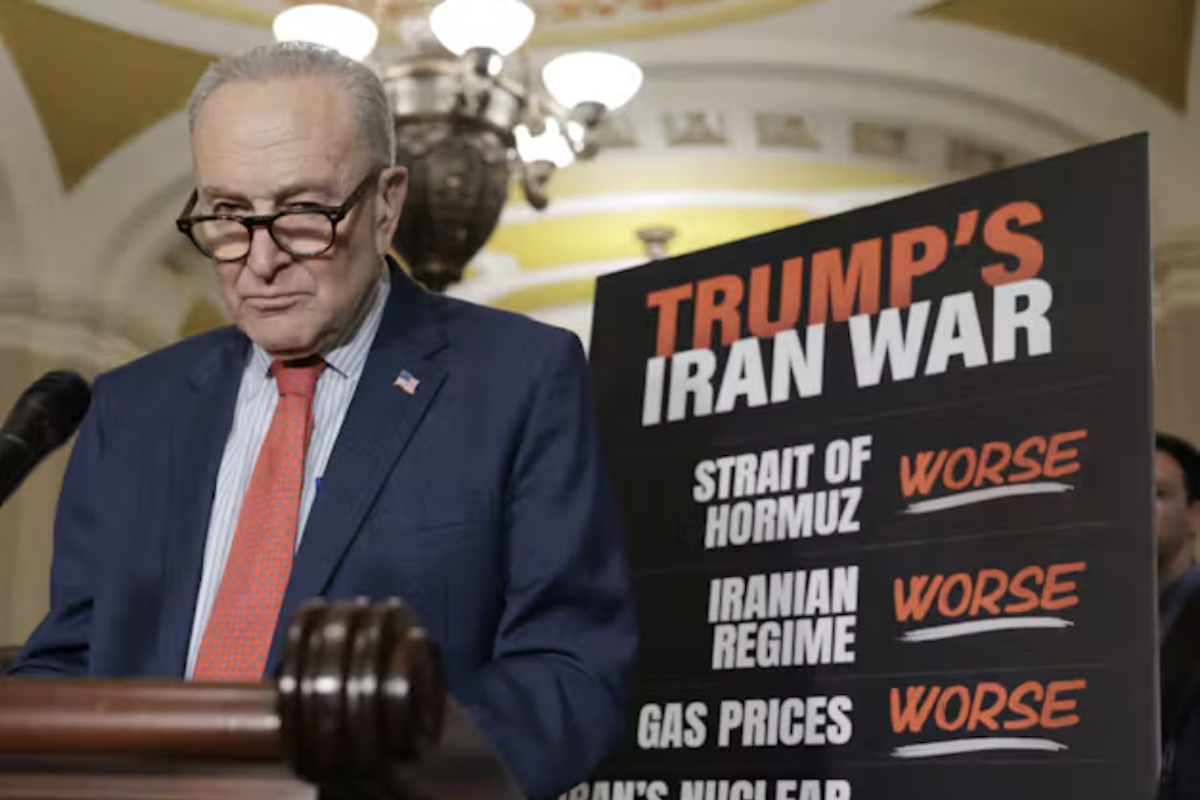
Following a resounding, sweeping electoral triumph for Democratic candidates in the 2026 U.S. midterm elections, the party now holds enhanced legislative leverage to push back against core planks of President Donald Trump’s second-term agenda, with the widely derided, financially draining military campaign against Iran emerging as one of their highest immediate policy priorities. While Trump retains executive authority to veto any formal congressional legislation designed to terminate the conflict, Democratic leaders hold a formidable procedural tool embedded in the U.S. Constitution that could force a policy shift: the power to block federal funding earmarked for continued military operations in Iran.
This path, however, carries significant political risks. Historical precedent shows that wielding the power of the purse to defund an active overseas war can spark a partisan firestorm that backfires against the party leading the charge, eroding public support rather than galvanizing it. Even if Democrats succeed in winding down hostilities, analysts warn that the deep, lasting harm the Iran campaign has inflicted on Washington’s global diplomatic standing may prove irreversible.
Democratic leadership has mapped out three distinct strategic pathways to push for a full withdrawal from Iran, though two of these options face steep structural limitations. The most straightforward approach is to pass binding legislative text mandating an end to the war. Earlier this year, in June, Congress moved under the 1973 War Powers Resolution to pass a bipartisan concurrent resolution directing Trump to either withdraw all U.S. forces engaged in hostilities against Iran or secure explicit congressional authorization to continue the campaign. That measure, which drew cross-party Republican support, was immediately dismissed as non-binding by the Trump administration, which ignored its directives entirely. A follow-up version of the resolution later failed to advance in the Senate that September.
For a war termination measure to carry the full force of federal law, it would need to clear both chambers of Congress before landing on Trump’s desk, where a presidential veto is all but guaranteed. Overriding that veto would require a two-thirds supermajority vote in both the House of Representatives and the Senate, a threshold that would demand dozens of Republican lawmakers break publicly with their party’s sitting president, a high bar few political observers consider easily attainable.
A second, slower Democratic strategy centers on congressional oversight powers, including launching sweeping, high-profile investigations into the execution, cost, and strategic justification of the Iran war. This process would likely feature public hearings, official subpoenas for internal administration documents, and even potential impeachment proceedings against senior Trump administration officials. Hakeem Jeffries, the widely presumed incoming Speaker of the House, could target Secretary of Defense Pete Hegseth for impeachment to appease the progressive anti-war wing of the Democratic caucus and hardline Trump critics. But at this stage, the legal grounds for such impeachment proceedings remain untested and ambiguous, and even with a new Democratic Senate majority, securing the two-thirds vote required to remove a cabinet official would still need significant Republican backing. More critically, the drawn-out, months-long timeline of congressional oversight probes makes this approach ill-suited to deliver a rapid end to active combat operations.
The most viable, immediate lever available to Democratic lawmakers to halt the Iran war is the constitutional “power of the purse” enshrined in Article I, Section 9, which explicitly states that no federal funds may be drawn from the U.S. Treasury except via formal congressional appropriations. Once the new Democratic-controlled Congress is sworn in this coming January, every new dollar the Trump administration’s Department of War requests for the Iran campaign will require explicit sign-off from both the House and Senate. Democrats could attach a targeted rider to the annual national defense budget that explicitly prohibits the use of allocated funds for any further hostilities against Iran. Trump could veto that entire defense appropriations bill in response, but such a move would freeze pay and operational funding for every active-duty U.S. service member nationwide, a political move that would carry enormous electoral risk for both parties.
This exact scenario played out in 2007, when a Democratic-led Congress attempted to insert a withdrawal timetable for U.S. forces in Iraq into a defense spending bill, only for then-President George W. Bush to issue a full veto. The fight devolved into a bitter partisan blame game, with both sides accusing the other of abandoning U.S. troops in the field. Facing mounting voter backlash, congressional Democrats ultimately backed down rather than being framed as undermining military personnel. That identical political peril hangs over the party today: Democratic leaders must weigh whether they are willing to stake their electoral credibility on a funding fight that Trump’s allies would almost certainly frame as a betrayal of deployed U.S. service members, leaving the question of which side will blink first in the high-stakes standoff unanswered.
In the aftermath of the midterm rout, Trump himself acknowledged last week that public frustration over the Iran war was a key contributing factor to the Republican Party’s devastating losses, though he doubled down on his decision to launch the campaign, claiming he would repeat the exact same actions if necessary to prevent Tehran from developing a nuclear weapons capability. Vice President JD Vance took a far more critical stance, posting a blunt statement to social media platform X that explicitly identified the Iran war as the core reason for the GOP’s midterm collapse, adding that any honest post-election reckoning within the Republican Party had to start with acknowledging that fact. Vance, who has a long public record of criticizing unconstrained U.S. military intervention in overseas conflicts, had previously publicly aligned himself with Trump’s Iran policy since taking office, but the scale of the Republican electoral defeat has now cleared a path for him and other disillusioned GOP lawmakers to break ranks with the president on the war.
For Trump, agreeing to a negotiated end to the conflict now would represent a major public humiliation. To date, the U.S. has poured nearly $50 billion into the Iran military campaign with almost no measurable, tangible strategic gains to show for the massive investment. Tehran has demonstrated that it can effectively exert control over the critical Strait of Hormuz global energy chokepoint, while Iran-aligned Houthi forces in Yemen have sustained repeated attacks on commercial shipping in the Bab al-Mandeb Strait, disrupting global supply chains. These cascading costs will linger long after the end of Trump’s presidency, with many geopolitical analysts arguing that the botched Iran campaign could deliver a fatal blow to the unipolar global order the United States built in the aftermath of the Cold War, with the largest long-term strategic beneficiary of the chaos likely not Tehran, but Beijing.