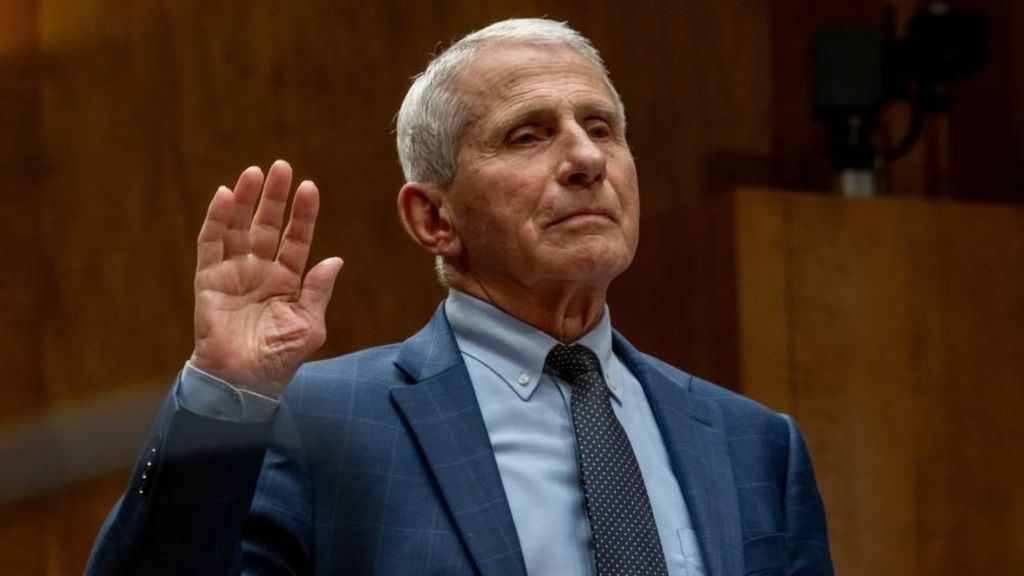
A high-stakes, confrontational Senate hearing focused on former White House chief medical adviser Anthony Fauci’s handling of the COVID-19 pandemic has erupted into a major political and legal firestorm, after the nation’s one-time top infectious disease expert declined to answer more than 100 questions by invoking his U.S. Constitutional Fifth Amendment right against self-incrimination.
The hearing, led by Senate Homeland Security and Governmental Affairs Committee Chairman Rand Paul, a Republican from Kentucky, ended with Paul issuing a stark warning: Fauci faces a very real possibility of criminal prosecution for his refusal to testify. Paul, who has spent years leveling accusations that Fauci covered up COVID-19’s origins and improperly funded gain-of-function research at China’s Wuhan Institute of Virology, confirmed the committee will hold a vote next week on a resolution to hold Fauci in criminal contempt of Congress. If the committee approves the measure, it will move to the full Senate for a vote, where supporters would need 60 votes to advance — a steep hurdle that would require bipartisan support from Democratic lawmakers, a outcome widely seen as a longshot. Should the resolution pass the Senate, it would be referred to the District of Columbia’s top federal prosecutor for potential criminal proceedings.
Fauci, who previously led the National Institute of Allergies and Infectious Diseases, told the committee he was acting on the explicit advice of his legal counsel when he invoked the Fifth Amendment. Legal experts note that invoking this constitutional protection is not an admission of guilt, and is a standard practice used by individuals across all tiers of U.S. legal proceedings, even in non-criminal investigations. Notably, former President and current White House occupant Donald Trump himself invoked the Fifth Amendment dozens of times during a 2022 civil deposition connected to investigations into his business, the Trump Organization.
A key complicating factor in any potential prosecution is the pre-emptive pardon former President Joe Biden granted Fauci before leaving office, covering all federal crimes Fauci may have committed between 2014 and 2025. Even so, legal questions remain unresolved: the pardon does not cover actions after 2025, including Fauci’s refusal to comply with Wednesday’s hearing, and presidential pardons only apply to federal offenses, not state-level investigations. Paul acknowledged the unclear scope of the pardon, saying the question of whether it grants Fauci immunity from current proceedings is a legal issue that may ultimately need to be settled by the courts. Already, Florida’s top attorney James Uthmeier has announced his office will launch an investigation into Fauci, though he has yet to release specific details about the alleged misconduct under review.
Paul’s allegations against Fauci center on longstanding claims that COVID-19 leaked from the Wuhan Institute of Virology, a theory that received CIA backing last year. During Wednesday’s hearing, Paul pointed to a discrepancy between Fauci’s public statements and private writings: while Fauci publicly supported the theory that the virus originated naturally via animal-to-human spillover, his personal diaries suggest he privately believed the virus emerged from a laboratory accident. Committee Republicans also questioned Fauci on the shifting COVID-19 public health guidance rolled out during the pandemic, changes that public health officials have long defended as necessary adjustments as new scientific information about the virus emerged. Fauci has repeatedly denied any wrongdoing connected to pandemic response or coronavirus research funding.
The hearing quickly split along partisan lines, with multiple Democratic lawmakers rushing to Fauci’s defense. Senator Maggie Hassan of New Hampshire called the proceeding a deliberate political stunt designed to entrap Fauci. Former President Trump, who has clashed repeatedly with Fauci even as he awarded the former official a presidential commendation for work on the Operation Warp Speed vaccine program in 2021, also waded into the controversy on social media, labeling Fauci “crazy” and claiming Fauci had long intentionally lied about the virus’s origins to protect China.
The global scientific community remains divided on COVID-19’s origins. The World Health Organization confirmed last year that the natural spillover theory remains the best supported by current available evidence, but added that the question remains inconclusive until additional data is uncovered. For Fauci personally, the hearing marks the latest escalation of years of targeted political attacks: the former official has received hundreds of death threats during and after the pandemic, and Trump last year ordered the removal of the federal security detail assigned to protect him.
As the country awaits next week’s contempt vote, legal and political observers note that the outcome remains highly uncertain, with the pardon, partisan split in the Senate, and unclear jurisdiction over potential charges all creating major barriers to any formal prosecution.