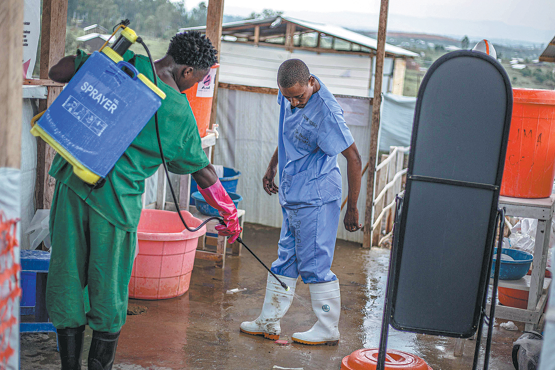
Two months after an Ebola outbreak emerged in eastern Democratic Republic of the Congo, the United Nations has issued a stark warning that the epidemic is spreading far more rapidly than official tracking has captured, with its true scale potentially reaching two to four times the size of published case counts.
As of July 11, official data logged nearly 2,000 confirmed infections and more than 700 deaths across five affected provinces, already ranking this event as the third-largest recorded Ebola epidemic in history and the fastest-growing outbreak the global health community has faced in modern history. Chikwe Ihekweazu, executive director of the WHO Health Emergencies Programme, confirmed the alarming acceleration following a visit to the outbreak’s epicenter in Bunia, Ituri Province, telling reporters in Geneva that the past month has seen the sharpest single-month case growth of any Ebola outbreak the WHO has ever responded to.
In recent days, Ihekweazu noted, the outbreak has hit some of its highest single-day infection peaks, with more than 80 new confirmed cases recorded in a single 24-hour window. The most worrying trend, health officials emphasize, is that a large share of new fatalities are occurring in community settings, with patients dying before they can reach formal treatment facilities. Caused by the Bundibugyo Ebola strain – for which no approved vaccines or targeted treatments currently exist – the outbreak has already spread beyond its original Ituri Province epicenter to neighboring Haut-Uele and Tshopo provinces. While roughly 95 percent of cases remain concentrated in Ituri, hidden, untraced transmission chains are driving the epidemic’s expansion.
WHO epidemiological modeling estimates that the true caseload is vastly undercounted. “You have to imagine that this is a fire. There’s something driving the fire in its heart, and it’s also expanding at the same time,” Ihekweazu said. Even with improvements to diagnostic testing and disease surveillance, roughly 80 percent of new confirmed cases are not linked to already known contact chains, confirming that large portions of transmission remain undetected by response teams.
The outbreak has also taken a heavy toll on the frontline workforce: the Africa Centres for Disease Control and Prevention (Africa CDC) has confirmed at least 112 infections and 35 deaths among healthcare workers responding to the crisis. For aid organizations operating on the ground, rapidly shifting outbreak dynamics have made containment efforts far more challenging. Frederick Lai Manantsoa, emergency coordinator for Doctors Without Borders in DR Congo, explained that persistent insecurity, large-scale population movement and internal displacement have made routine surveillance and contact tracing increasingly difficult. “The success of the response depends on how quickly we can identify suspected cases, isolate them and cut the chain of transmission,” Manantsoa said. “There are several dynamics of the outbreak which make surveillance and contact tracing extremely complex.”
Despite the grim outlook, global and local health authorities have recorded important progress toward addressing the outbreak. This week marked the launch of new clinical trials focused on developing effective treatments and preventive interventions for the Bundibugyo strain, marking a new phase in the global response. The EBO-PEP platform trial, based in Ituri Province, aims to recruit nearly 1,000 high-risk contacts across DR Congo and neighboring Uganda to test whether antiviral medications can prevent infection after exposure to the virus.
Africa CDC has pledged $1 million to support the trial, while the governments of DR Congo and South Africa have committed an additional $5 million in combined funding. WHO Director-General Tedros Adhanom Ghebreyesus called the trial a potential turning point for Ebola response, noting that the research could create a “game-changing approach” for preventing infection among exposed people and improve global capacity to bring future outbreaks under control quickly.