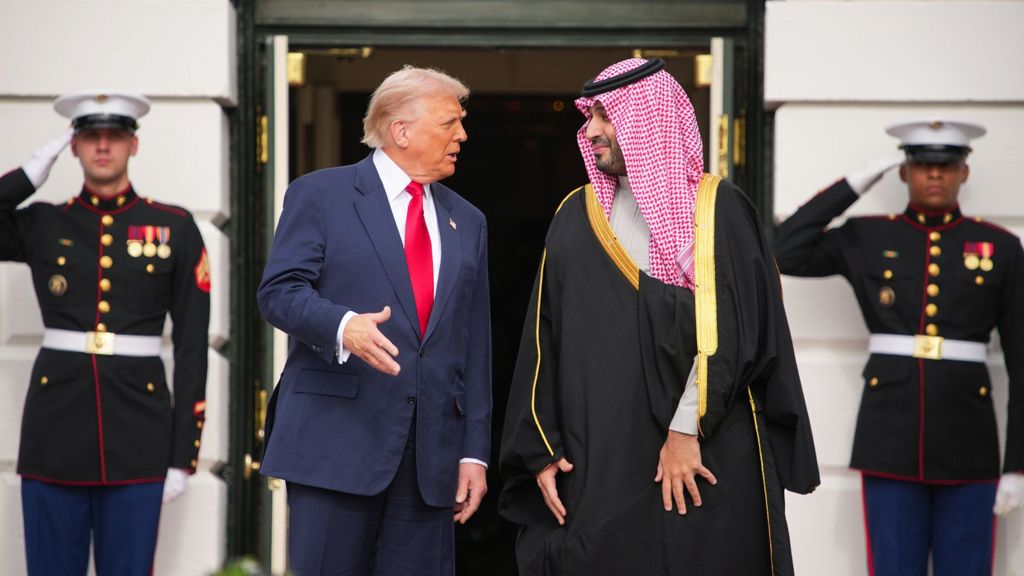
A new twist has emerged in the long-awaited US-Saudi civilian nuclear cooperation agreement, with President Donald Trump publicly confirming that the entire deal hinges on Riyadh formally joining the Abraham Accords, the 2020-brokered deal that normalized relations between Israel and several Arab nations. In a post on his Truth Social platform, Trump clarified key terms of the framework, emphasizing that the agreement, which is strictly limited to non-military nuclear development, will not allow Saudi Arabia to enrich uranium on its own territory – a point that addresses widespread concerns about potential nuclear proliferation in the volatile Middle East.
The unprecedented condition, first outlined by Trump in private discussions with Saudi leadership, has not yet been confirmed as a formal binding clause in the still-unreleased agreement text, and the Saudi government has not issued an official response to Trump’s public announcement as of press time. White House Press Secretary Karoline Leavitt confirmed on Thursday that Trump has repeatedly raised the requirement with Saudi officials during past negotiations. “He has said if they don’t join the Abraham Accords, the deal is off,” Leavitt stated, adding that diplomatic discussions with Saudi counterparts will continue in the coming weeks.
Trump’s announcement comes one day after the bilateral agreement was officially unveiled, which has already drawn sharp criticism from nonproliferation experts and some members of Congress from both major political parties. Critics warn that opening the door to Saudi civilian nuclear development could create a pathway for the kingdom to pursue a nuclear weapons program down the line, exacerbating tensions in a region already grappling with long-running nuclear standoffs. While Trump’s Republican Party holds majority control of both the Senate and House of Representatives, meaning deal opponents lack the votes to block congressional approval, the concerns have added new scrutiny to the framework.
According to a statement from the US Department of Energy, the agreement establishes two core binding documents: a peaceful nuclear cooperation pact and a bilateral safeguards agreement. Together, the department says, these documents lay the legal groundwork for what is expected to become a decades-long, multi-billion-dollar partnership that advances both US economic and strategic priorities, with nonproliferation as a central stated goal. The full agreement will now be sent to Congress for a mandatory review period before it can take effect. The International Atomic Energy Agency (IAEA) also confirmed Thursday that it is aware of the plan and is preparing to implement verification measures once a formal request is submitted. “We look forward to receiving the request for such verification and to working with the US and KSA in ensuring the implementation of those measures,” an IAEA spokesperson said.
The Abraham Accords, first negotiated during Trump’s first presidential term in 2020, marked a historic breakthrough in Middle East diplomacy, with the United Arab Emirates and Bahrain becoming the first Arab nations to normalize formal relations with Israel in decades. Since the initial agreement was signed, Sudan, Morocco and Kazakhstan have also joined the framework. Saudi Arabia has long held firm that it will not normalize relations with Israel or join the accords until a sovereign Palestinian state is established, though US officials have signaled they are pushing for a breakthrough that would break this decades-long stalemate.
Israeli officials have broadly welcomed Trump’s announcement, with Prime Minister Benjamin Netanyahu’s office noting on social media platform X that Saudi membership in the accords “would be an historic leap forward for peace in the Middle East.” The prime minister’s statement did not address the nuclear deal itself, but Israeli Economy Minister Nir Barkat has previously said the country would accept Saudi civilian nuclear power. Still, some prominent Israeli figures have raised sharp alarms. Former Israeli Defense Minister Avigdor Lieberman argued that “Every military nuclear program begins with a civilian one,” echoing nonproliferation experts’ concerns. Notably, Israel is widely believed to possess an arsenal of nuclear weapons, though it has maintained a decades-long policy of neither confirming nor denying this status.
The nuclear file has been the center of a years-long standoff between Western powers and Iran, which has repeatedly denied Western accusations that it seeks to develop nuclear weapons. For its part, Saudi Arabia has walked a careful line on nuclear ambitions: Crown Prince Mohammed bin Salman, the kingdom’s de facto ruler, told CBS News in 2018 that Riyadh had no plans to pursue a nuclear bomb, but warned that “without a doubt if Iran developed a nuclear bomb, we will follow suit as soon as possible.”
Prior to Trump’s announcement, US media reports had speculated that the draft agreement could allow Saudi Arabia to enrich uranium domestically – a capability that can be used to produce fuel for civilian power reactors, but also can be refined to create the core material for nuclear weapons. Trump’s explicit rejection of that possibility has pushed back against those reports, but nonproliferation experts still warn that allowing domestic enrichment would represent a major shift in US policy. Rosemary Kelanic, director of the Middle East programme at US-based think tank Defense Priorities, noted that “The US has never done that before. We have never helped another country enrich on their own soil.” Kelanic added that allowing domestic enrichment creates significant risk, because “if you can produce your own nuclear fuel, you become a much bigger risk” for developing nuclear weapons.
Beyond strategic nonproliferation goals, the agreement also promises major economic benefits for US firms, with the Department of Energy confirming it will open broad access for American companies to participate in Saudi Arabia’s growing civilian nuclear energy program, as the kingdom seeks to expand its power generation capacity to support its long-term economic diversification plans.