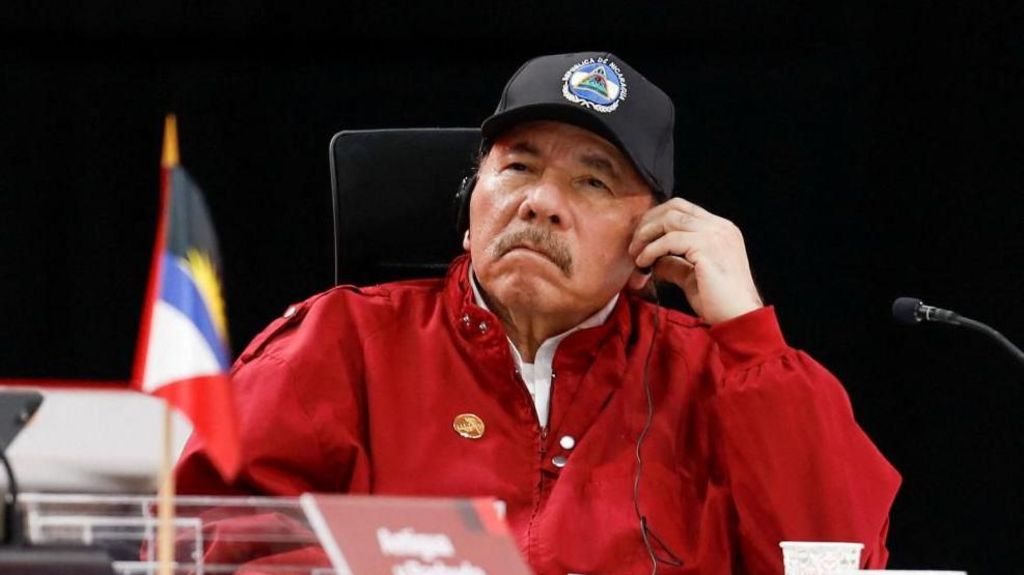
Nicaragua’s government-dominated National Assembly has launched debate on a proposal that would bar all opposition political parties from participating in future elections, with a final vote scheduled for the first week of August. The legislative push comes just days after President Daniel Ortega publicly declared there would be no more opportunities for opposition groups to contest elections in an effort to take national power.
Ortega’s inflammatory remarks drew immediate international pushback, starting with Volker Türk, United Nations High Commissioner for Human Rights, who emphasized that democratic participation requires that people of all political ideological backgrounds be guaranteed the right to both vote and run for public office. Now 80 years old, Ortega has held continuous presidential power since 2007, and his administration has increasingly consolidated authoritarian control over the years: political opponents have been systematically jailed, forced into exile, and stripped of their Nicaraguan citizenship.
The controversial comments were delivered Sunday during a national address marking the anniversary of the 1979 Sandinista Revolution, the leftist uprising that Ortega participated in to oust the U.S.-backed dictator Anastasio Somoza. In his speech, Ortega claimed that Nicaraguan opposition groups are financed by the United States, accusing them of plotting to infiltrate the electoral system and seize power through balloting. He framed the proposed ban as a defensive measure, saying new legislation would build “a wall to block the coup mongers” that would prevent opposition forces from taking power “regardless of how much money they are given by the Yankees.”
U.S. Secretary of State Marco Rubio was among the first global leaders to condemn the plan, saying Ortega’s remarks laid bare the “true authoritarian nature” of his regime. Rubio added that Ortega and his wife Rosario Murillo — whom Ortega appointed as co-president in a 2025 constitutional reform — have “abandoned even the pretense of popular consent.”
Gustavo Porras, president of Nicaragua’s National Assembly, rejected all international criticism in an interview with a pro-government media outlet. He defended the legislative process, saying the body and Nicaragua’s top electoral oversight body are working to ensure “not even a crack” is left open for the opposition to gain any political foothold in the country.
The current political unrest follows a deeply flawed 2021 presidential election, which was preceded by a brutal government crackdown on all viable opposition candidates. Ortega won the one-sided contest after every major challenger capable of drawing significant voter support was either detained, disqualified from running, or forced to flee the country. Dozens of lower-level opposition figures were also arrested, and only a handful of little-known, low-support candidates were permitted to appear on the ballot.
In November 2025, four years into Ortega’s 2021 five-year term, the ruling party-controlled National Assembly passed a unanimous constitutional reform that extended presidential terms from five to six years. The reform also formalized Murillo’s role as co-president, creating a clear line of succession that would allow her to take over the presidency if Ortega, whose health is widely reported to be frail, becomes permanently unable to serve.
Since 2018, when Nicaraguan security forces killed more than 300 people while crushing widespread anti-government protests, most domestic opposition activists have avoided public criticism of the Ortega-Murillo administration for fear of repression. But exiled Nicaraguan opposition leaders have been vocal in their condemnation of the latest proposed ban. Juan Sebastián Chamorro argued that the plan is clear proof Ortega intends to “turn Nicaragua into a one-party country” modeled on Cuba, North Korea, and China. Felix Maradiaga, a former opposition presidential candidate who was jailed by the Ortega regime, told Agence France-Presse that the ban reveals Ortega’s deep fear of popular dissent. “Ortega is admitting what most worries him: he hasn’t neutralized the opposition, he knows the desire for change is still alive, and is still fighting for the country,” Maradiaga said.