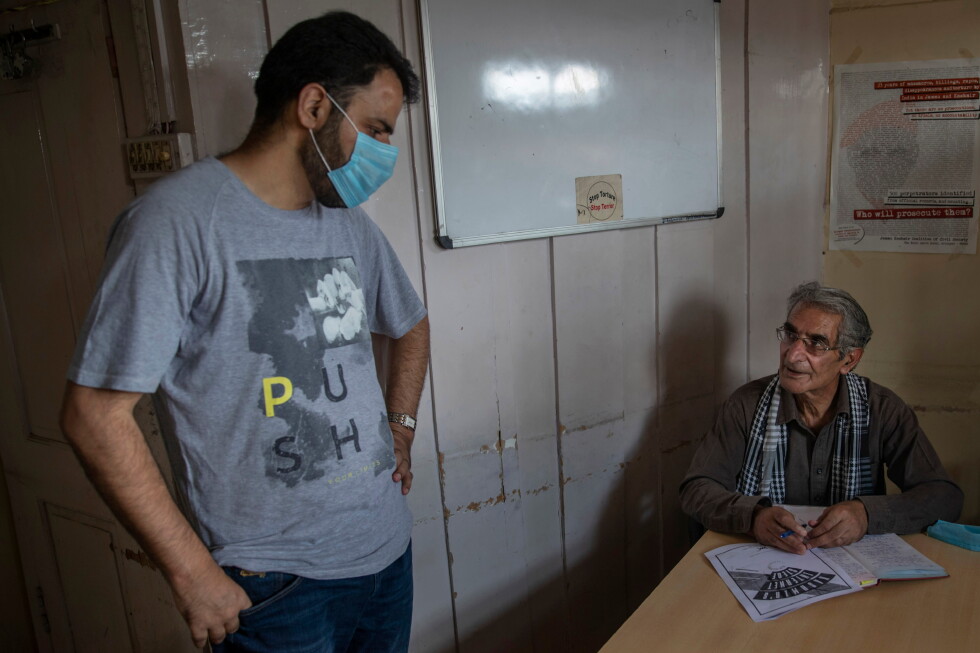
In a closely watched legal development out of India’s capital New Delhi, a prominent Kashmiri human rights campaigner and a respected independent journalist have walked free from jail on bail after years of detention on controversial terrorism financing charges stemming from their work in India-administered Kashmir.
Rights advocate Khurram Parvez was first taken into custody under India’s sweeping Unlawful Activities Prevention Act (UAPA), a strict anti-terror legislation, back in 2021, while journalist and researcher Irfan Mehraj was arrested under the same law two years later in 2023. Though both were released from New Delhi’s Tihar Jail late Wednesday, their freedom remains heavily constrained by strict court-ordered conditions, as India’s federal National Investigation Agency (NIA), the country’s top counterterrorism body, moves to overturn the bail ruling.
The release marks a rare win for critics of the Indian government’s widespread crackdown on dissent in Kashmir, a campaign that has ramped up dramatically since New Delhi revoked the Himalayan region’s long-held semi-autonomous special constitutional status in August 2019. In the years following that policy shift, authorities have used the stringent anti-terror law to detain dozens of rights workers, independent journalists, and political dissidents across the region, drawing widespread international condemnation.
The path to release began last week, when a lower Indian court granted bail to Parvez and Mehraj. The NIA immediately filed an appeal to block the order, bringing the case before the Delhi High Court. On Tuesday, the high court declined to suspend the lower court’s release ruling, but sided with the agency to impose far harsher restrictions on the pair’s movement, association, and public activity while the appeal proceeds through the legal system.
International human rights organizations, including the United Nations’ Office of the High Commissioner for Human Rights, have repeatedly called for the pair’s release for years, arguing their detention was solely a result of their legitimate human rights documentation and journalistic work. Parvez has been a leading figure with the Jammu and Kashmir Coalition of Civil Society (JKCCS), a prominent regional human rights organization that has documented widespread abuses by Indian security forces in Kashmir for decades. Mehraj worked as a researcher with the group alongside his independent journalism.
The NIA’s case alleges that Parvez, Mehraj, and the JKCCS used the organization to channel funding to militant groups and advance a separatist political agenda in the region. Both men have repeatedly and categorically denied all the allegations leveled against them. The JKCCS has become one of the most prominent sources of on-the-ground reporting on human rights violations in Kashmir, publishing in-depth investigations that document what it describes as systemic, routine torture by Indian security forces deployed across the region. India maintains hundreds of thousands of troops in Indian-administered Kashmir, and the JKCCS has repeatedly highlighted that broad legal immunity granted to security personnel has created a culture of impunity that enables ongoing abuse with no accountability.
Following the pair’s release, two leading global human rights groups issued a statement condemning the legal proceedings against them. The Paris-based International Federation for Human Rights and the World Organization Against Torture called the charges against Parvez and Mehraj “trumped-up,” arguing the entire case is a politically motivated effort to discredit both the men and the legitimate human rights work carried out by the JKCCS. The organizations renewed their call for Indian authorities to drop all charges against the pair entirely.
Full legal proceedings against Parvez and Mehraj are set to continue in the coming weeks, with the NIA’s appeal against the bail ruling expected to be heard in the Delhi High Court in the near future.
The Kashmir region has been mired in conflict for nearly 80 years, with both India and Pakistan claiming the entire Himalayan territory. Since 1989, armed militant groups have fought against New Delhi’s rule in Indian-administered Kashmir, where the majority of the population identifies as Muslim, with many supporters backing either unification with Pakistan or full independence for the region.