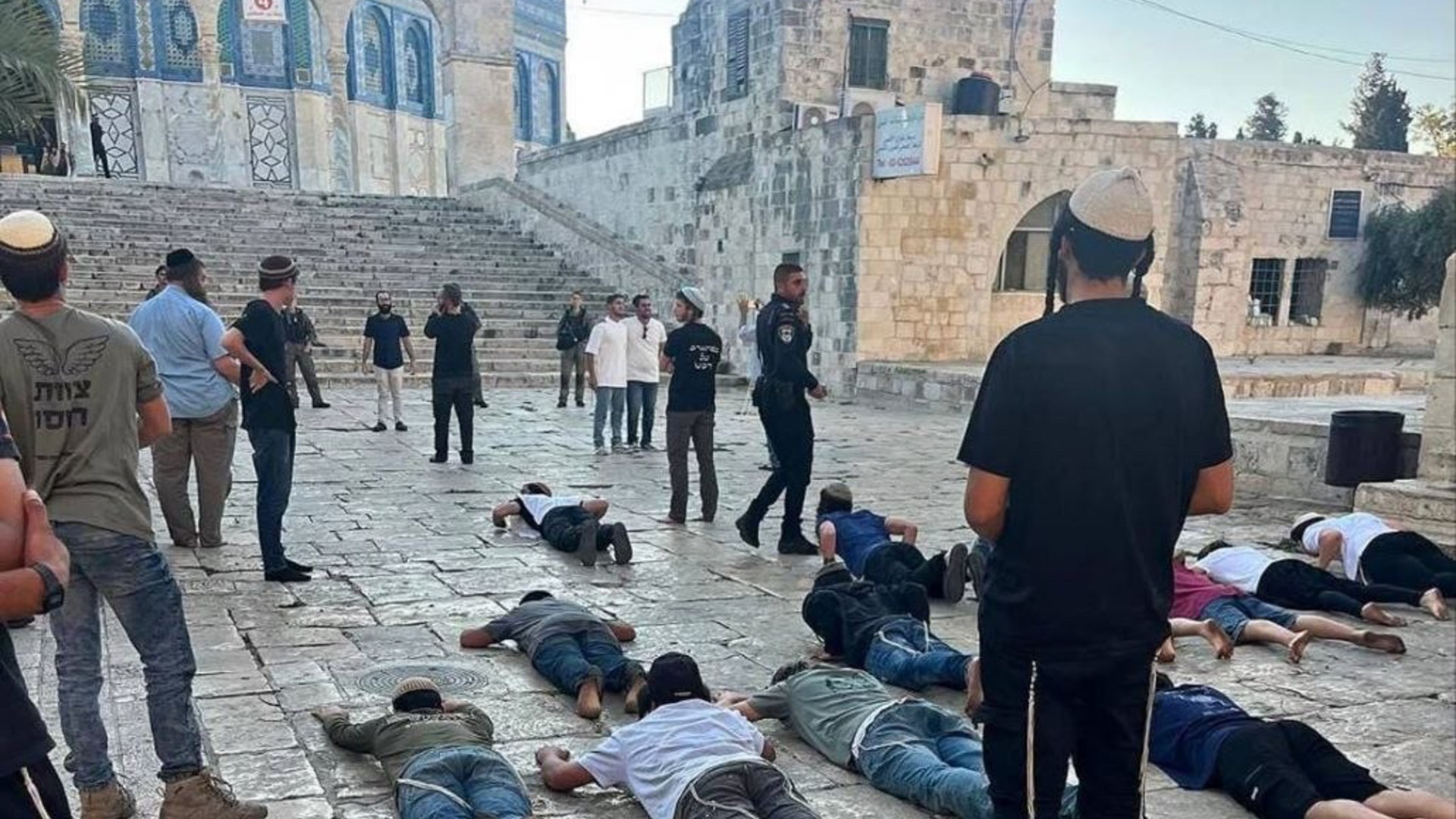
On Thursday, a large-scale incursion into the Al-Aqsa Mosque compound in occupied East Jerusalem was led by senior Israeli government officials and lawmakers, with thousands of ultranationalist Israelis entering the sacred Islamic site under heavy armed police protection, in a move that has sharply escalated regional tensions.
Prior to the entry of Israeli groups, Israeli security forces had blocked hundreds of Palestinian worshippers from reaching the mosque for pre-dawn prayers, forcing many faithful to hold prayer services in adjacent streets outside the complex. By 10 a.m. local time, the Palestinian Ministry of Endowments and Religious Affairs confirmed that at least 2,300 Israelis had entered the mosque’s courtyards, with the incursion expected to continue through midday.
Among the high-profile participants were Itamar Ben Gvir, Israel’s far-right national security minister, and Amit Halevi, a sitting legislator from Prime Minister Benjamin Netanyahu’s ruling Likud Party. The incursion was timed to coincide with Tisha B’Av, a Jewish fast day that marks the destruction of the First and Second Temples in Jerusalem. Ultranationalist Jewish groups that advocate for the destruction of Al-Aqsa Mosque to build a Third Jewish Temple on the site had organized the mass action, originally setting a target of 5,000 participants.
Witnesses on the ground documented participants violating longstanding site rules: they raised Israeli flags across the mosque courtyards, held Jewish prayer services, danced and sang, and even erected a temporary shade tent — all acts explicitly prohibited under the decades-old status quo agreement that governs the site.
The Palestinian Endowment Ministry issued a scathing condemnation of the incursion, calling it a “blatant incursion” led by senior Israeli political figures that represents a gross violation of the site’s Islamic sanctity and a direct attack on the historical and legal status quo at Al-Aqsa. “The entire 144-dunam Al-Aqsa Mosque complex is the exclusive, indivisible right of the Muslim world alone,” the ministry said in a statement, adding that “these provocative actions, carried out at the highest levels of the occupying government, are intended to ignite a religious war across the entire region.”
The status quo, a decades-old arrangement recognized by the international community, designates the entire Al-Aqsa compound as an exclusively Islamic holy site, with full administrative authority over access, worship, maintenance and excavations held by the Jerusalem Islamic Waqf, the Muslim religious trust that manages the site. However, since Israel occupied East Jerusalem in 1967, it has gradually eroded this agreement, seizing control of entry access from the Waqf and facilitating regular daily incursions by ultranationalist Israelis. In recent years, these incursions have grown dramatically in size, drawing tens of thousands of Israeli participants annually.
The Palestinian Authority’s Jerusalem Governorate noted that Israeli authorities relaxed group size restrictions for Thursday’s incursion, allowing groups of up to 150 people to enter at once, compared to the usual cap of around 30. Over the past decade, Israeli officials have also increasingly permitted Jewish prayer and flag displays inside the compound, actions that directly contravene the status quo.
Days before the incursion, Sheikh Ekrima Sabri, senior Al-Aqsa preacher and former Grand Mufti of Jerusalem, warned that Israeli authorities were deliberately exploiting Jewish religious holidays to escalate provocative actions aimed at permanently changing the status of the holy site. He noted that officials have increasingly turned these occasions into opportunities to organize large-scale incursions involving cabinet ministers, senior officials and members of Israel’s parliament, in a bid to normalize the violations and grant them political legitimacy. The incursion proceeded amid widespread silence from the international community and major Islamic organizations, as highlighted in local Palestinian reporting on the event.