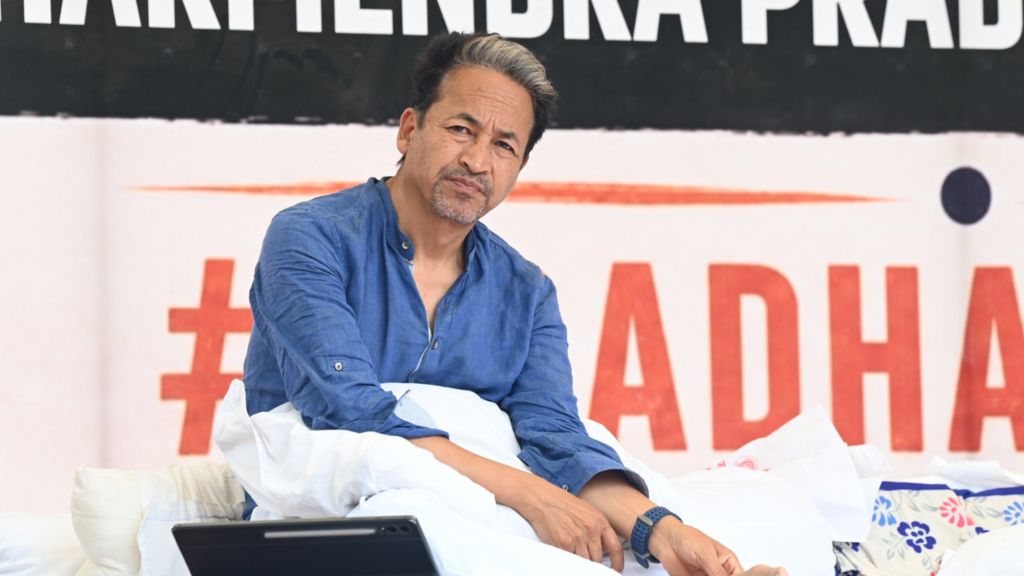
### Delhi Protests Intensify As Iconic Activist Refuses To End 26-Day Hunger Strike
One of India’s most high-profile education reform advocates remains firm in his hunger strike, even as his health declines, drawing tens of thousands of protesters to the streets of New Delhi and sparking one of the most significant political challenges to Prime Minister Narendra Modi’s government in recent years.
Sonam Wangchuk, a renowned Indian educationist and activist popularly known as “Sonam sir” to his supporters, marked 26 days of a water-and-salt-only fast this week. The 26-day strike has already cost him 11 kilograms (24 pounds), but in a video address from his hospital bed, Wangchuk said he remains resolved to keep protesting until the government meets his key demands.
Wangchuk threw his weight behind the youth-led Cockroach Janta Party (CJP) movement, which formed earlier this year after India’s chief justice sparked national outrage by labeling unemployed young activists and aspiring journalists as “cockroaches” (the justice later clarified he only meant people holding fake academic credentials). The movement’s core demands are sweeping national education reforms and the resignation of Union Education Minister Dharmendra Pradhan, who students hold morally responsible for repeated high-stakes public exam leaks, most recently the national medical entrance examination.
The standoff between protesters and authorities turned violent on 20 July, when tens of thousands of demonstrators marched to India’s parliament during the opening of the monsoon legislative session. Police responded to the mass gathering with baton charges and tear gas, leaving at least 60 protesters and 118 police personnel injured. Authorities arrested 70 demonstrators, most of whom have since been released on bail, and dismantled the movement’s stage and makeshift encampment at Jantar Mantar, New Delhi’s iconic long-standing protest site. Despite the crackdown, protesters have refused to vacate the space, maintaining a 24-hour sit-in under heavy deployment of police and paramilitary forces.
Just days after the violent clashes, Wangchuk was forcibly removed from the Jantar Mantar protest site on Saturday and transferred to a hospital in Gurugram, where he was admitted to the intensive care unit on Wednesday. Prior to his hospital admission, Wangchuk spent 21 days fasting in Delhi’s extreme summer heat, surviving only on salt and water. In a Wednesday health update, Medanta Hospital confirmed Wangchuk is being treated by a multidisciplinary team of doctors, noting that his vital signs remain stable and he is fully alert, with all care provided under his informed consent.
Multiple senior political figures, from CJP founder Abhijeet Dipke and dozens of opposition lawmakers to celebrities and Union Health Minister JP Nadda, have publicly urged Wangchuk to end his fast. Nadda, who visited the activist in hospital Tuesday night, said the government is open to holding discussions on the issues Wangchuk has raised. “We inquired about his health and well-being. We also requested him to break his fast, join the mainstream, and guide the children in the right direction,” Nadda told reporters.
Wangchuk has rejected all calls to end his strike, laying out a clear precondition for stopping his fast in a three-minute video address from his hospital bed Wednesday night. “Many leaders, including ministers from the ruling party, have appealed to me to end my fast. I want to do that too because my work is important to me,” he said. “If I receive that assurance soon, I will end my hunger strike today. If not, I will unfortunately have to continue.” Wangchuk’s only stated demand at this time is a formal government guarantee that no force or retaliatory action will be taken against participating student protesters. He praised student demonstrators for their restraint during the 20 July crackdown, noting: “Despite being lathi-charged, they did not retaliate. Seeing the brutal action against them, I decided to continue my hunger strike.”
While Wangchuk’s recent public statements have not repeated the movement’s demand for Pradhan’s resignation, CJP leadership insists that demand remains non-negotiable. “The peaceful protest at Jantar Mantar will continue until Pradhan resigns,” Dipke told supporters this week. “We will not let Sonam sir’s hunger strike go in vain. We will not let the brutal assault on students go in vain.”
As public pressure mounts, authorities have taken additional steps to limit crowd sizes at the protest site: starting Wednesday, 16 central Delhi metro stations were closed without official explanation, a move protesters say is intentionally designed to block new demonstrators from reaching Jantar Mantar.
The protest movement has grown into a national political flash point, with opposition leaders stepping up to express solidarity with demonstrators. On Tuesday, senior Congress Party leader Rahul Gandhi was among the opposition figures staging a demonstration outside Prime Minister Modi’s residence; videos of police dragging Gandhi away from the protest went viral online, sparking widespread public outrage.
After days of silence, Modi broke his public silence on the crisis Thursday with a post on the social platform X, framed as an outreach to India’s youth. “Nothing is more important than the welfare and future of our youth,” he wrote, announcing that the government would establish fast-track courts to deliver quick, strict punishment for anyone involved in organizing exam leaks. “This continues our series of steps for safeguarding the interests of students… Those who try to harm the future of our youth will not be spared.”
Despite Modi’s announcement, protesters show no sign of stepping back, and Wangchuk remains resolved to continue his fast. The movement’s ability to draw tens of thousands of people to the streets has demonstrated that the unregistered, satirical political group has evolved into a major force capable of disrupting national politics, turning a protest over education reform into one of the most high-profile challenges to the current Indian government in recent years.