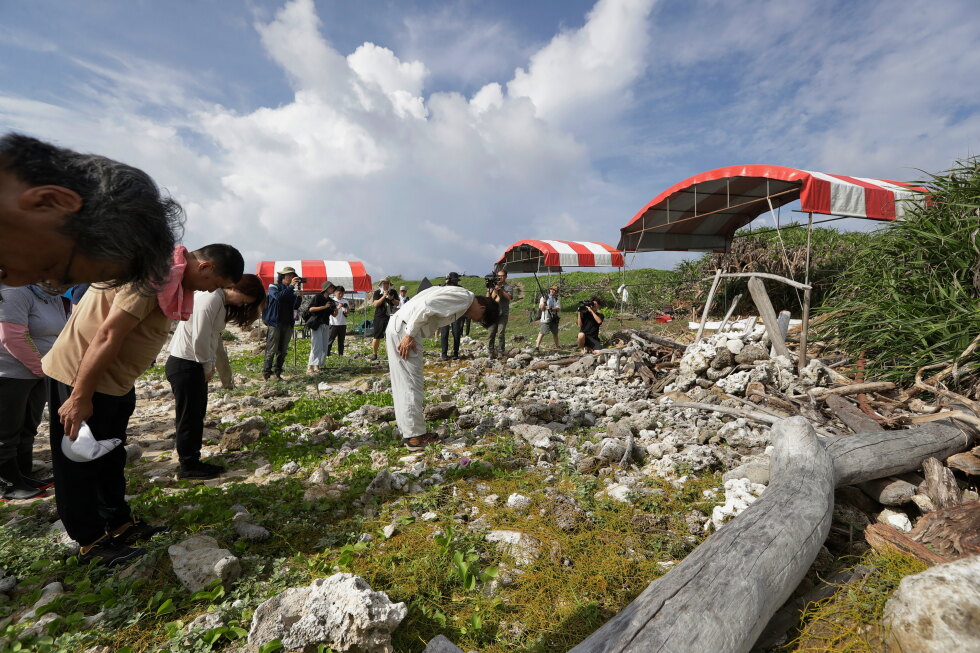
Eighty years after the end of World War II, a new excavation effort to recover the remains of fallen Japanese soldiers kicked off on Monday in Taiwan’s southern Pingtung County, opening a new chapter in a decades-long mission to bring missing service members home to their families. Before digging began at the site in Hengchun Township, participating experts and volunteers stood in silent tribute, heads bowed, honoring the thousands of lives lost in the 1944 Bashi Channel attack.
The excavation targets a site tied to one of the deadliest maritime tragedies of the Pacific War. In 1944, U.S. forces attacked a Japanese military convoy, sinking a transport ship and other accompanying vessels in the Bashi Channel, the body of water that separates Taiwan from the Philippines. Historical data compiled by recovery teams confirms more than 4,700 soldiers and crew members perished in the attack, with only 65 survivors. Historians and local researchers say many of the bodies washed ashore on Pingtung’s rugged coastline, where local residents reportedly gathered the remains and interred them in a rocky area near the discharge outlet of Taiwan’s Third Nuclear Power Plant. That remote site is the focus of the current week-long dig.
The search for the missing soldiers is the product of years of collaborative work between Japanese historians, volunteers based in Taiwan, and local residents who preserved memories of the 1944 tragedy. Teams spent decades collecting oral histories, cross-referencing wartime records, and narrowing down the exact location of the unmarked mass grave to prepare for this excavation. If any human remains are recovered and successfully yield usable DNA samples, they will be repatriated to Japan during a future official mission, under existing recovery protocols.
This dig marks the first large-scale recovery of Japanese WWII remains in Taiwan in nearly half a century, following the last excavation in 1975 that uncovered 242 sets of remains. Official Japanese government records show 41,900 Japanese service members died on Taiwan during the war; of that total, only 26,300 have been recovered to date, leaving more than 15,600 still missing. Globally, more than 1.1 million Japanese WWII soldiers who died overseas have yet to be found, out of a total of 2.4 million overseas fatalities.
In a statement ahead of the excavation, Tatsuaki Inoue, a representative of the Japan Association for the Recovery and Repatriation of War Casualties, acknowledged the long wait for families of the missing. “We feel very sorry that we kept them waiting for such a long time,” he said. “But on the other hand, we are very happy that we came to be able to excavate in search of their remains.”
To accelerate this ongoing national effort, the Japanese government passed a dedicated law in 2016 expanding funding for recovery work and extending official support for the mission through 2030, including scaling up access to DNA testing to identify recovered remains.
Scholars of Japanese wartime history say the persistent push to recover missing remains reflects deep unresolved grief among bereaved families, as well as unique aspects of Japan’s WWII losses. “For bereaved families who have not received the remains of their loved ones, the lack of certainty regarding where and how their relatives met their end — and the feeling that they were unable to give them a proper sendoff — is likely one of the main reasons why the recovery of remains continues even 80 years later,” explained Akira Nishimura, a professor of religious studies at the University of Tokyo. Nishimura added that civil society groups, particularly religious organizations, have played an outsize role in driving recovery efforts and organizing memorials that bring comfort to grieving families, while preserving the memory of the war dead.
Australian Monash University associate professor of Japanese studies Beatrice Trefalt noted that a large share of Japan’s WWII fatalities occurred at sea, leaving no trace of remains and creating persistent uncertainty for families. “Because of the enormous amount of uncertainty about who died or not, or how, the search for remains has been a constant in postwar Japanese history,” Trefalt said, adding that many families maintain the Japanese government has a core responsibility to account for conscripted service members who lost their lives in the conflict.
Kazuko Tachi, a Japanese historian and activist who has led the efforts to recover the Bashi Channel remains, got involved in the work only after relocating to Taiwan, when local residents shared their first-hand memories of bodies washing ashore after the 1944 attack. “Those Taiwanese uncles taught me the importance of holding a memorial service for the war dead,” Tachi said. “It’s been more than 80 years since the war ended but I believe it is important to pray for the war dead, which I will keep on doing.”
In Pingtung, the legacy of the Bashi Channel tragedy is already formally honored at two local memorial sites. Beside Chaoyin Temple, a monument dedicated to the fallen Japanese service members bears an inscription that reads: “We pray for the peace of all humanity in the world.” The temple itself honors those who died in the 1944 attack, holding a Japanese flag alongside a statue of the Buddhist Bodhisattva Ksitigarbha, a figure revered in traditions across East Asia for guiding and protecting the souls of the departed.
Taiwan’s historical context frames this recovery effort: the island was a Japanese colony from 1895 until the end of World War II, and is currently a self-governing entity that China claims as part of its own territory.