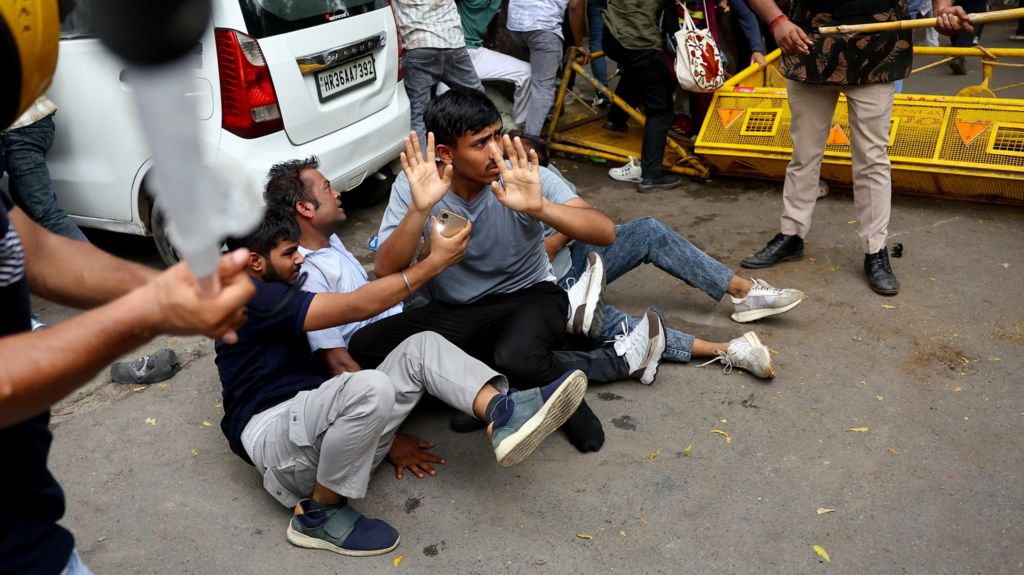
What started as a lighthearted online parody has rapidly grown into one of the most high-profile youth-led mass movements India has seen in recent years. Tens of thousands of Gen Z demonstrators flooded the streets of New Delhi on Monday, demanding the immediate resignation of the country’s top education official and sweeping systemic reforms to India’s troubled higher education examination system.
The unexpected rise of the Cockroach Janta Party (CJP), or Cockroach People’s Party, traces back to an offhand comment made by India’s Chief Justice Surya Kant. During a public court hearing, Kant allegedly compared unemployed young people who turned to journalism and activism to cockroaches and parasites. The justice later walked back the remark, clarifying he was only referring to individuals holding fraudulent academic credentials, not the broader Indian youth population. Even so, the comment struck a nerve. Movement founders reclaimed the derogatory label, and built the group’s name as a playful parody of the ruling Bharatiya Janata Party (BJP), Prime Minister Narendra Modi’s party which has held national power since 2014.
CJP founder Abhijeet Dipke, a 30-year-old political communications strategist and former Boston University student, originally launched the movement as a joke. He shared a simple Google Form to collect sign-ups for the satirical group, never expecting the overwhelming response that would follow: tens of thousands of young Indians signed on almost immediately, transforming the parody project into a bona fide protest organization that channels widespread frustration among India’s disaffected youth.
The catalyst for Monday’s mass capital demonstration was the forced detention and hospitalization of prominent Indian engineer and activist Sonam Wangchuk. The 59-year-old activist had been conducting a 20-day hunger strike at Delhi’s historic Jantar Mantar, a centuries-old public space that has long hosted peaceful political protests, in solidarity with the CJP movement. When authorities forcibly removed Wangchuk and transported him to a hospital on the preceding Saturday, Dipke issued a call for demonstrators to march on India’s national parliament, sparking the mass gathering.
At the core of the CJP’s demands are long-simmering grievances over India’s broken higher education entrance exam system, most recently highlighted by a high-stakes leak scandal involving the National Eligibility cum Entrance Test (NEET), the country’s mandatory entrance examination for admission to all national medical colleges. In May of this year, nearly 2.3 million aspiring medical students sat for the notoriously difficult exam, after months and often years of intense preparation. Just days after the test was administered, authorities were forced to cancel the entire exam following widespread confirmed allegations of question paper leaks. Students were required to retake the exam weeks later under heavy security, a devastating blow that left countless candidates reeling. The CJP and affected student families claim that around 20 aspirants died by suicide as a direct result of the distress caused by the cancelled exam. This is not an isolated incident: the NEET exam was rocked by an identical leak scandal back in 2024, amplifying public anger over the lack of accountability in the system.
Beyond demanding Wangchuk’s immediate release, the CJP is calling for a full overhaul of India’s education system, stricter accountability for repeated exam mismanagement and leaks, and the resignation of Education Minister Dharmendra Pradhan. In the wake of Wangchuk’s detention, Dipke, who has launched his own hunger strike in protest, expanded the demands to call for Prime Minister Narendra Modi to step down as well. Young movement volunteers have embraced the group’s cockroach identity in creative ways: many have appeared at clean-up drives and protests dressed as the insect, turning the derogatory comparison into a unifying rallying symbol.
While it remains uncertain whether the CJP will achieve its stated policy and leadership goals, the movement has already left an indelible mark on India’s national political landscape. Monday’s demonstration marks the largest mass protest against the Modi government in the national capital in recent years, and has drawn high-profile public support from multiple major Indian opposition parties. Congress party president Mallikarjun Kharge condemned the police use of baton charges against protesting students, calling the crackdown an “attack on democracy.” All India Trinamool Congress MP Mahua Moitra joined demonstrators on the streets of Delhi before heading to parliament for official business, and Samajwadi Party chief Akhilesh Yadav released a statement affirming that the gathered students and protesters deserve to be treated with dignity and respect.