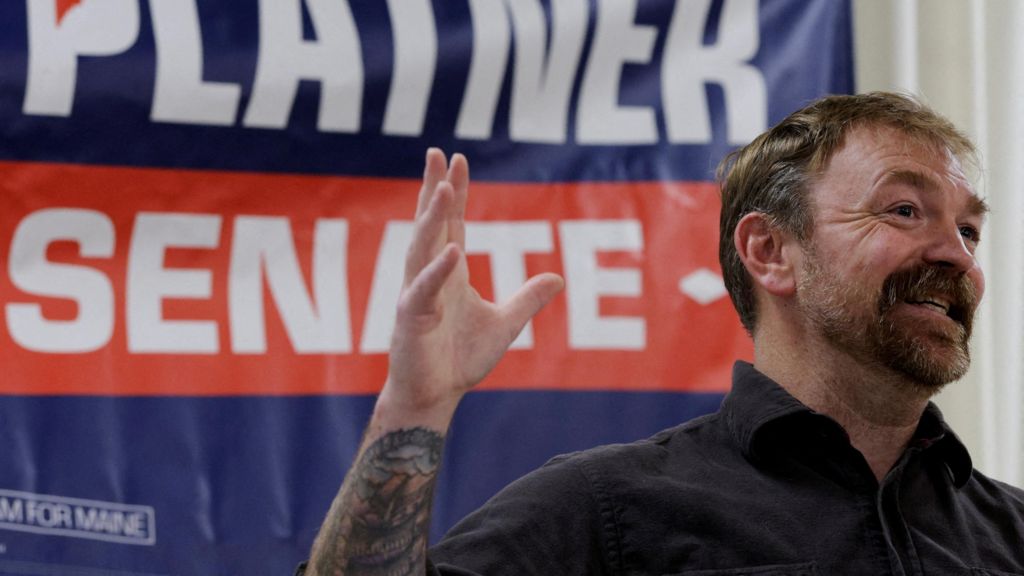
The fight for Maine’s critical U.S. Senate seat has been upended by the expected exit of Democratic candidate Graham Platner, who suspended his campaign following public misconduct allegations, leaving state Democrats scrambling to name a replacement ahead of November’s general election against Republican incumbent Susan Collins.
Platner, who won Maine’s Democratic primary earlier this year running as an outsider with populist policy positions, had been plagued by ongoing misconduct claims throughout his general election campaign. In an 11-minute video announcing his campaign suspension, Platner said he would formalize his withdrawal only once he verifies that the Maine Democratic Party will run an open, transparent candidate selection process. That formal withdrawal is required by a July 13 deadline, just days away from Platner’s announcement, and the party must select a new nominee by July 27.
The race is widely viewed as make-or-break for national Democrats, who are targeting a longshot takeover of Senate control in November. To flip the majority from Republicans, Democrats must unseat Collins — the longest-serving Republican woman in Senate history — hold every one of their current Senate seats, and pick up three additional seats nationwide. A win in Maine is non-negotiable for Democrats to achieve this majority, which they say would let them push back against the policy agenda of President Donald Trump.
Even before Platner officially confirmed his exit, a crowded field of Democratic hopefuls has already stepped forward to declare their candidacy for the open nomination.
Among the early contenders is Nirav Shah, a public health expert who narrowly missed the Democratic gubernatorial nomination in Maine earlier this year. Shah has centered his campaign on the urgent goal of defeating Collins, and called for a transparent selection process that includes at least one televised debate and multiple public town halls to let voters weigh in on the contenders.
Former state senator Troy Jackson, a former logger who also ran in this year’s gubernatorial primary, has also entered the race. Jackson has close ties to Platner: he appeared alongside the former candidate at dozens of campaign events, and he has the implicit backing of Platner’s most prominent national ally, left-wing Vermont Senator Bernie Sanders. Jackson ultimately placed third in this year’s gubernatorial primary.
Jordan Wood, a former U.S. House staffer who unsuccessfully sought the Democratic nomination for a Maine U.S. House seat earlier this year, has switched races to run for the open Senate nomination. Wood has pledged to run a grassroots-funded campaign, rejecting all corporate and lobbyist donations entirely.
Maine Secretary of State Shenna Bellows officially launched her campaign Thursday. Bellows, who also ran in this year’s gubernatorial primary, previously challenged Collins in 2014 and lost. In her announcement, she pledged to unify Maine Democrats and run a campaign centered on working-class interests, focused on overturning the current political system that she says fails most Americans.
Dan Kleban, founder of the popular Maine Beer Company, who suspended his own initial Senate campaign last year, re-entered the race Wednesday ahead of Platner’s announcement. Kleban, who frames himself as a non-career politician, noted he built his small business from a kitchen table operation into a major employer that now supports more than 100 Maine workers.
While speculation has swirled around a potential bid from former Democratic gubernatorial candidate Janet Mills, who suspended her primary campaign once Platner gained momentum, it remains unclear whether Mills — who was backed by Senate Democratic leadership as an establishment-friendly candidate — will rejoin the race. Meanwhile, celebrity speculation around actor Patrick Dempsey, best known for his role on *Grey’s Anatomy*, was put to rest when the Maine native wrote an opinion piece ruling out a run, saying he can best contribute to public service through his existing work. Local media also report that Platner has encouraged state legislator Valli Geiger, a close supporter, to enter the race, but he has not issued a formal endorsement of any candidate to replace him.
All contenders are walking a careful political line: they must embrace the populist policy positions that drove Platner’s primary win, while also proving they have the experience and campaign infrastructure to take on Collins’ well-funded, well-established political operation.
Maine Democrats are moving forward with plans to select a new nominee via a party convention attended by roughly 600 delegates, but the party faces a tight timeline: once a nominee is selected, they will have just four months to unify the party and build voter support ahead of the November election. Despite the last-minute disruption, state party leaders struck an optimistic tone in a post-suspension statement.
“There is an unprecedented amount of energy and enthusiasm among Maine Democrats, driven in part by many of the dedicated volunteers and supporters who were inspired by Graham Platner’s campaign,” the party said. “We look forward to coming together and harnessing that energy around our new nominee as we work to defeat Susan Collins in November.”