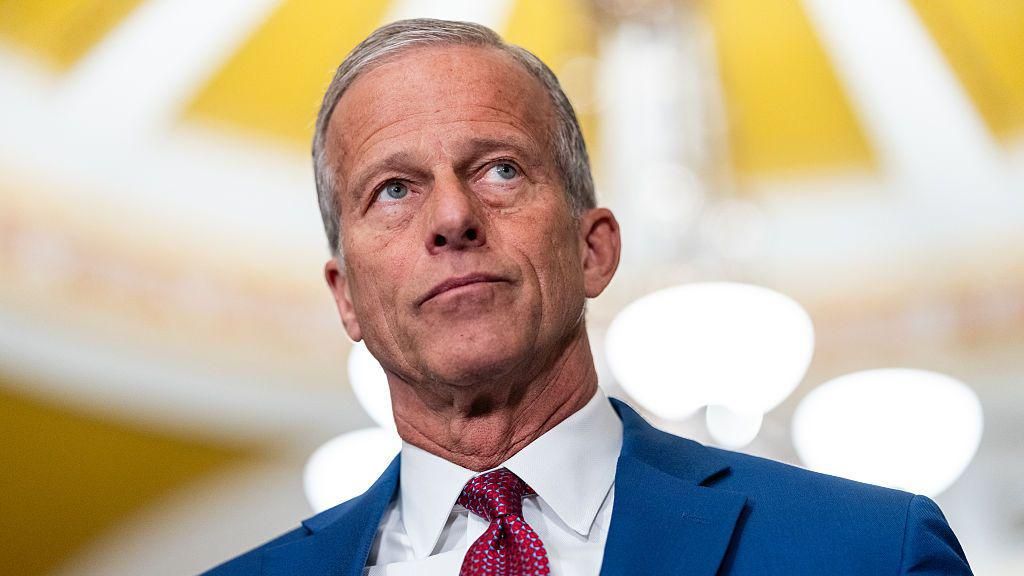
A high-stakes political rift has emerged within the Republican Party, as Senate Majority Leader John Thune has become the most prominent member of former President Donald Trump’s own party to publicly oppose the newly unveiled $1.776 billion “Anti-Weaponization Fund,” a initiative created to compensate people the Trump administration claims were unfairly targeted by prior U.S. presidential administrations.
Thune’s public criticism marks the most significant intraparty pushback against the plan to date. Speaking with reporters on Capitol Hill, the top Senate Republican made his stance clear: he is “not a big fan” of the fund and sees no clear justification for its existence. He added that he remains uncertain of the fund’s intended use, and called for a rigorous full vetting process by congressional lawmakers, noting that the widespread backlash following the announcement guarantees the proposal will face intense scrutiny moving forward.
The fund was announced Monday by the U.S. Department of Justice, as part of a deal that saw Trump drop a $10 billion lawsuit against the Internal Revenue Service (IRS) over the 2020s leak of his personal tax returns to national media outlets. Under the terms of the agreement, Trump, his adult sons Donald Trump Jr. and Eric Trump, and the Trump Organization — all named plaintiffs in the original suit — will receive a formal apology from the agency, but no direct financial compensation. The $1.776 billion funding amount was intentionally chosen to mark the 250th anniversary of the United States’ 1776 declaration of independence from Great Britain.
Governance of the fund will fall to a five-member commission, four of which will be directly appointed by the U.S. Attorney General, a structure that has drawn sharp criticism from lawmakers across the aisle. Democrats have already decried the initiative as an unaccountable “slush fund” designed to direct taxpayer dollars to Trump’s political allies, including many who faced criminal charges or convictions for their role in the January 6, 2021 riot at the U.S. Capitol.
Acting Attorney General Todd Blanche defended the fund during a Tuesday congressional hearing, pushing back against Democratic claims of partisan bias. Blanche argued the initiative is explicitly non-partisan, stressing that no groups are barred from filing claims, including Democrats. While he acknowledged the fund structure is unusual, he noted it is not without precedent in U.S. governance.
Democratic lawmakers rejected Blanche’s defense, with senior Washington Senator Patty Murray calling the initiative open, blatant political corruption. “Trump and his cronies cash it. American taxpayers who are already being whacked with high prices are going to foot the bill,” Murray said during the hearing.
The controversy has already sparked personnel upheaval: just hours after the fund was announced on Monday, Brian Morrissey, general counsel for the U.S. Treasury Department, resigned abruptly after just seven months on the job. Morrissey has not publicly shared his reason for stepping down, but a Treasury Department spokesperson confirmed his departure, noting he served the agency with “honour and integrity.”