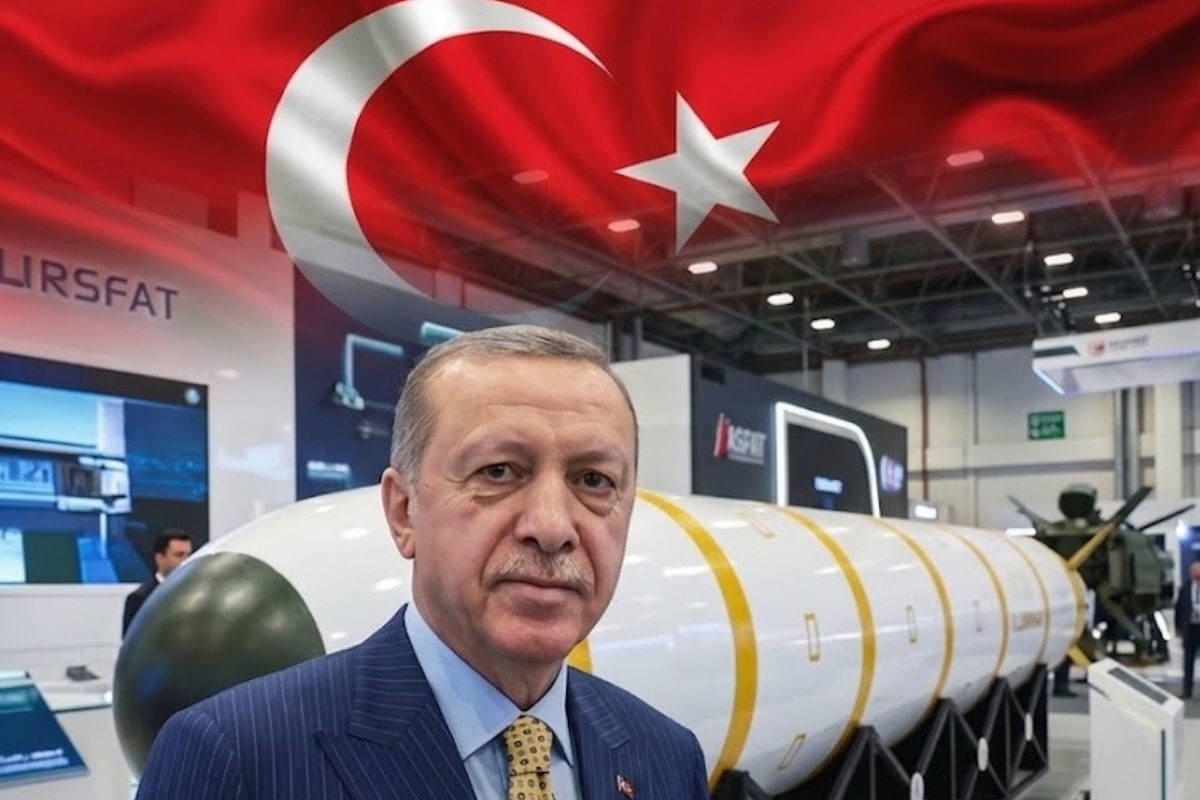
At Istanbul’s SAHA 2026 defense exhibition this month, Turkey pulled back the curtain on its highly anticipated Yildirimhan intercontinental ballistic missile, a flashy reveal that has sparked far more debate about Ankara’s long-term strategic ambitions than the technical capabilities of the weapon itself. What the public saw at the event was only a mock-up of the system, and to date, no fully operational prototype has completed the rigorous full-scale testing required to deploy the missile, leaving major questions about its actual existence as a functional weapons system.
According to statements from Turkish officials, the 18-meter Yildirimhan is designed to carry a 3,000-kilogram warhead across 6,000 kilometers at hypersonic speeds reaching Mach 25. If these specifications are fully realized, Turkey would join an extremely small group of nations capable of fielding ICBM-class weapons that can strike targets across Europe, Africa, and Asia from Turkish territory. However, Western defense analysts and independent missile experts have cast significant doubt on the project, framing it as overly ambitious and far beyond the technological and industrial capabilities Turkey has publicly demonstrated to date.
Beyond the missile’s technical details, the unveiling exposes a major shift in Turkish strategic thinking, shaped by a cascade of regional and global shifts: the ongoing U.S.-Israeli war on Iran, rising instability across the Middle East, and growing skepticism in Ankara about the reliability of NATO security guarantees. The ICBM project is also deeply intertwined with Turkey’s rapidly expanding domestic defense industrial base, its growing homegrown missile development ecosystem, and its parallel ambitions to develop an independent civilian space launch capability. For Ankara, the symbolic power of announcing an indigenous ICBM program matters just as much, if not more, than building and fielding an operational weapon.
Scholars have long traced the evolution of Turkey’s missile program, which originated during the Cold War as Ankara relied entirely on NATO and U.S. nuclear security guarantees. In an April 2026 report for the International Institute of Strategic Studies (IISS), researchers Sıtkı Egeli and Arda Mevlütoğlu note that the program has transformed into a fully indigenous effort, driven by growing regional missile threats, lessons learned from the 1991 Gulf War, and a decades-long push for full defense industrial autonomy.
The ongoing conflict with Iran has emerged as the most immediate rationale for Ankara’s push to develop a long-range deterrent like Yildirimhan. Writing for War on the Rocks in February 2026, analyst Nima Gerami points out that while U.S. and Israeli airstrikes have inflicted heavy damage on Iran’s nuclear enrichment facilities, Iran’s stockpile of highly enriched uranium (HEU) remains largely intact. Gerami cites a recent International Atomic Energy Agency (IAEA) report confirming Iran still holds 440 kilograms of uranium enriched to 60% purity—enough material to produce up to 10 functional nuclear weapons if enriched further. These stockpiles are stored in underground tunnel complexes that have remained structurally intact through multiple waves of strikes, and Gerami notes that repeated military campaigns have actually made the stockpiles harder to locate, rather than easier, allowing Iran’s nuclear program to survive through concealment, dispersal, and gradual rebuilding.
The threat to Turkey from Iran’s capabilities became concrete in the early days of the war, when Iran launched ballistic missile strikes on Turkish territory, targeting the Incirlik Air Base, a critical joint NATO and Turkish facility that hosts between 20 and 50 U.S. B-61 nuclear bombs. As Sinan Ciddi of The National Interest reports in a March 2026 analysis, any successful strike on Turkish soil would force Ankara to retaliate with force, creating an urgent need for long-range deterrent capabilities.
In a February 2026 interview with CNN, Turkish Foreign Minister Hakan Fidan explicitly tied Ankara’s long-range missile efforts to potential nuclear proliferation in the region, stating that Turkey would be forced to develop its own nuclear weapons if Iran moves forward with acquiring a nuclear arsenal. This push is reinforced by growing uncertainty over the reliability of long-standing U.S. security guarantees. Writing for the Council on Foreign Relations (CFR) this month, analyst Liana Fix argues that the Trump administration’s decision to withdraw 5,000 U.S. troops from Germany has severely undermined the credibility of American deterrence across Europe. On top of that, depletions to U.S. weapons stockpiles caused by the Iran War have created delays in missile and interceptor deliveries to NATO allies, further eroding confidence in alliance security commitments.
Russia’s recent use of the Oreshnik conventional intermediate-range ballistic missile (IRBM) against Ukraine has also shaped Turkey’s approach to long-range weapons development, offering a potential template for how conventionally armed long-range systems can function as a deterrent. In an August 2025 peer-reviewed article for the Vojno Delo journal, researchers led by Nenad Miloradović argue that conventionally armed long-range missiles can provide a credible non-nuclear deterrent, capable of penetrating adversary air defenses and striking high-value targets deep inside enemy territory.
However, other analysts have pushed back on the military utility of conventional ICBMs. In a December 2024 analysis for the Royal United Services Institute (RUSI), Sidharth Kaushal and Matthew Savill note that while conventionally armed ICBMs and IRBMs are far harder to intercept than shorter-range systems, they generally lack the precision required to reliably strike tactical military targets with conventional warheads. For point targets like individual buildings, the pair argue, cruise missiles or drones are far more effective, though large ICBM payloads can still be used against area targets like clusters of buildings despite their inaccuracy. Even so, deploying an expensive ICBM to deliver a conventional warhead makes little military or economic sense, leading many analysts to conclude that Turkey’s Yildirimhan reveal is less about conventional deterrence and more about signaling that Ankara has the capacity to deliver nuclear warheads if it chooses to pursue a nuclear weapons program.
Skeptics of overt Turkish nuclear ambitions argue that significant constraints would block any open push for a nuclear arsenal. Writing for New Eastern Outlook (NEO) in February 2026, Alexandr Svaranc notes that as a NATO member, Turkey cannot develop nuclear weapons without formal coordination with the U.S. and United Kingdom. Svaranc adds that strong opposition from Israel and heavy diplomatic pressure from the U.S. would almost certainly block any overt Turkish nuclear program, and that a public push for nuclear weapons could even put Turkey at risk of a pre-emptive Israeli military strike. He also notes that Turkish nuclear ambitions would alarm both Russia and China, given Turkey’s NATO membership and its regional Pan-Turkic policy near Russian and Chinese borders.
Despite these constraints, there is evidence that Turkey is laying quiet, deliberate groundwork for a potential future nuclear program. Writing for the Foundation for Defense of Democracies (FDD) in February 2025, Ciddi points to a 2024 uranium mining agreement between Turkey and Niger, which could help Ankara secure long-term uranium supplies and eventually develop an independent domestic nuclear fuel cycle. Turkey’s expanding civilian nuclear energy program, Ciddi adds, also provides critical infrastructure, technical expertise, and personnel training that could support a future nuclear weapons effort. Ultimately, Turkey’s core goal is achieving full strategic autonomy, and it seeks an independent deterrent to offset Iran’s growing nuclear capabilities in the short term.
Beyond the Yildirimhan ICBM, Turkey already has a suite of potential nuclear delivery systems, including the Cenk medium-range ballistic missile (MRBM), the SOM air-launched cruise missile (ALCM), and Reis-class submarines modified for land-attack missions.
For analysts, whether the Yildirimhan ever becomes a fully operational deployed weapon is ultimately less important than what the project reveals about Turkey’s long-term trajectory. Across an increasingly unstable Middle East, where the regional nuclear balance is shifting rapidly, Ankara is steadily building the industrial, technological, and political foundations for an independent national deterrent—one that will reshape regional security dynamics for decades to come.