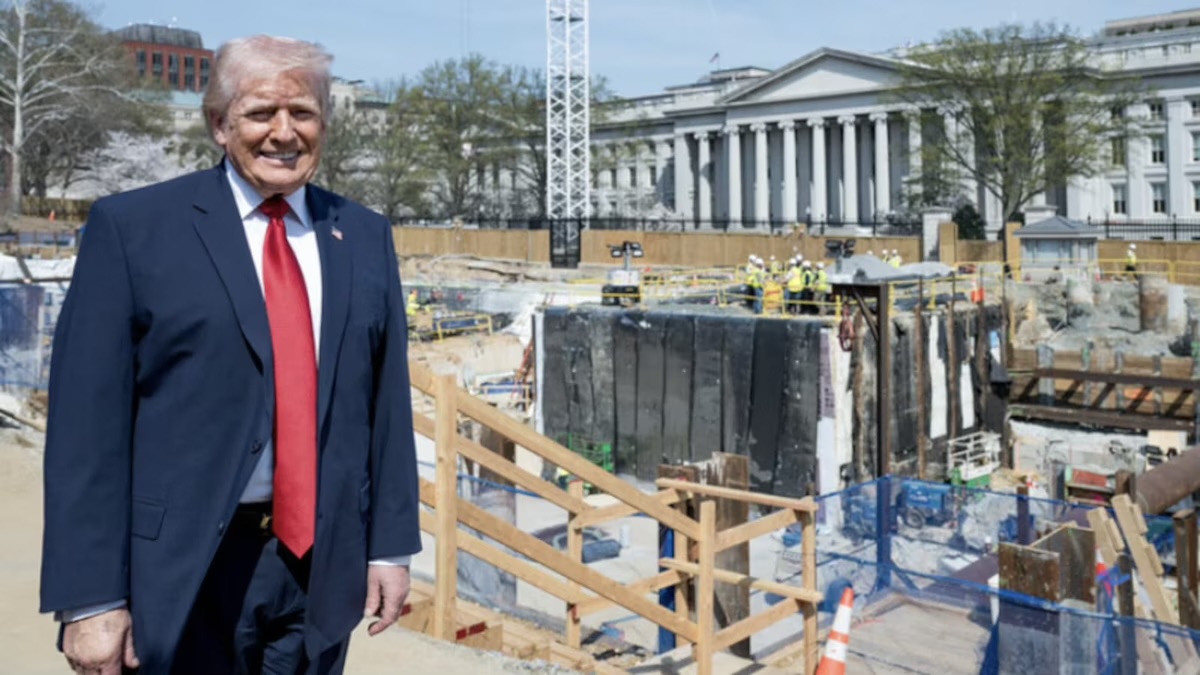
Facing sagging approval ratings that have dropped to the lowest point of his second term in recent public polling, former and current U.S. President Donald Trump used a Tuesday press briefing outside the White House to pivot public attention to the ongoing construction of a luxury ballroom on White House grounds, where he highlighted its unexpected integrated military defense features.
During the exchange with reporters, Trump opened with praise for the planned venue, claiming it will stand as one of the most impressive facilities of its kind once completed. He then centered his remarks on the ballroom’s defensive capabilities, focusing particularly on rooftop drone infrastructure. “On top of the roof, we’re gonna have the greatest drone empire that you’ve ever seen,” Trump told reporters, adding that the system will serve a protective role for the entire city of Washington, D.C.
When pressed by a reporter to offer more detail on the venue’s hidden security features, Trump expanded on the underground components of the construction project. He described the sub-surface sections as far more technically complex than the above-ground ballroom, noting that unseen lower levels house critically important facilities that the U.S. military seized the rare opportunity to develop. “Because what you don’t see are the floors that are beneath here. And they have very, very important rooms down there, very, the most important. This was the one opportunity for the military to do something,” Trump said.
Trump added that construction is progressing ahead of the original timeline, and confirmed the venue will feature a fully sealed, drone-proof roof that doubles as a drone port capable of accommodating an unlimited number of unmanned aerial vehicles, a technology he emphasized is increasingly central to modern security operations.
Beyond the ballroom announcement, Trump doubled down on dismissing widespread public concern over the economic fallout of his unauthorized military conflict with Iran, which has driven U.S. gasoline prices to a national average of $4.53 per gallon as of Tuesday and pushed overall inflation to its highest level since 2023. Framing the higher energy costs as a minor trade-off, Trump told reporters, “This is peanuts… And I appreciate everybody putting up with it for a little while, it won’t be much longer… But I don’t even think about that. What I think about is you can’t let Iran have a nuclear weapon, and they won’t have a nuclear weapon.”
Notably, there is no verified evidence to support Trump’s claim that Iran was close to developing a nuclear weapon when he launched military operations against the country in late February without the required congressional authorization for war. Just one month prior, U.S. Director of National Intelligence Tulsi Gabbard testified under oath before the Senate Select Committee on Intelligence that Iran’s nuclear weapons program had already been completely destroyed in U.S.-led airstrikes the previous year, and that no efforts to rebuild the country’s uranium enrichment capability had been detected in the time since.
Trump’s showcase of new defense-related infrastructure also comes just days after an anonymous White House official leaked an unsubstantiated claim to media outlets that Cuba was preparing to launch a drone attack on the U.S. — an allegation that was widely mocked and dismissed by both the Cuban government and independent policy analysts as absurd.
The president’s Tuesday press briefing followed a major announcement he made Monday on his Truth Social platform, where he revealed he had agreed to delay a planned large-scale military attack on Iran at the formal request of three top Gulf Cooperation Council leaders. In his post, Trump wrote that he had been asked by Qatari Emir Tamim bin Hamad Al Thani, Saudi Crown Prince Mohammed bin Salman Al Saud, and United Arab Emirates President Mohamed bin Zayed Al Nahyan to call off the strike, which had been scheduled for Tuesday, to allow for ongoing diplomatic negotiations to move forward. The leaders have expressed confidence that a negotiated agreement acceptable to both the U.S. and all regional and global stakeholders can be reached, Trump added.
Highlighting the core non-proliferation demand of the U.S., Trump emphasized in his post that any final deal will include a critical provision barring Iran from ever developing nuclear weapons. He went on to confirm that out of respect for the allied leaders, he has directed Secretary of War Pete Hegseth, Joint Chiefs of Staff Chairman General Daniel Caine, and the entire U.S. military to stand down from the scheduled attack. However, he added that U.S. forces remain on high alert and ready to launch a full-scale offensive against Iran at a moment’s notice if negotiations fail to produce an acceptable agreement.
Reacting to Trump’s announcement on X (formerly Twitter), Trita Parsi, co-founder and executive vice president of the Quincy Institute for Responsible Statecraft, offered a measured assessment of the development. Parsi concluded that “once again, Trump has realized that escalation will end up badly for the U.S. That does not necessarily mean, though, that the necessary realism, discipline and creativity will be mustered for the talks.”