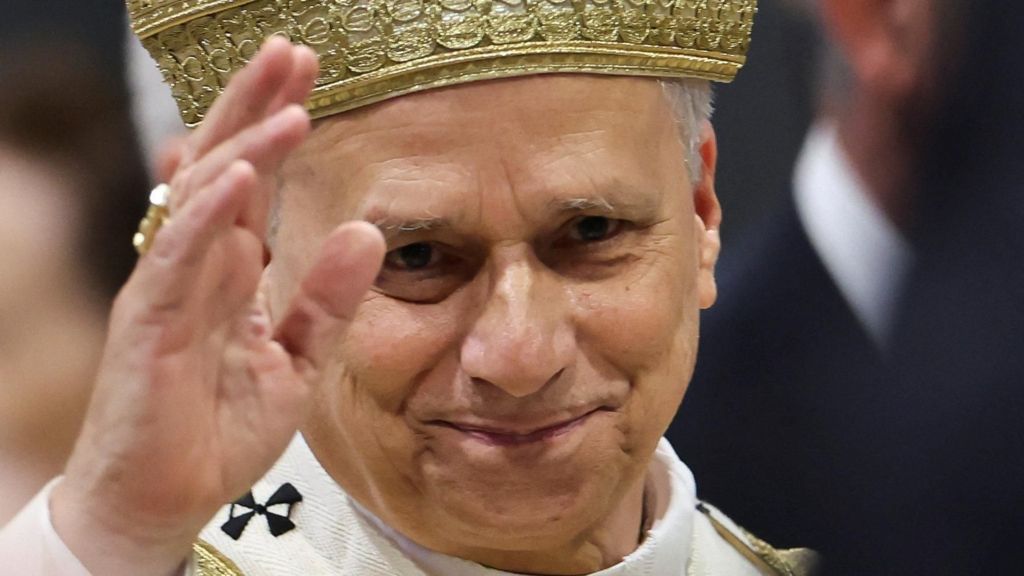
A high-profile public disagreement between former U.S. President Donald Trump and Pope Leo has taken center stage in global diplomatic discourse, centered on competing stances toward the ongoing Middle East conflict, just as U.S. Secretary of State Marco Rubio prepares for a key two-day visit to Vatican City and Italy.
The core of the conflict stems from Pope Leo’s consistent, vocal opposition to the U.S.-Israeli military campaign against Iran. In a recent public statement, the pontiff reaffirmed his long-held pacifist position: as a spiritual leader, his core mission is to spread the Gospel and advocate for global peace, and he will not step back from that calling even in the face of harsh political criticism. “The mission of the Church is to preach the Gospel, to preach peace,” Pope Leo told reporters ahead of Rubio’s arrival. “If someone wants to criticize me for preaching the Gospel … I hope simply to be listened to because of the value of God’s words.” Last month, he doubled down on this stance, noting, “As a pastor, I cannot be in favour of war. I would like to encourage all to make efforts to look for answers that come from a culture of peace and not from a place of hate and division.”
Trump has repeatedly lashed out at the Pope over these anti-war remarks, distorting the pontiff’s position to claim Pope Leo supports Iran acquiring nuclear weapons—a claim Pope Leo has never made. In an interview with conservative radio host Hugh Hewitt this week, Trump argued that the Pope’s stance is “endangering a lot of Catholics and a lot of people.” On social media, Trump went further, attacking Pope Leo’s character and legitimacy, claiming he was only elected to the papacy because church leaders picked an American to curry favor with his administration, writing “If I wasn’t in the White House, Leo wouldn’t be in the Vatican.” He also labeled Pope Leo “WEAK on crime” and “terrible for Foreign Policy.” After that social media post, Trump drew widespread backlash for sharing an edited image that depicted him as a Jesus-like figure; he later tried to downplay the incident, telling reporters he believed the image showed him as a doctor before the post was removed.
Several top U.S. officials have lined up to support Trump’s criticism of the Vatican. Vice President JD Vance, a convert to Catholicism, argued that the Vatican should “stick to matters of morality” rather than weigh in on international military policy. Even so, U.S. Ambassador to the Holy See Brian Burch has sought to downplay tensions between the two governments, telling reporters this week that there is no “deep rift” between Washington and the Vatican. “Nations have disagreements, and I think one of the ways that you work through those is … through fraternity and authentic dialogue,” Burch said. He added that Rubio’s scheduled meetings with Vatican and Italian leaders will create a structured space to work through any existing differences.
The disagreement has also created friction between Trump and Italian Prime Minister Giorgia Meloni, once a close political ally of the former president. Meloni, who has also criticized the Middle East conflict, has publicly come to Pope Leo’s defense. When reporters asked whether she would meet with Rubio during his visit, she simply confirmed, “I think so.”
Rubio, a Catholic himself, is set to hold a series of meetings with both Vatican officials and Italian government counterparts during his trip. A spokesperson for the U.S. State Department confirmed that the official agenda for the visit includes advancing bilateral relations between the U.S. and both Italy and the Vatican, discussing the ongoing crisis in the Middle East, and aligning on mutual interests in the Western Hemisphere. The visit comes as diplomatic positioning around the Middle East conflict continues to split global leaders, with this high-profile clash between a sitting pontiff and a former U.S. president putting new attention on the rifts over the war.