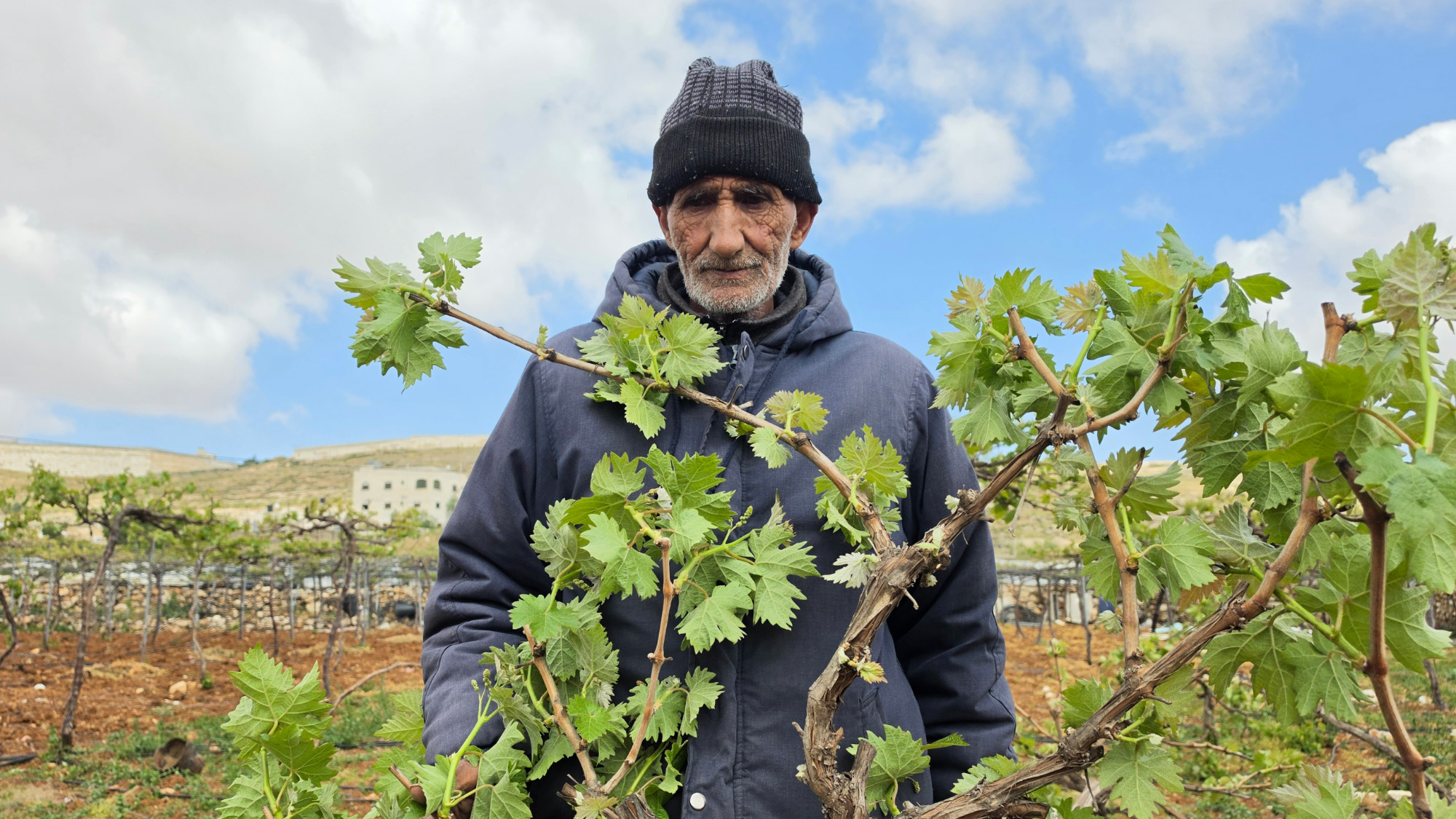
Deep in the fertile Baqa’a Valley east of Hebron, in the Israeli-occupied West Bank, 68-year-old Palestinian farmer Zuhur Tarwa stood frozen in disbelief when Israeli military markings suddenly stretched across the vineyard she had nurtured for years alongside her two daughters. For seasons, the couple’s 200 grapevines had grown lush with broad green foliage, building anticipation of a bountiful annual harvest. That harvest never came: first the official confiscation order arrived, and within days, bulldozers rolled onto the land.
“They razed the entire plot, uprooting every grapevine and every other crop we had growing,” Tarwa told Middle East Eye in an interview days after the destruction. “All we are left with now is grief at this empty sight.”
Tarwa’s family’s devastating loss is not an isolated incident. It is part of a growing, systematic pattern of land seizure unfolding across Hebron, a region long celebrated for growing some of the finest grapes in the Middle East. The Israeli military has recently seized large tracts of privately owned Palestinian agricultural land to expand Route 60, a major highway that connects Israeli settlements scattered across the West Bank. The 235-kilometer road expansion project has already required the seizure of tens of thousands of dunams of Palestinian-held land, according to local and official records.
Bulldozing operations began earlier this week across multiple districts of Hebron, with local grassroots sources confirming that at least 400 dunams of productive vineyards, holding roughly 40,000 mature grapevines, have been destroyed so far. Tarwa’s daughters owned 2.8 dunams of the seized land; adjacent property belonging to Tarwa’s brother-in-law has already been reduced from a thriving cultivated vineyard to barren, cleared dirt. “Nothing can stop their plans or their heavy machinery,” Tarwa said. “We are powerless here—all we can do is mourn what we’ve lost.”
For Hebron’s Palestinian communities, grapes are far more than just a commercial crop. They are a centuries-old symbol of cultural identity, deeply rooted in the land, and a core source of household income for hundreds of families. Grapes rank as Palestine’s second-largest agricultural product, only behind olives, with dozens of families in the al-Baqa’a Valley relying entirely on grape cultivation to make ends meet. The entire Baqa’a region, which spans roughly 10,000 dunams of fertile soil stretching from Beit Einun and Bani Na’im to the Qizoun area, counts among the most productive vineyard regions in the entire West Bank.
For decades, Israeli forces and civilian settlers have targeted Palestinian olive groves, destroying a critical livelihood asset for thousands of families across the occupied territories. In recent years, this systematic pressure has expanded to include vineyards, concentrated heavily in the Hebron and Bethlehem regions. The latest round of bulldozing and land seizure comes just weeks ahead of the annual grape harvest, compounding the financial and emotional harm for affected farming households.
Atta Jaber, an anti-settlement activist who owns family vineyards in the Baqa’a Valley, explained that the ongoing confiscations and destruction are a deliberate strategy to force Palestinian farmers off their ancestral land. Jaber’s own family has cultivated grapes in the region for more than a century, and has already lost swathes of property to previous Israeli seizures: part of their land was taken in 1970 to build the Kiryat Arba settlement, with additional land seized in 1985 for the construction of the Kharsina settlement. Beyond the loss of farmland, the expansion of settlements has also led to home demolitions and the displacement of dozens of local Palestinian families.
“In 1995, Israeli bulldozers suddenly arrived to pave the first iteration of Route 60 through our land,” Jaber recalled. “That was our third major loss after the two settlements were established, and it cut off the livelihoods of nearly 800 Palestinian families in this area alone.” Before the latest round of uprooting, Jaber’s vineyard generated a minimum of 60,000 Israeli shekels, around $20,000, in annual income, money that supported his entire extended family. “I care for my grapevines like my own children,” he said. “We have no other source of income here—this is how we were raised, and what we pass down to our children: the land is everything, it is our livelihood and our future. But Israel is systematically destroying all of that.”
Data collected by Palestinian advocacy groups confirms that the targeting of Palestinian fruit trees by Israeli forces and settlers has escalated sharply in recent years, shifting from scattered, isolated incidents to a consistent, systematic pattern across multiple regions of the West Bank. Figures from the Wall and Settlement Resistance Commission show that approximately 35,273 olive, grape, and fig trees were either uprooted, damaged, or poisoned in 2025 alone—a statistic that highlights the severe damage to Palestinian farmers’ livelihoods and the wider agricultural sector of the occupied territories.
Across the West Bank and Gaza Strip, tens of thousands of dunams of land are dedicated to grape cultivation. According to Mahmoud Fatafta, spokesperson for the Palestinian Ministry of Agriculture, Hebron and its surrounding northern regions alone hold around 37,500 dunams of cultivated grapevines. In the Baqa’a Valley specifically, roughly 1,300 dunams are planted with grape vines, producing an estimated 13,000 tonnes of table grapes and 1,000 tonnes of grape leaves for commercial sale each year, Fatafta told Middle East Eye.
Despite the region’s natural fertility and generations of agricultural expertise, Palestinian agricultural officials warn that the grape sector now faces existential threats, including repeated land confiscations that have shrunk total cultivated areas, as well as ongoing attacks on vineyards and farmers by Israeli settlers. Fatafta confirmed that around 200 dunams of vines have already been bulldozed and uprooted in al-Baqa’a, warning that destruction operations are continuing in what he calls a deliberate, systematic campaign to eliminate Palestinian vineyard cultivation in the region.