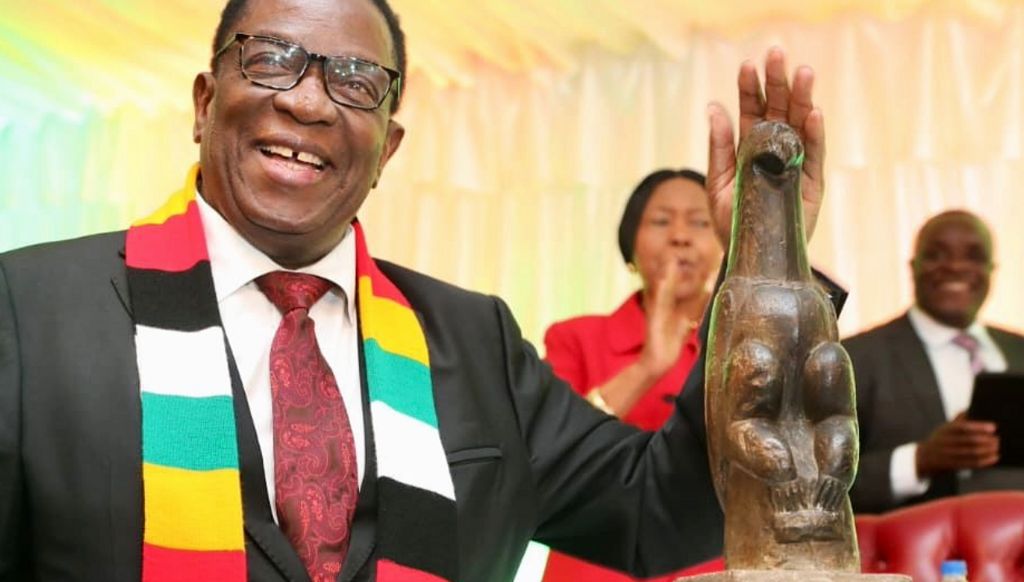
For more than a century, a gap has sat in Zimbabwe’s national heritage: one of eight iconic ancient soapstone bird sculptures, looted by colonial invaders and scattered across the globe, remained outside the country’s borders. That changed this week, when the final missing Zimbabwe Bird touched down on home soil 137 years after it was ripped from its original place at the Great Zimbabwe ruins, in a landmark repatriation organized by neighboring South Africa.
Known globally as the Zimbabwe Bird, this stately eagle carving has been embedded in the country’s national identity for generations, featured prominently on Zimbabwe’s flag, banknotes, and official coat of arms. But few symbols carry as layered a history as this carving, one that traces a long arc of colonial theft, decades of diplomatic negotiation, and a growing global movement to return looted African cultural heritage.
The eight original bird sculptures were carved between the 11th and 15th centuries for Great Zimbabwe, a sprawling medieval stone city that gave the modern nation its name — Zimbabwe translates to “house of stone” in local languages, and the country remains celebrated worldwide for its contemporary stone carving tradition. The birds, ranging from 25 centimeters to 50 centimeters in height (and reaching more than a meter when mounted on their original columns), were placed on walls and stone monoliths to watch over the city.
Scholars have not reached a consensus on which ethnic group originally created the carvings, though many believe they are the work of ancestors of the Shona people, who make up Zimbabwe’s current majority population. The birds carry deep cultural and spiritual meaning: most experts agree they depict either the bateleur eagle (called *chapungu* in Shona, a sacred species to both Shona and Venda communities) or the African fish eagle. Plan Shenjere-Nyabezi, an archaeology professor at the University of Zimbabwe, calls the Zimbabwe Birds “the most significant archaeological treasures ever discovered in the country, powerful and cherished symbols of our national heritage.”
The theft of the final bird began in 1889, when European hunter Willi Posselt stumbled on the Great Zimbabwe ruins amid a wave of pre-colonial exploration. According to Posselt’s own writing, local people armed with spears and guns initially protested his removal of what he called the “best specimen” of the birds, but he ripped the carving from its column after exchanging blankets and other goods for access. He ultimately sold the sculpture to Cecil Rhodes, the infamous British imperialist who led the colonization of what is now Zimbabwe and Zambia. Rhodes displayed the bird as decorative art at his lavish Cape Town estate, where it remained for more than a century after his death in 1902.
Over the decades, the other missing birds slowly made their way home. After Zimbabwe gained independence in 1980, the new government launched a formal campaign to recover all eight carvings, with only two remaining within the country’s borders at the time. In a striking 1981 trade, South Africa’s apartheid government returned four birds it held in a national museum in exchange for a collection of 1,000 insect specimens from Zimbabwe’s Natural History Museum. Germany followed suit in 2003, repatriating a soapstone pedestal fragment that had been held in Berlin’s Ethnological Museum since 1907.
But the final bird held by South Africa was blocked for decades by a century-old legal barrier. When Rhodes died, his 1902 will vested his estate and all its contents to the South African government, and the 1910 Rhodes Will Act banned the sale or transfer of any of his possessions. Every request for repatriation from Zimbabwe was rejected on the basis of this law, according to South African Minister of Culture Gayton McKenzie.
This week, South Africa overcame that legal obstacle to complete the handover, alongside the repatriation of eight sets of Zimbabwean human remains exhumed by colonial researchers and held in a South African museum. McKenzie called the removal of the remains a product of “misguided colonial pseudoscience,” noting “these are not abstractions, but people… removed from their graves, their communities, and their homeland under the logic that their bodies were data.”
To get around the 1910 Act, South Africa initially arranged a two-year loan of the sculpture to Zimbabwe, but McKenzie has confirmed that the South African government is currently reviewing the century-old law to formalize permanent repatriation, and insists the bird will never be returned to South Africa. The handover was welcomed by Zimbabwean President Emmerson Mnangagwa, who called the moment “the return of a national icon.”
The repatriation marks a rare milestone in the global movement for the return of looted African artefacts: while most repatriations to date have come from European colonial powers including France, the Netherlands, Germany, and the United Kingdom, this transfer sees an African nation returning stolen heritage to another African country. Zimbabwe continues to push for the repatriation of other cultural items, including the skulls of 19th-century anti-colonial heroes believed to be held in the UK.
For Zimbabwean leaders and scholars, the return of the final bird is more than a cultural victory — it is a spiritual homecoming. The carving will be placed on permanent display at an on-site museum at the Great Zimbabwe UNESCO World Heritage Site, where it will join the seven other recovered birds for preservation. “The bird is Zimbabwe’s heritage… one should not have to travel to other countries to enjoy their own heritage,” said Shenjere-Nyabezi.
Edward Matenga, one of Zimbabwe’s leading scholars of the Zimbabwe Bird sculptures, described the handover as a “win-win” for both nations, calling it a cathartic step for South Africa to confront its colonial legacy. The arrival of the bird also came just days ahead of Zimbabwe’s independence anniversary, with Mnangagwa noting the timely homecoming: “Let the people of Zimbabwe come and witness. Let the children of this great nation see with their own eyes the symbol of their identity and let the world know Zimbabwe is a nation that respects its past.”