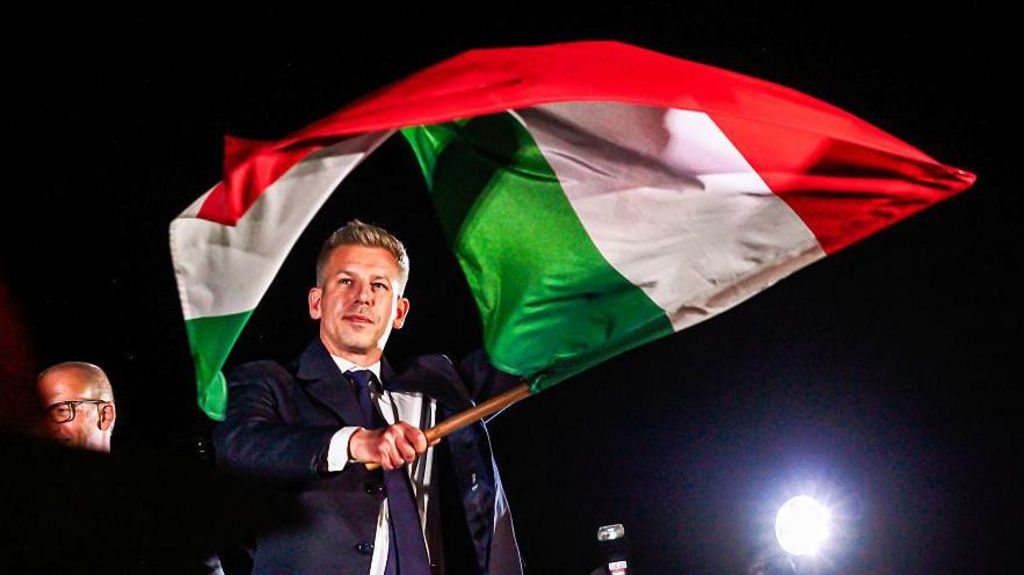
Hungary’s political landscape has undergone its most seismic shift in nearly two decades, after newcomer Péter Magyar and his Tisza Party secured a dramatic landslide victory in last Sunday’s national election, ending Viktor Orbán’s 16 years of uninterrupted governance. With final vote counts set to be formalized this Saturday – including recounts for closely contested constituencies and the tabulation of overseas ballots – preliminary results give Tisza 52% of the popular vote, translating to roughly 140 seats in the 199-seat National Assembly, enough for a commanding two-thirds supermajority. Orbán’s long-ruling Fidesz party has plummeted from its previous 135 seats to just an estimated 55, a collapse that has sent shockwaves through the party that once dominated every level of Hungarian politics.
Within days of the victory, Magyar moved quickly to lock in a timeline for power transition. He secured a commitment from Hungarian President Tamás Sulyok to bring forward the convening of the new parliament to the week starting May 4, when the body will vote to install the new Tisza-led government. In a marked break from the past two years, when state broadcasters largely sidelined or attacked Magyar, he gave fiery interviews to public television and radio, and has pledged to introduce legislation to suspend the outlets’ current programming until independent, impartial editors can be appointed to replace the outgoing leadership aligned with Fidesz.
Buoyed by his supermajority, Magyar has also announced plans to retroactively cap the number of consecutive terms a sitting prime minister can serve at two. With Orbán already having held the post for five terms, the reform would permanently block the former leader from returning to the country’s highest office, effectively closing the book on his decades-long political dominance.
It was not until late Thursday, four days after the election defeat, that Orbán finally broke his public silence in an interview with his party’s Patrióta YouTube channel. Acknowledging the historic shift, the ousted prime minister called the result “the end of an era”, saying he would accept the outcome with dignity. He opened up about feeling “pain and emptiness” from the loss, and took full personal responsibility for the defeat, though he offered little in-depth analysis of the campaign’s missteps beyond highlighting the years-long delay of the Russian-designed Paks 2 nuclear power plant, which is now six years behind its original completion schedule.
Orbán met this week with the Hungarian president, but slipped into the building through a side entrance to avoid questions from the press. Fidesz has scheduled a top leadership meeting for April 28, ahead of a full party congress in June, where the party will chart its future as an opposition bloc. Orbán indicated that he would be willing to stay on as party leader if re-elected by members, but admitted the party requires “complete renewal”. Of Fidesz’s 55 incoming parliamentary seats, only 12 are won by individual constituency candidates, with the rest coming from party lists. Orbán argued that many of the list-based deputies need to be replaced, as they have no experience working in opposition, a rare admission of weakness for a party where public dissent has long been uncommon.
Within Fidesz, there is no clear successor to Orbán, and no current figure matches his unique political skill and charisma for unifying competing factions within the party. Senior party insiders told the BBC that Fidesz faced an impossible structural challenge after 16 years in power: it could not credibly position itself as a force for change, even as voters grew hungry for turnover. Campaign advisers from the U.S. and UK had already criticized Fidesz’s core slogan, “the safe choice”, for alienating the large bloc of young Hungarian voters hungry for change. To counter this perception, Orbán leaned heavily on two younger senior cabinet members – 47-year-old Foreign Minister Péter Szijjártó and 51-year-old Transport Minister János Lázár – to headline campaign rallies, but the strategy backfired: their energy only highlighted how aged and worn Orbán, who turns 63 next month, appeared after 38 years of frontline politics. The result is a mood of fear and internal recrimination sweeping through the defeated party.
In Budapest, widespread anger at the outgoing government has already boiled over into public view, with nearly every Fidesz campaign poster defaced across the city center. Most have the word “Vége” – Hungarian for “the end” – spray-painted across Orbán’s face, while others have been torn down or covered in expletives. The sudden collapse of Fidesz’s public popularity, even among some former supporters, has been one of the most striking aspects of the election result.
For Magyar and his incoming administration, the top immediate priorities are stopping capital flight by oligarchs closely aligned with Fidesz – many of whom are rumored to be moving assets to popular destinations like Dubai – and preventing the destruction of corruption evidence in government ministries. While some outgoing officials have been shredding documents in government offices, two Tisza insiders told the BBC that multiple current civil servants have already reached out to the incoming team, offering digital copies of incriminating records on USB drives in exchange for job security or immunity from future prosecution. Tisza also alleges that in the final week before the vote, as polls consistently predicted a large Tisza majority, Fidesz rushed through dozens of no-bid contracts for IT, infrastructure, and research projects to hand-picked allied companies, locking in public spending commitments that will carry over to the new government.
The tough rhetoric coming from Tisza leadership is both a reflection of popular anger and a calculated political move, after two years of sustained demonization of Magyar and his party by the Fidesz-controlled Central European Press and Media Foundation (Kesma), which controls 476 media titles including roughly 50 major news outlets. Beyond media reform, Magyar has already reaffirmed key campaign pledges: establishing a dedicated office to recover state assets stolen under the previous government, and bringing Hungary into the Luxembourg-based European Public Prosecutor’s Office (EPPO), a move designed to signal to the European Union that the new government is serious about tackling corruption.
Magyar has already held talks with Zsolt Hernádi, CEO of Hungarian energy giant MOL, which operates critical refineries serving both Hungary and Slovakia. On energy policy, the incoming prime minister agrees with Orbán on one urgent priority: the reopening of the Druzhba oil pipeline from Russia, which has been closed since late January. Ukrainian President Volodymyr Zelensky indicated this week that flows could resume by the end of the month, though Magyar has stressed his commitment to diversifying Hungary’s energy supplies, particularly by expanding capacity on an alternative pipeline from Croatia’s Krk Island.
Exit polling estimates show nearly three-quarters of voters aged 18 to 29 backed Tisza, a generational rejection of Orbán’s long rule. Réka Szemerkényi, a former Hungarian ambassador to the U.S. under Orbán who is now based at Budapest’s Equilibrium Institute, told the BBC that young voters sent a clear policy message with their votes. “The chants were ‘Ria, Ria Hungaria’ – meaning we love our country – then ‘Europa’, and the third I heard repeatedly was ‘Russians go home’. These three together are like a foreign policy agenda,” she explained.
International reaction has been swift, with a high-level delegation from European Commission President Ursula von der Leyen’s office arriving in Budapest on Friday for informal talks with Tisza’s leadership. The new Hungarian government stands to unlock €17 billion (£15 billion) in frozen EU funds that were withheld from the Orbán government over concerns about rule of law and corruption, but will need to meet 27 strict benchmarks on judicial independence, anti-corruption enforcement, and media freedom to access the money. With Hungary’s economy already mired in a deep recession, Magyar and his team have made clear they know they need to deliver results quickly to meet the high expectations of voters who swept them into power.