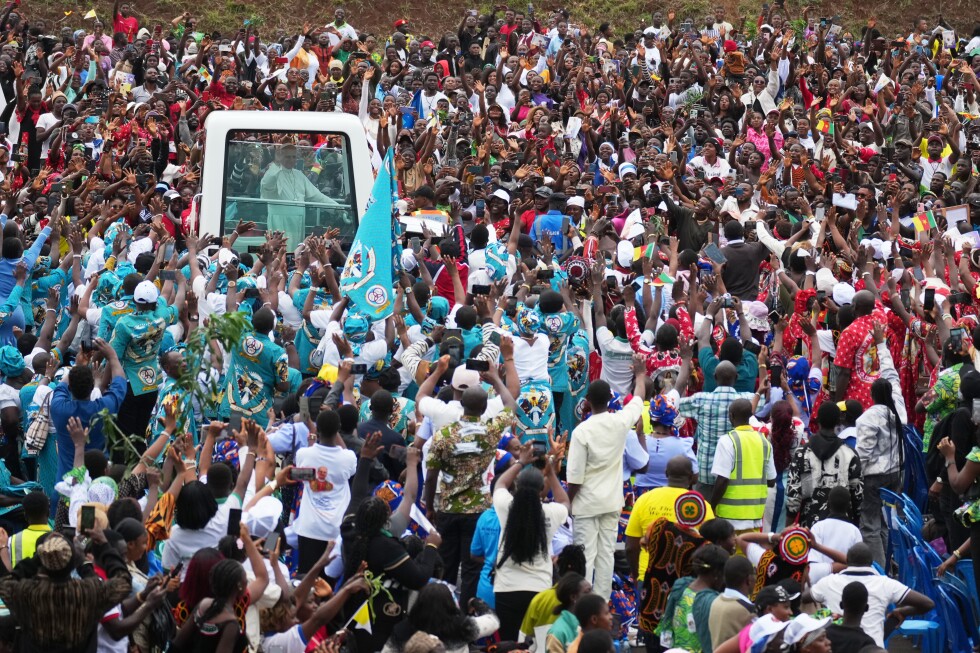
As Pope Leo XIV, the first American pope in history, approached the midpoint of his 11-day four-nation African tour on Friday, his schedule in Cameroon centered entirely on lifting up and engaging the Central African nation’s massive youth population, a demographic that sits at the heart of growing political and economic friction in the country.
The day kicked off with a high-profile trip to Douala, Cameroon’s largest commercial port city, where Leo planned to lead an open-air Mass and visit a local hospital. Vatican organizers projected that as many as 600,000 worshippers and attendees would gather for the liturgy — a turnout that would mark the largest crowd the pontiff has drawn over the entire course of his African journey, his first visit to the continent since assuming the papacy.
After the Douala events, Leo returned to Cameroon’s capital Yaoundé to meet with students, faculty and senior leadership at the Catholic University of Central Africa. For popes visiting developing nations, these campus encounters have long served as a key platform to urge young people to persist through systemic challenges ranging from entrenched poverty to widespread public corruption.
Cameroon offers a striking case study of the gap between Africa’s burgeoning youth population and its long-tenured aging leadership. Roughly 29% of the nation’s 29 million residents identify as Catholic, and the country has one of the youngest age profiles in the world, with a median age of just 18 years old. At the same time, Cameroon is led by 93-year-old President Paul Biya, the world’s oldest sitting head of state, who has held uninterrupted power since 1982 and secured an eighth consecutive term in deeply contested presidential elections held last October.
In his opening address to Biya and senior government officials shortly after arriving in Cameroon, Leo did not shy away from the country’s most pressing tensions. He called for the immediate dismantling of what he termed the “chains of corruption” that have held back widespread progress, and emphasized that Cameroon’s young people are the sole source of the nation’s future and lasting hope.
While Cameroon is an oil-rich state that has recorded modest economic growth in recent years, the vast majority of young Cameroonians report that economic benefits have never trickled down beyond a small circle of political and business elites. Official World Bank data puts the country’s overall unemployment rate at 3.5%, but more than half — 57% — of workers between the ages of 18 and 35 are stuck in unstable, unregulated informal employment that offers little to no job security or social benefits.
Widening economic frustration has triggered two interconnected crises for the nation: widespread brain drain, and a catastrophic shortage of skilled workers in critical public sectors including healthcare. According to Cameroon’s Ministry of Higher Education, roughly one-third of all newly graduated trained doctors left the country in 2023 alone, lured by higher-paying roles and better working conditions in Europe and North America. The outflow of medical professionals has left already under-resourced public hospitals and clinics critically understaffed.
In his address to government leaders, Leo warned of the risks of leaving youth grievances unaddressed. “Of course, when unemployment and social exclusion persist, frustration can lead to violence,” the pontiff said. “Investing in the education, training, and entrepreneurship of young people is, therefore, a strategic choice for peace. It is the only way to curb the outflow of wonderful talent to other parts of the world.”
Tensions over Biya’s decades-long rule boiled over after last October’s election, when main opposition candidate Issa Tchiroma Bakary challenged the official election results, sparking deadly protests across the country. The visit comes as Cameroon continues to grapple with nearly a decade of armed conflict in its Anglophone regions, with many local residents hoping the papal tour will bring progress toward national healing.