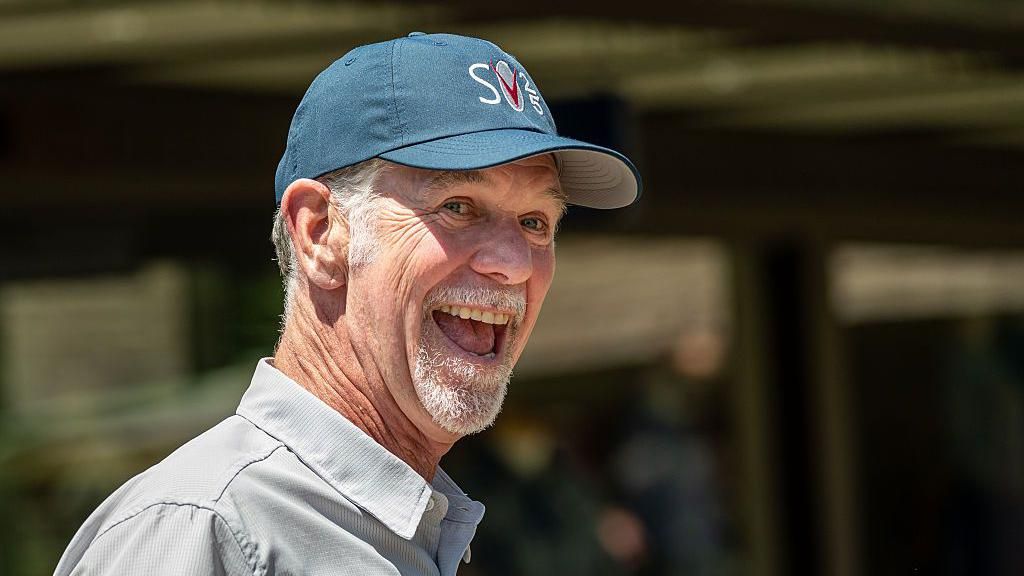
Nearly three decades after he co-founded what would become the world’s most influential streaming entertainment giant, Reed Hastings has announced he will step down as executive chairman of Netflix, departing the top leadership role he held long after giving up the co-CEO title three years ago.
Hastings, who launched Netflix alongside business partner Marc Randolph in 1997, leaves behind a legacy that redefined global media consumption. What began as a low-key postal DVD rental service, delivering discs to customers in iconic red envelopes, evolved over the decades into a $450 billion industry disruptor that upended Hollywood’s traditional distribution models and popularized the binge-watching culture that transformed how audiences engage with television and film. After stepping down as co-CEO in 2023, Hastings retained the position of executive chairman to guide the company’s strategic direction; he will formally exit the role this coming June.
In a statement reflecting on his nearly 30-year tenure, Hastings noted that Netflix reshaped his life in countless ways, singling out the 2016 global rollout of the platform that opened access to Netflix content for nearly every person on the planet as his favorite memory. The company confirmed Hastings’ departure is driven by his plan to shift focus to philanthropic work and other personal interests, a transition he has planned for years as Netflix built out its current leadership structure.
The leadership announcement came paired with Netflix’s first quarterly financial results following its unsuccessful bid to acquire Warner Bros Discovery. To many analysts’ surprise, the platform delivered stronger-than-expected performance: first-quarter 2026 revenue grew 16% year-over-year, a gain fueled by increased subscription pricing and growing advertising revenue across the service. Current co-CEOs Ted Sarandos and Greg Peters pushed back against concerns that the failed acquisition bid distracted the company from its core operations, noting that the solid Q1 results prove the business never lost focus on its core priorities.
“We said from the beginning it was a nice to have, not a need to have,” Sarandos said of the abandoned Warner Bros Discovery deal. “Our biggest risk was losing focus on our core business… as you can see from our Q1 results we did not lose focus.”
Despite the positive revenue beat, investor reaction was muted: Netflix’s share price dropped roughly 8% in after-announcement trading. Sarandos and Peters also paid tribute to Hastings’ transformative leadership, confirming that his influence will continue to shape the streaming giant’s strategic direction even after he exits the chairman role.
Hastings’ departure comes at a pivotal, challenging juncture for Netflix. The platform faces intensifying competition across multiple fronts: legacy rival streaming services are consolidating, with the proposed Paramount Skydance takeover of Warner Bros set to create a much larger direct competitor, while short-form video platforms including TikTok and YouTube continue to siphon viewer attention and advertising dollars. In response to this shifting landscape, Sarandos outlined Netflix’s next chapter of growth: the company will double down on strengthening its core content offering, while expanding into new verticals including video podcasts, live music, interactive gaming (including a new children’s gaming app), and live sports. Later this year, the platform will make a major foray into live sports entertainment when it broadcasts the highly anticipated heavyweight boxing match between Tyson Fury and Anthony Joshua in the United Kingdom.