Legendary Japanese contemporary artist Yayoi Kusama, whose instantly recognizable polka dot works transformed global visual art, passed away on August 14 at a Tokyo hospital at the age of 97, her official studio confirmed in a public statement released Thursday.
Kusama remained dedicated to her craft right up to her final moments, the statement emphasized: “She continued to paint until her final days, never setting aside her brush, and continued exploration of forever love and eternal soul. We will carry forward Kusama’s wishes and, through art, continue to bring hope and strength for the future to people around the world.”
Widely celebrated as one of Japan’s most influential contemporary creators, Kusama’s work has been showcased in leading cultural institutions across the globe, including New York’s Museum of Modern Art and the Whitney Museum of American Art. Repetition lies at the core of her artistic identity: while she experimented with recurring motifs ranging from woven net patterns to swirling, worm-like forms, polka dots remain her most iconic signature. These vibrant, psychedelic spots danced across her canvases, took shape as glittering spheres, and became glowing installations that immerse visitors in her singular visual world.
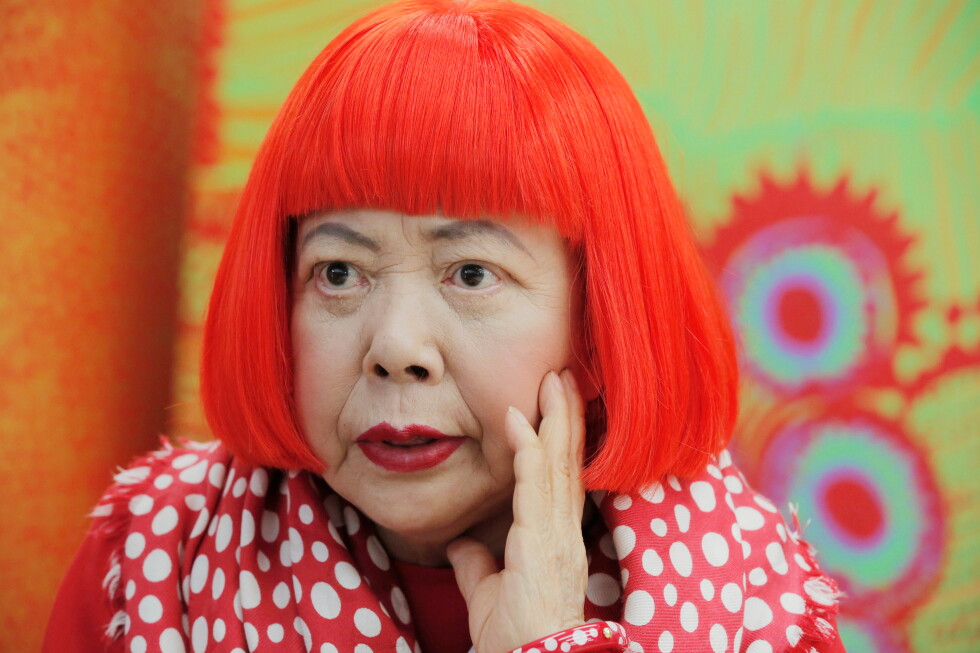
In a 2012 interview with The Associated Press, Kusama — appearing in her characteristic orange bob wig and a garment covered in her beloved dots — summed up her creative mantra simply: “Polka dots are fabulous.” Speaking in a gentle, straightforward tone, she added, “I want to create a thousand paintings, maybe two thousand paintings, as many as I can draw. I will keep painting until I die.” She kept that promise.
Kusama drew the world as she experienced it: she explained that the spotted perspective that defined her work originated from the hallucinations she experienced from childhood. For decades, she navigated regular stays in psychiatric institutions, but her mental health struggles never derailed her trailblazing career. In 1957, she became one of the first Japanese female artists to relocate to New York to pursue artistic work. Though soft-spoken and naturally shy, she was unapologetically bold in advancing her unique creative vision, sticking to her dot-centric style for decades while working to make her art accessible to mainstream audiences, not just gallery elites.
In her later life, Kusama received the widespread acclaim she had long been denied. She collaborated with global luxury fashion brand Louis Vuitton and lent her designs to a range of licensed consumer goods, from teacups and t-shirts to keychains and store display figures of herself. In 2008, one of her works sold for $5.8 million at Christie’s auction house, cementing her status as a major commercial force in the art world. In 2016, she received Japan’s highest honor for artists, the Order of Culture. Upon accepting the award, she reaffirmed her unwavering commitment to her craft, noting that the sincerity and devotion she brought to her personal life formed the core of her artistic legacy. “I feel there is little left in my life, but I am now still fighting to the death for my art,” she said at the time. “I am giving all I have so that many people will continue to be interested in my art, even after I am dead.”
Critics have labeled her work with a wide range of labels, from pop art and avant-garde to feminist art, but Kusama rejected most attempts to box her practice into narrow categories. Born into a middle-class Japanese family, Kusama grew up feeling deeply misunderstood: her parents discouraged her artistic ambitions, pushing her to pursue traditional domestic life and marriage instead, offering to buy her kimonos rather than paints and brushes. Knowing she had to escape to fulfill her potential, she chose to build her career in the United States.
When Kusama arrived in New York, the dominant artistic trend was abstract expressionist “action painting,” defined by gestural drips and broad brushstrokes — not the controlled, repetitive dots that would become her trademark. She endured years of poverty and public obscurity, but never abandoned her commitment to painting dots. In the late 1960s, she gained media attention (and legal scrutiny) for anti-war “happening” performances where she placed paper dots on participants’ bodies — and even on a horse — leading to obscenity arrests for some involved. While building her practice in New York, she befriended leading contemporary artists including Andy Warhol, Georgia O’Keeffe, and Joseph Cornell, all of whom praised her innovative creative approach.
Over her seven-decade career, Kusama created a vast body of quirky, celebratory works that span multiple mediums. Notable pieces include *Macaroni Girl*, a figure covered in dry macaroni that explores fear of food; *The Visionary Flowers*, large-scale sculptural works of twisting tulips; and *Mirrored Corridor*, an immersive installation that uses reflective surfaces to create the illusion of an endless field of dotted phallic forms. Beyond visual art, Kusama also experimented with filmmaking and published multiple novels. She once told the AP that the origin of her creative ideas remained a mystery even to her: she simply picked up her brush and started creating, and the process often surprised her. “I think, ‘Oh, I drew that? I was thinking that,’” she said.
Kusama embraced public attention and acclaim for her work, happily reading her poetry for reporters and posing with energy for press photographs. She remained a disarmingly charming mix of vulnerability and defiance to the end: one moment declaring herself “an artistic revolutionary,” and the next murmuring, “I am so afraid, all the time, of everything.” Her work and legacy continue to resonate with audiences around the world, carrying forward the message of hope and creativity she spent a lifetime building.