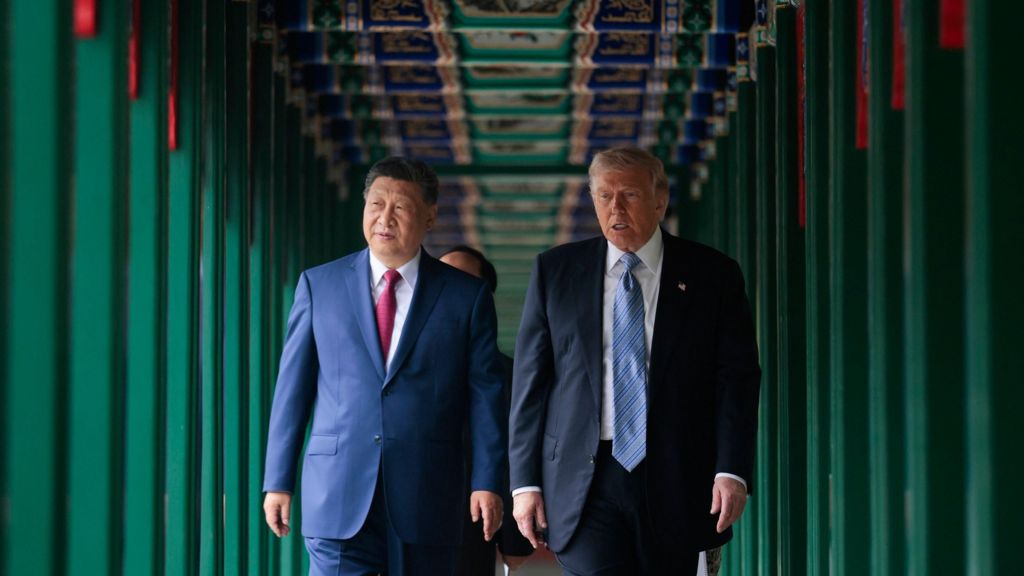
The final stop of former U.S. President Donald Trump’s two-day Beijing visit was a rare guided tour of Zhongnanhai, the centuries-old heavily secured compound that houses China’s top leadership, with Chinese President Xi Jinping serving as his host. The high-profile excursion capped a trip defined by elaborate diplomatic pageantry, though concrete details of finalized policy agreements between the two global powers remained largely undisclosed.
Coming on the heels of escalating tensions over bilateral trade and tensions surrounding the Iran conflict, the summit saw both leaders adopt a notably conciliatory tone. Trump described his time in China as “incredible,” while Xi framed the meeting as a step forward in building a “new bilateral relationship.” During a stroll through the compound’s landscaped grounds, the pair stopped to admire blooming Chinese roses, and Xi promised to send cuttings of the flowers to Trump, a gesture the U.S. president welcomed enthusiastically.
Nestled just kilometers from central Beijing, the 14th-century Zhongnanhai compound holds a status equivalent to the White House in U.S. politics. Originally built as a secondary imperial retreat for Chinese emperors, the site is celebrated for its scenic lakes, sprawling manicured gardens, and centuries-old historic trees. It has served as the central headquarters of China’s Communist government since 1949, and today ranks among the country’s most politically symbolic landmarks. For foreign dignitaries, an invitation to tour the compound is widely interpreted as a marker of high honor and close bilateral ties.
When Trump asked how many foreign leaders had previously been granted access to the compound, Xi noted that such invitations remain “extremely rare.” Past visitors include Russian President Vladimir Putin and Belarusian President Alexander Lukashenko, who toured the site the previous year. Several U.S. presidents have also received invitations dating back decades: Richard Nixon during his groundbreaking 1972 visit, George W. Bush, and Barack Obama all toured the compound during their time in office.
During the tour, Trump paused to admire what he called “the most beautiful roses anyone has ever seen” and mature ancient trees, which Xi confirmed were between 200 and 400 years old. When Trump expressed surprise at their longevity, Xi added that even older 1,000-year-old specimens can be found across China.
Hours before the Zhongnanhai walk, Fox News aired a pre-recorded exclusive interview with Trump, where he praised Xi as “warm” and “very sharp.” In the interview, Trump claimed Xi had pledged that China would not supply military weapons to Iran, though he added that Xi noted China would continue purchasing large volumes of Iranian crude oil and supported keeping the Strait of Hormuz open to global shipping.
While Chinese officials have not issued a formal public response to Trump’s specific claims, the country’s foreign ministry released a general statement confirming that Beijing has been working behind the scenes to facilitate an end to the Iran conflict, confirming that Chinese diplomats are pushing for Tehran to enter negotiations. As Iran’s largest crude oil buyer and biggest overall trade partner, China holds unique economic and political leverage over Tehran – a lever the Trump administration had hoped Beijing would use to advance its diplomatic goals ahead of the summit.
Though a fragile temporary trade truce was a core item on the summit agenda, the Iran issue had grown into a more pressing priority in the months leading up to the meeting. Even so, Trump told reporters that trade talks between the two sides had progressed “better than last time.” The U.S. delegation included a cohort of American business leaders, who Trump said were in Beijing to finalize commercial agreements and help create new jobs back in the United States.
Trump publicly claimed China had agreed to purchase U.S. crude oil, 200 new commercial jets from Boeing, and large volumes of U.S. agricultural products. However, when asked to confirm these deals during a press briefing later that day, China’s foreign ministry declined to comment on the specific agreements. Chinese officials have only referenced “a series of new consensuses” reached between the two leaders without elaborating on the content of any deals.
Independent policy analysts note that China’s global economic standing has expanded steadily in recent years, as Beijing has diversified its trade partnerships beyond the U.S. to insulate itself from the impact of U.S. tariffs. Trump’s visit came on the heels of high-profile trips by leaders from Britain, Canada, and Germany, all of whom traveled to Beijing to expand bilateral trade ties.
Following the conclusion of the Beijing summit, Trump extended an invitation to Xi to visit the White House for a second summit in September, a date that has already been added to the official diplomatic calendar. Closing out his visit after the Zhongnanhai tour, Trump told reporters: “You’re gonna walk away hopefully very impressed, like I’m very impressed with China.”