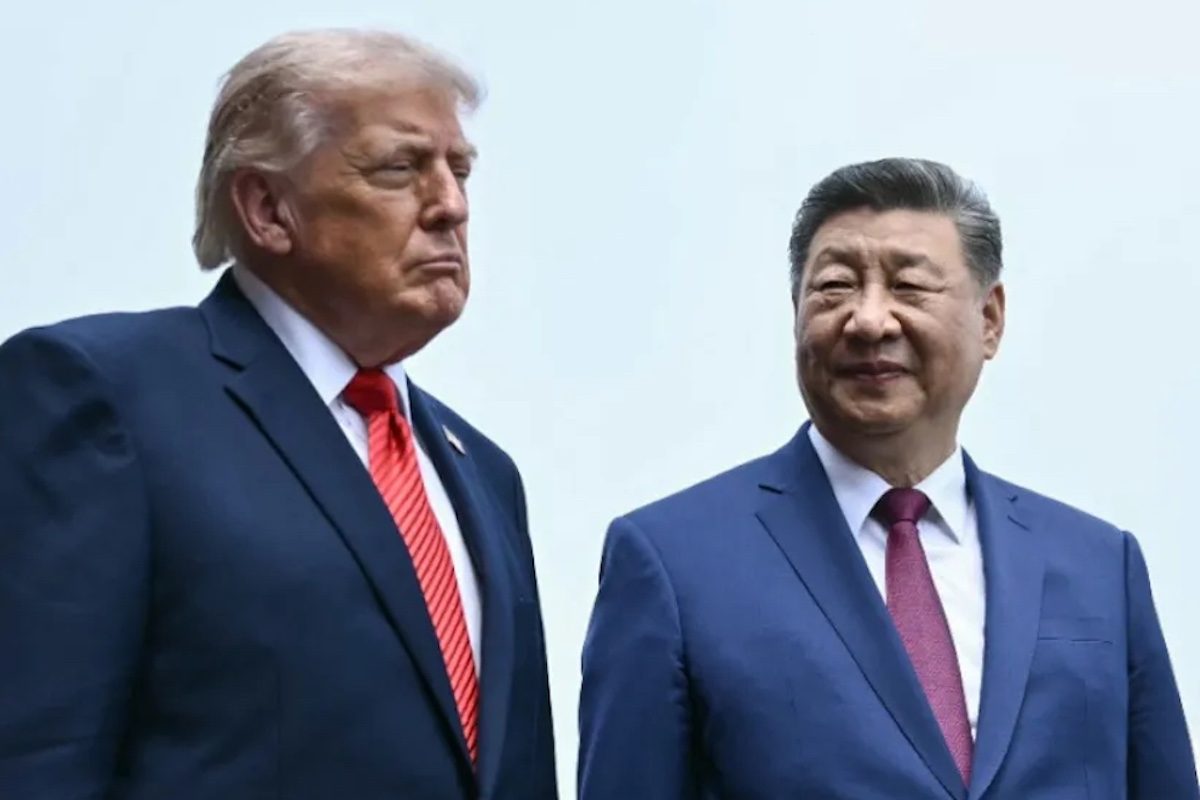
For former US President Donald Trump, few experiences rankle more than being overshadowed – especially during a high-stakes appearance on one of the most prominent stages of his second presidential term: Beijing. While Trump’s inner circle has pushed back against the idea, Nvidia CEO Jensen Huang did exactly that during Trump’s long-awaited trip this week, a reality that has not gone unnoticed by global financial markets.
As analysts predicted, the first visit by a sitting US president to Beijing in eight years delivered abundant ceremonial fanfare, but few tangible diplomatic breakthroughs. Chinese President Xi Jinping extended enough concessions to allow Trump to frame the trip as a success back in Washington, including agreements to explore cooperation to ease trade tensions and, critically, pursue an end to the ongoing war in Iran.
The real center of attention, however, was Trump’s delegation of more than 30 chief executives, whose combined companies hold a total market capitalization of roughly $20 trillion – a sum equivalent to China’s entire annual gross domestic product. This corporate entourage, assembled to push for greater access to the world’s second-largest economy, ultimately drew more global attention and interest than the summit’s headlining political leader, who has long craved the spotlight.
No corporate leader captured more attention than Huang, a last-minute addition to the delegation who joined the presidential delegation mid-journey, catching up to Air Force One at a refueling stop in Alaska. Huang’s late inclusion has been widely interpreted as a sign that the Trump administration is going to great lengths to accommodate Beijing, as the chip giant seeks regulatory approval to sell its cutting-edge H200 AI chips to Chinese buyers.
Amanda Hsiao, an analyst at Eurasia Group, notes that Huang’s last-minute participation makes a potential near-term announcement of Chinese approval for a first batch of H200 chip imports far more likely than previously expected – a shift that runs counter to earlier market projections.
This development carries major implications for the global AI boom that has pushed global stock markets to record all-time highs. For Trump’s Beijing trip, Huang’s progress could end up being the most durable achievement of the entire visit. A breakthrough on AI chip trade would be a landmark win for Nvidia, which is currently approaching an unprecedented $6 trillion market valuation.
While the summit produced preliminary talks of Boeing aircraft orders, increased Chinese purchases of US soybeans, and a reciprocal visit by Xi to Washington later this year, the most pressing high-stakes issues – including unfettered access to Chinese rare earth minerals, coordinated AI governance standards, and reopening the Strait of Hormuz to commercial shipping – were deferred to future negotiations.
As former US Congressman Adam Kinzinger observed on his YouTube channel, Xi received Trump like a polite host entertaining a salesperson, and that particular salesperson appears to be returning to the US with very few concrete deals to show for the trip.
At this stage, global markets are in a holding pattern. It will be several months before it becomes clear whether the diverse delegation of tech, finance, and defense executives – which also includes Tesla’s Elon Musk, Apple’s Tim Cook, and the leaders of Boeing, Citi, and Goldman Sachs – will deliver tangible results from the meetings.
One major wild card is that Trump enters these negotiations with far less political and economic leverage than he anticipated at the start of 2026. Much of the outcome hinges on whether Trump’s increasingly unpredictable White House avoids disruptive new policies, such as additional sweeping tariffs on Chinese goods, an escalation of the Middle East conflict, or other sudden policy shifts that could roil global markets.
During his meeting with the US corporate delegation, Xi affirmed that China would continue opening its domestic economy to foreign investment. Trump described his bilateral talks with Xi as “great” and struck a broadly optimistic tone in public remarks, and the warm, welcoming visual of the summit has already provided a modest boost to global investor sentiment.
Beneath the positive optics, however, significant uncertainty remains. Xi issued a stark warning that mismanagement of the Taiwan question could lead to direct military confrontation, a statement that served as a clear wake-up call for geopolitical risk analysts. The moment also put Trump in an awkward position: standing alongside Xi, he declined to even respond to reporters’ questions about the Taiwan issue.
Economists are also grappling with the implications of Xi’s reference to the “Thucydides trap,” the theoretical risk that a rising power will inevitably go to war with an established ruling power, framing the dynamic between the world’s two largest economies, which together account for $53 trillion in annual GDP. Even as Xi acknowledged this historic risk, he called for building a “constructive, strategic and stable relationship” between the two global powers.
To be sure, the simple fact that the leaders of the US and China met face-to-face and held constructive dialogue this week is an unambiguous positive for the global economy. That milestone alone counts as a meaningful economic win after years of escalating tensions.
Yet what has been lost in much of the post-summit coverage is Trump’s defining policy goal across both of his presidential terms: forcing China into a sweeping “grand bargain” trade deal that would pressure Beijing to make deep structural economic concessions. After days of photo opportunities and diplomatic pleasantries in Beijing, that core goal appears more elusive than ever.
Carlos Casanova, an economist at Union Bancaire Privee, notes that a major diplomatic breakthrough remains improbable in the medium term. “More plausible are modest gestures, including calibrated moves toward a tariff truce in select categories and assurances on critical-materials access,” he explained.
As US-China working-level talks resume in the coming weeks, rare earths are a top candidate for a small-scale agreement. Chinese rare earth exports surged 197% year-over-year in April, up from just 3.3% growth in March, a trend that highlights both Washington’s dependence on Chinese supplies and Beijing’s gesture of goodwill ahead of the summit.
Casanova adds that a “mutual understanding to maintain a stable supply in exchange for restraint on punitive measures would be a logical, market-friendly outcome, especially given vast investments in artificial intelligence that have fueled the stellar performance of equity markets in the United States.”
Still, just as with unresolved tensions around Iran and the Strait of Hormuz, global markets cannot ignore the underlying risks that remain after the 2025 trade escalation. China retains the ability to at any time restrict exports of rare earth minerals, which are critical inputs for electric vehicles, LED displays, lithium-ion batteries, military radar systems, semiconductors, and smartphones.
Beijing could also choose to deepen its strategic partnership with Iran, including ramping up crude oil purchases from Tehran, providing military equipment assistance, and expanding intelligence sharing. It could also cancel Boeing’s planned 200-plane order, or shift agricultural purchases back to Brazilian soybean suppliers.
As Trump returns to a White House grappling with internal disarray, his core MAGA base is unlikely to be impressed by the trip’s outcomes. Since taking office for his first term in 2017, Trump has repeatedly promised to force China into a subordinate trade position and demonstrate US dominance. The results so far tell a different story: China’s GDP has grown by $8 trillion since 2017, even amid years of escalating US tariffs and trade restrictions.
Despite US tariffs reaching as high as 145% on Chinese goods in 2025, China closed the year with a record $1.2 trillion annual trade surplus.
For Trump, the political calculus is clear: only a high-profile, transformative trade victory over China can justify the last 15 months of tariff volatility, elevated inflation, and economic disruption to his most loyal supporters. The current trip delivered nothing close to that.
The Iran war that Trump launched alongside Israel in late February further complicated his negotiating position in Beijing. The resulting surge in global oil prices, combined with ongoing inflation from tariffs, has left Trump’s national approval ratings at historic lows.
Now, he returns to Washington with little more than an agreement to continue talking about a potential framework for a future deal. In the aftermath, the Trump administration is likely to face critical headlines highlighting the gap between Trump’s bold pre-trip rhetoric and the minimal concrete progress achieved in Beijing.
Additionally, with Republicans facing midterm Congressional elections this November, the party is vulnerable to attacks that it has been too soft on China, given the deference the Trump administration showed to Xi’s inner circle during the summit. Trump also risks being boxed in by the diplomatic agreement he reached with Beijing.
Bill Bishop, a veteran China analyst who publishes the Sinocism newsletter, points out that Xi’s inner circle “wants a period of strategic detente and this concept could realize that on terms favorable to them for the rest of Trump’s second term.”
Bishop adds that “any future US moves to address PRC industrial overcapacity, tighten technology controls, etc. could then be cast by Beijing as violations of the new ‘constructive China-US relationship of strategic stability’ to which the two leaders personally agreed.”
While China faces significant domestic headwinds, including a persistent property sector crisis, Xi has leveraged the Trump era to position China as a more stable global economic partner open for foreign business. It will take time to determine whether this week’s Beijing summit marks another soft power victory for Xi’s economic governance model.
What is clear is that Xi will need to do more to convince American households, already grappling with persistent inflation, that China has not undercut US economic interests at home.