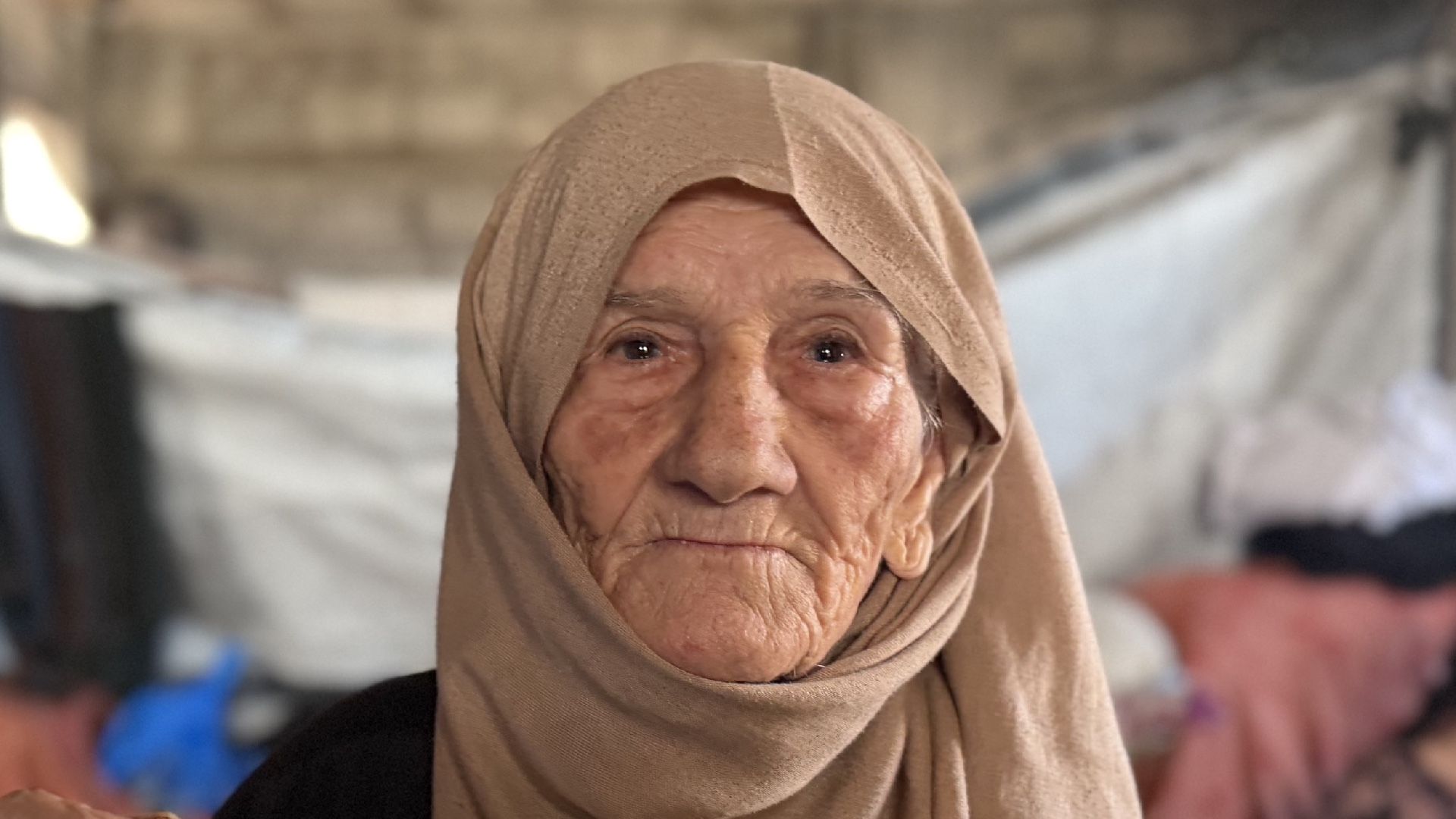
At 95 years old, Fatema Obaid carries a lifetime of trauma that few can imagine: she has survived two catastrophic displacement events, watched 70 of her family members killed in ongoing violence, and endured months of Israeli bombardment, systematic starvation, and repeated forced displacement across the Gaza Strip. Yet this grandmother, who first lived through the 1948 Nakba as a young girl, has rejected repeated Israeli military orders to leave Gaza City in the current conflict, warning that fleeing a second time would usher in an even crueler catastrophe than the one she endured 75 years ago.
Speaking from an unfinished apartment in western Gaza City, where she now shelters alongside her surviving grandchildren, Obaid framed the current violence as an escalation of the displacement and dispossession that began with the 1948 Nakba. “In the first Nakba, it is true that hundreds of thousands lost their land, homes and villages,” she told Middle East Eye in an interview published in 2026. “But in this Nakba, we have lost an entire history. We lost entire families, and entire generations have been destroyed for decades to come. What they could not do in 1948, they are doing now.”
Obaid was born and raised in Gaza City’s Shujaiya neighbourhood, close to the de facto border between Israel and Gaza that emerged after the 1949 armistice agreement. In 1948, Zionist militias launched widespread attacks on Palestinian towns and villages across historic Palestine, forcibly expelling some 750,000 Palestinians—roughly 75 percent of the territory’s Palestinian population—to make way for the creation of the state of Israel; an event widely categorized by scholars as ethnic cleansing. Obaid and her family were temporarily displaced for several months that year, but eventually returned to their home in Shujaiya, which remained outside Israeli control after the 1949 ceasefire.
More than 75 years later, Obaid has found herself reliving the same trauma of displacement, but this time with far greater brutality. She draws a sharp line between the 1948 catastrophe and the current war, arguing there is no comparison between the two events.
Obaid’s experience mirrors that of generations of Palestinians in Gaza. In 1948, tens of thousands of expelled Palestinians flooded into Gaza, expecting to return to their homes within days when the fighting ended. Instead, the enclave became a permanent, overcrowded refuge for displaced families. Today, around 1.6 million Palestinian refugees and their descendants—approximately 73 percent of Gaza’s total population—reside in the strip.
Since the start of Israel’s military campaign in October 2023, Obaid has been displaced more than 10 times. Her childhood home in Shujaiya and the entire surrounding neighborhood have been reduced to rubble, now incorporated into an Israeli-imposed no-go zone. “I have lived in Shujaiya since I was born. Even after marrying my cousin, I moved only a few streets away,” she recalled. “We fled for a few months in 1948 but eventually returned. Only during this Nakba did we lose our homes, our neighbourhood and all of eastern Gaza. They bombed our house and killed more than 70 members of my family—my sons, grandchildren, nephews, their children and many others from our extended family.”
Historical records place the Palestinian death toll from the 1947–1949 Nakba between 13,000 and 15,000. By comparison, Israeli forces have killed more than 72,000 Palestinians in Gaza over the past two years of the current campaign, with nearly two million residents displaced. Even after the recent ceasefire agreement, around 1.5 million Palestinians remain uprooted, most living in unsanitary makeshift tent camps across southern Gaza.
Shortly after Obaid was forced to flee Shujaiya for another part of Gaza City in October 2023, the Israeli military issued repeated mass expulsion orders ordering all northern Gaza residents to move south. When hundreds of thousands refused to comply, UN experts concluded that Israel imposed systematic starvation as “a savage weapon of war” to force Palestinians out of their territory. For months, Gaza City residents were cut off from basic supplies including wheat flour and clean drinking water, and the UN-backed Integrated Food Security Phase Classification officially declared famine in Gaza City in August 2025.
Even amid this unrelenting hardship, Obaid has refused to leave Gaza City. “There were days when we could not find even a sip of water,” she said. “We counted every sip we drank, could barely find food, and were forced to flee from one place to another each time. It destroyed my health, but I did not want to leave Gaza City. I did not want to be buried outside it at the end of my life. I did not want to relive a catastrophe we have endured for nearly eight decades.”
Back in her Shujaiya home, Obaid had spent more than 80 years curating a collection of personal mementos that carried her life story: her long white wedding dress, the jackets and clothing of her late husband who died 20 years ago, cooking pots and gifts from her family and in-laws, and decades of personal savings. Every last one of these items was lost when she was forced to flee in panic. “Every time we fled, we fled in terror. We had no time to gather any belongings. We couldn’t even take a bottle of water with us. I escaped wearing only this same dress,” she said.
The only possession that survived both cataclysms is a pair of simple earrings that her father gave her as a young girl before the 1948 Nakba. “I have kept them all these years. I could never sell them or replace them, because they were once held in my father’s hands. They carry his memory with them. I never take them off, and that is why they have survived with me,” she explained. “They are the only thing left from before the Nakba. They survived two Nakbas, while so many members of my family were killed. These earrings are still alive.”
Obaid is among the dwindling number of remaining first-hand witnesses to the 1948 Nakba still living in Gaza who have lived through the current genocide. Since October 2023, Israeli attacks have killed at least 4,813 elderly Palestinians in Gaza, and many more have died from hunger, untreated chronic illness, and the total collapse of Gaza’s healthcare system amid Israel’s ongoing blockade and repeated forced displacement orders.
“People laugh when I say only one and a half of my sons are still alive; one who survived, and the other who was severely injured and is currently unable to walk,” Obaid said. She reflected on a lifetime marked by loss: her mother died shortly after she was born, and she has endured a lifetime of hardship, repeated displacement, and the death of most of her family. “At this age, I have lost my sons and many members of my family, endured starvation, and suffered repeated displacement,” she said. “But nothing is more painful than being uprooted from your own land and knowing that, after all these years, you will die in displacement.”