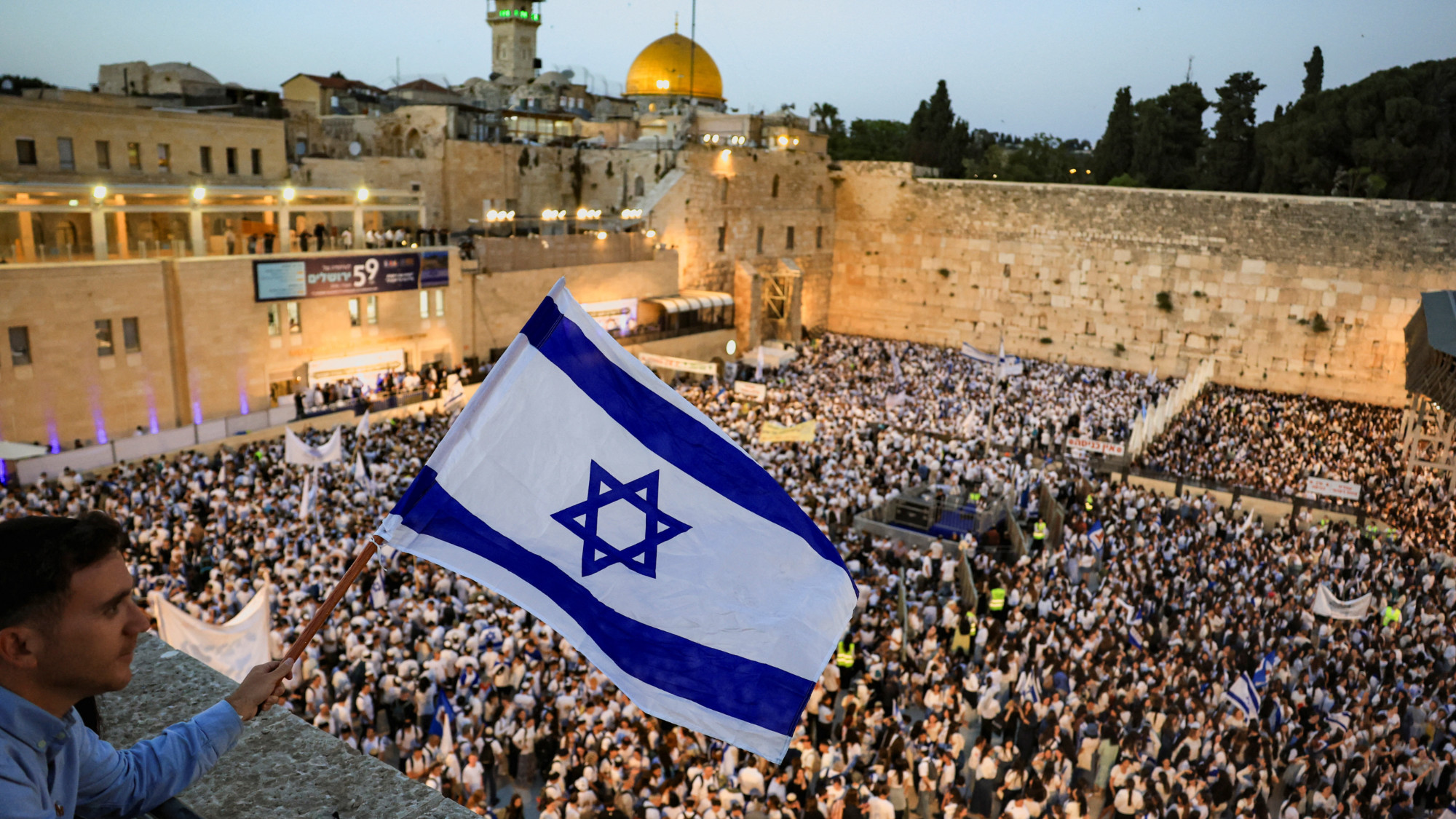
By midday on Jerusalem Day 2026, the narrow, usually bustling lanes of Jerusalem’s Old City Muslim Quarter had fallen eerily silent. Most storefronts were shuttered with metal security shutters pulled tight, and Palestinian residents who once filled the area had locked themselves indoors or fled entirely.
Fadi, a 48-year-old local shop owner, summed up the harsh reality facing local traders as he dragged his outdoor display table inside and secured his shop for the day. “If I don’t want to get attacked, I have to close,” he explained.
Under ordinary conditions, Thursdays draw throngs of visitors and locals to the Old City’s historic markets, turning the quarter into a vibrant hub of commerce and community. This year, however, the annual ultra-nationalist Flag March, a provocative event marking Israel’s capture of East Jerusalem in the 1967 Six-Day War, forced local Palestinians to cede their own neighborhood to the procession. Organizers intentionally route the march directly through the Muslim Quarter as a deliberate show of dominance, turning the area into a flashpoint for sectarian violence year after year.
Even hours before the official event was set to kick off, far-right Israeli settlers, identifiable by their traditional knitted kippahs and long side curls (peyot), began roaming the quarter. A group of teenage settlers passing a still-open Palestinian shop launched into a torrent of anti-Palestinian slurs, and the confrontation quickly escalated into a physical assault on two shop owners. The shopkeepers defended themselves with plastic chairs while activists from the grassroots group Protective Presence stepped in to de-escalate the clash. The entire confrontation lasted less than 30 seconds, but it set the tone for the rest of the day: the young attackers faced no immediate intervention or arrest, offering an early preview of the impunity that would define the day’s violence.
Despite a heavy visible deployment of armed Israeli police across the Old City, dozens of Palestinian business owners later reported their storefronts had been vandalized or ransacked by march participants. This pattern of violence repeats annually, tied directly to Israel’s national celebration of its 1967 occupation of East Jerusalem and the formal declaration of Jerusalem as Israel’s unified capital. In recent years, the march has been increasingly dominated by far-right political factions, growing more aggressive and volatile as it is weaponized to assert unchecked Israeli control over the city’s majority-Palestinian resident population.
Human rights and community activists have repeatedly documented that Israeli security forces rarely intervene to stop attacks on Palestinians or protect their property during the march, even when offenders are young and easily contained. To fill this gap left by intentional state neglect, local and international activist groups have organized volunteer protective presence teams to monitor the event and support Palestinian residents.
“Every year there is bullying, verbal hate and physical violence,” explained Yonatan Shargian, an organizer with the grassroots movement Standing Together. He noted that while the number of volunteers has grown in lockstep with rising violence, their work serves a broader purpose beyond de-escalation: sending a message that “this place belongs to all of us, and everyone deserves to feel safe and protected”.
Further tension ignited near the holy site of Al-Aqsa Mosque, when far-right National Security Minister Itamar Ben Gvir led a group of hundreds of settlers into the mosque compound. The politician waved an Israeli flag and declared “The Temple Mount is in our hands”, echoing the extremist movement’s demand for full Israeli sovereignty over the site, which is the third-holiest in Islam. Joining Ben Gvir was lawmaker Yitzhak Kroizer, who later posted on Facebook calling for the full removal of Al-Aqsa Mosque and the construction of a Third Jewish Temple in its place.
As the afternoon wore on, hundreds of ultra-nationalist marchers gathered at Damascus Gate, the main entry point to the Muslim Quarter and Al-Aqsa Compound. Groups of teenage boys and adult men took turns chanting virulent hate speech, including calls for “Death to Arabs” and overtly racist, misogynistic slurs targeting Palestinian people. While activist volunteers stayed close to escort the few Palestinians who remained in the area to their homes, both volunteers and on-site journalists soon became the primary targets of aggression.
At one point, a crowd of young ultra-nationalists surrounded a working journalist, shoved him against a wall, threw his phone to the ground, and spat in his face. As they had after every attack throughout the day, Israeli police intervened only to break up the confrontation after the violence was already over, allowing the attackers to break into celebratory victory chants. In this instance, the crowd jeered “May your village burn” as they dispersed.
Shortly after the incident, activists and journalists were forced out of the procession route to clear the way for the main Flag March. What began as scattered small groups swelled into a massive sea of participants, moving through Damascus Gate in successive waves toward the Western Wall. The entire area was flooded with Israeli national flags, alongside dozens of the so-called Third Temple flags: a widely recognized symbol of the movement to demolish Al-Aqsa Mosque and build a Jewish temple on the site.
Provocative signage and accessories dotted the crowd, including a large banner reading, “It’s not Al-Aqsa, it’s the Temple Mount. You want a massacre? You’ll get the Nakba,” referencing the 1948 displacement of hundreds of thousands of Palestinians during the founding of Israel. Many marchers also wore stickers featuring Ben Gvir’s image alongside a noose, a reference to the recently passed death penalty bill for Palestinian political prisoners that the minister championed in the Israeli Knesset.
Before entering the Old City, each group of marchers paused to sing nationalist and religious hymns, openly celebrating their display of control over the Palestinian neighborhood. While the day was marked by widespread violence, many long-time activist observers noted that 2026’s event felt comparatively less chaotic than previous years—a shift they attributed not to less extremism, but to the fact that most Palestinians had already been forced out of the area, leaving far fewer targets for abuse.
For a national holiday that celebrates the unification of Jerusalem under Israeli control, the mass absence of Palestinian residents from their own neighborhood offered the clearest possible reflection of what that “unification” actually entails: the quiet, systematic erasure of the Palestinian community that has lived in the city for generations.