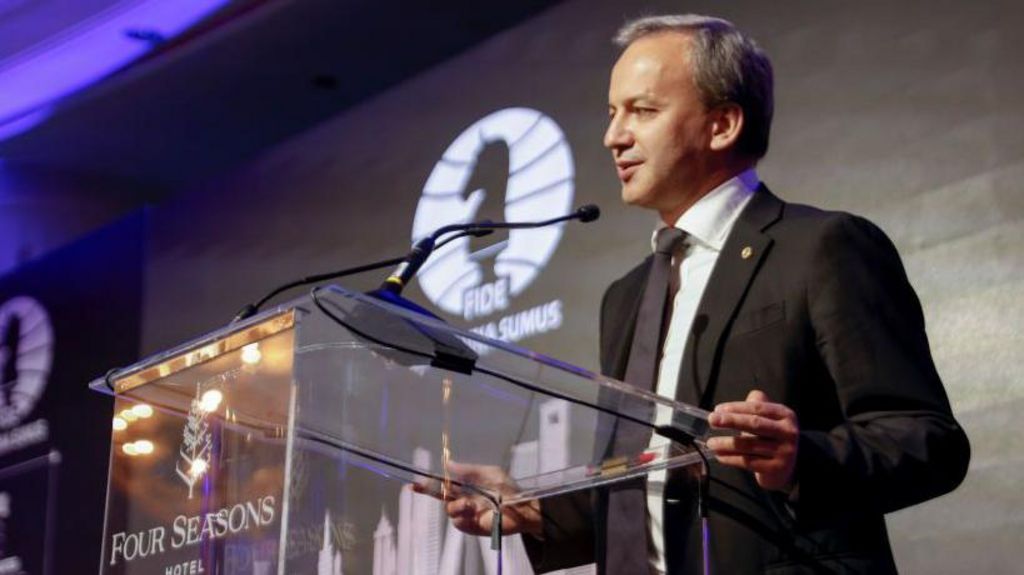
The global chess community is grappling with sudden upheaval after Arkady Dvorkovich, the sitting president of the International Chess Federation (Fide), announced he would voluntarily suspend his official duties after being added to the European Union’s latest package of sanctions targeting individuals linked to Russia’s actions in Ukraine.
The 54-year-old, a former Russian deputy prime minister and one-time Kremlin advisor, now faces a full EU travel ban and an asset freeze over his public positions on Russia’s 2014 annexation of Crimea. EU officials confirmed his inclusion on the sanctions list stems from his public support of the annexation, including referring to occupied Ukrainian cities as “new territories” of the Russian Federation. The bloc also noted that Dvorkovich serves on the board of the Chess Federation of Russia, which has organized competitive tournaments in Russian-occupied regions of Ukraine.
In an official statement, Dvorkovich clarified that he is stepping back from his day-to-day powers and responsibilities but has not formally resigned from his post. He called the EU’s sanctions designation “unlawful and unfair”, claiming the measures were deliberately implemented to bar him from continuing to lead and run for re-election at Fide. Dvorkovich also pushed back against widespread claims that Russia has wielded outsized influence over Fide during his tenure, arguing that the federation’s governance structure contradicts these accusations. “Fide is based in Switzerland… our top executives include people from India, Norway, Latvia, the US, Italy, France… and other countries around the globe,” he noted in written responses to the BBC.
Ukrainian officials and chess leaders have celebrated the sanctions and Dvorkovich’s suspension as a significant diplomatic win. Volodymyr Kovalchuk, first vice president of the Ukrainian Chess Federation, stated that individuals who develop sport in service of an invading aggressor state have no place holding senior international leadership roles, adding that Ukraine hopes Dvorkovich never returns to a position of influence in global chess. Kovalchuk also argued that Moscow has long invested heavily in controlling Fide, framing chess as a symbol of Russian intellectual superiority and using the federation to promote narratives favorable to the Kremlin.
Malcolm Pein, the British Fide representative, described the development as “an earthquake and a massive diplomatic victory for Ukraine”. He noted that for nearly 80 years, first the Soviet Union and then Russia have dominated international chess and used it as a key tool of soft power, and Dvorkovich’s suspension could substantially reduce Moscow’s influence in the global chess ecosystem.
Dvorkovich was first elected to the Fide presidency in 2018 and won a second term in 2022, leading the federation through one of the most turbulent eras in the history of the sport. After Russia launched its full-scale invasion of Ukraine in 2022, Russian national chess teams were banned from most top international competitions. However, Ukraine and its Western allies have alleged that Russian influence within Fide actually grew under Dvorkovich’s leadership, with Moscow pushing a “slow takeover” of the governing body by revising internal rules and pressuring delegates from other nations to support pro-Russia positions – a claim Moscow has repeatedly denied.
In 2024, a push led by pro-Russia factions to re-admit Russian national teams and officials to Fide competition failed, when the federation’s general assembly voted in September to maintain existing sanctions against Russia and its ally Belarus. Dvorkovich had been expected to run for a third term as Fide president at the organization’s upcoming general assembly in September, but his political future in global chess is now uncertain.
In recent years, competitive chess has experienced unprecedented global growth, with record audience numbers drawing major corporate sponsorships and elevating top players like Norwegian grandmaster Magnus Carlsen to household name status. Now, industry observers are widely speculating that the potential permanent departure of one of the most powerful and divisive figures in international chess could open the door to a new era of leadership for the sport.