In the heart of eastern Congo’s Ituri province, where one of the most rapidly expanding Ebola outbreaks in recorded history is unfolding, 28-year-old Aline Kasiwa makes an unwavering, dangerous choice every single day. For a week, she has cared for her ailing mother—feeding her, helping her drink, washing her clothes—all while acutely aware that every interaction puts her at risk of contracting the deadly Bundibugyo Ebola virus, a strain with no approved vaccine or targeted treatment. Too terrified to bring her mother to a local hospital, where she has heard even medical staff are dying from the disease, Kasiwa says she has no other option: “She is the only family I have left. I cannot abandon her.” With nothing but a low-cost cloth face mask to shield herself, Kasiwa embodies a stark, underreported reality of this crisis: women across eastern Congo are disproportionately exposed to Ebola, forced into frontline caregiving roles that leave them far more vulnerable to infection than their male counterparts.
Dr. Furaha Elisabeth, director of Bunia’s Karibuni Wa Maman gynecology and obstetrics clinic, explains that social norms in the region place almost all informal care work on women’s shoulders. “It’s the woman who gives them a bath, it’s the woman who feeds them, and it’s the woman who’s there to wash the dirty clothes and everything else,” she says. Beyond at-home care, women also traditionally lead burial preparation for deceased family members—a practice that carries extremely high Ebola transmission risk, given the virus spreads through contact with infected bodily fluids.
History bears out the lopsided risk of this crisis. Data from past Ebola outbreaks consistently shows women suffer higher infection and death rates than men. During the 1970s first recorded Ebola outbreak, 56% of deaths were women, according to UN Women. In the 2018–2020 Congo outbreak—the deadliest the country has ever experienced—women and girls made up roughly two-thirds of all confirmed cases. Sofia Calltorp, UN Women’s chief of humanitarian action, says the same pattern is already emerging in the current outbreak. “Ebola transmission follows social realities,” she notes. “The virus spreads along the lines of care-giving, domestic labor, front-line health work and burial practices.”
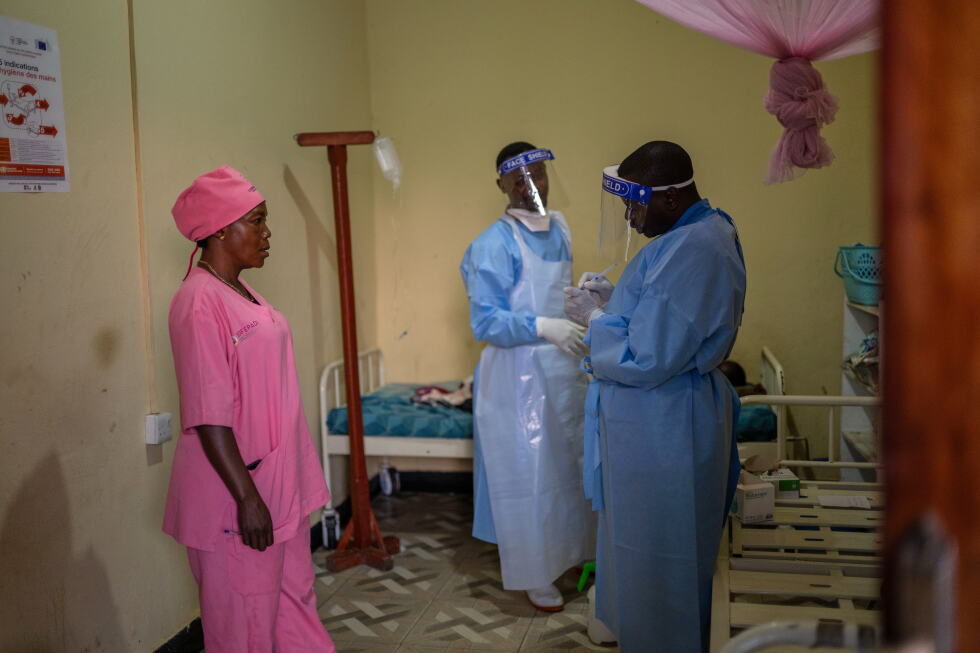
Compounding this inequality is a catastrophic shortage of critical personal protective equipment (PPE) that leaves both professional health workers and family caregivers defenseless. Staff at Karibuni Wa Maman clinic, which screens symptomatic patients before referring them to larger treatment centers, say they have received no full PPE since the outbreak began, despite repeated appeals to national health authorities. The clinic is run by local aid group Women’s Solidarity for Inclusive Peace and Development, whose president Julienne Lusenge says the only supplies the organization has secured from international and state partners are a small amount of hand sanitizer and a handful of masks for clinical staff. This gap puts even informal caregivers at extreme risk, Lusenge adds: most women caring for sick relatives at home do not even know their loved one may have Ebola, let alone have access to gear to protect themselves. “During previous outbreaks, many women died because they were the ones nursing sick family members,” she says.
Pregnant women face a particularly devastating, impossible dilemma. Many avoid seeking routine prenatal care at local clinics out of fear of contracting Ebola, leaving them and their unborn children without life-saving monitoring. Anny Ekyambo, a 32-year-old Bunia resident five months pregnant, says she shares this fear with most other pregnant women in her community. “I know that there are steps we must follow with the doctors to monitor the pregnancy and the baby, but we have no choice because this epidemic frightens us,” she explains. UN Women points out that pregnant women already face higher exposure due to their regular need for health services, and Lusenge warns that avoiding care will have dire secondary consequences: “We risk seeing a rise in prenatal and postnatal mortality, for both mothers and children.”
As of this week, Congolese authorities have confirmed 344 cases of Ebola, including 60 deaths, with dozens more suspected cases yet to be tested. Neighboring Uganda has recorded 15 confirmed cases and one death. The outbreak was identified weeks later than it should have been, because the rare Bundibugyo strain was not included in initial testing protocols. Even with incremental improvements in response coordination and new aid arrivals in recent days, medical charity Doctors Without Borders says the virus is still spreading faster than intervention teams can contain it. “Nobody knows the true scale and severity of this outbreak,” said Dr. Alan Gonzalez, the organization’s deputy director of operations.
Multiple overlapping challenges have hampered the international and state response to the crisis. Ituri province, where the outbreak is centered, is located more than 1,000 kilometers from Congo’s capital Kinshasa, with crumbling road networks and chronically underfunded, underequipped health facilities. Ongoing violent conflict has further blocked access: the Islamic State-allied Allied Democratic Forces rebel group operates in the region, while the Rwanda-backed M23 rebel militia controls key urban centers in neighboring North Kivu and South Kivu, where additional cases have been confirmed. Decades of conflict have also left local communities deeply wary of outside authorities and medical workers, pushing more people to rely on at-home care from family members rather than seek official treatment—once again shifting the risk onto women.
This coverage is supported by the Gates Foundation as part of AP News’ global health and development reporting in Africa, with the AP retaining full editorial control over all content.