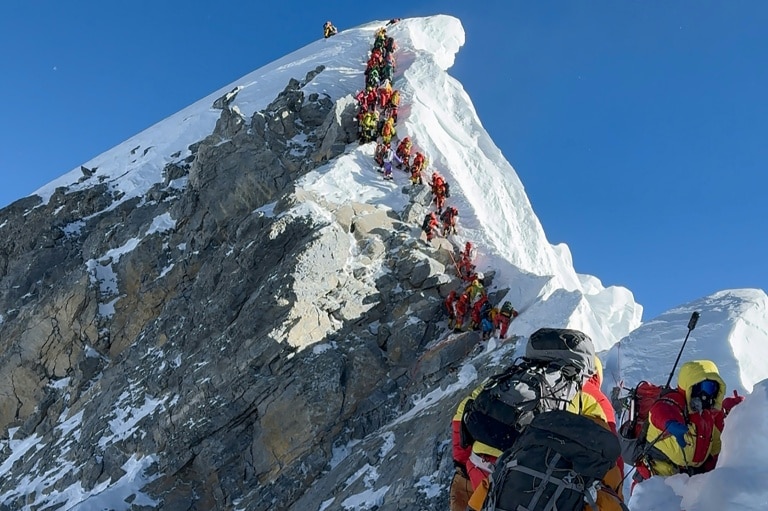
In a remarkable story of survival against the harshest conditions on Earth, an experienced Nepali climbing guide who went missing for six days on Mount Everest and was widely presumed dead has crawled back to Base Camp alive, expedition officials confirmed to AFP in an interview on Thursday.
Hillary Dawa Sherpa, a seasoned high-altitude climber familiar with Everest’s most dangerous terrain, disappeared in the upper reaches of the 8,849-meter world’s highest peak in the early hours of May 30. His unexpected return ended days of fruitless search efforts, when teams had already begun to prepare for the worst outcome.
Workers from the Sagarmatha Pollution Control Committee (SPCC), a local Nepali organization responsible for maintaining climbing routes and clearing accumulated waste from the mountain, made the surprise discovery of Sherpa on Thursday morning just a short distance from Base Camp. “He was crawling down when we found him,” explained Pemba Sherpa of 8K Expeditions, the firm that coordinated the official search and rescue operation for the missing guide. A rescue helicopter has already been deployed to airlift Sherpa to a specialized hospital in Nepal’s capital Kathmandu for urgent medical evaluation.
British climber Chris Thrall, a former Royal Marine who summited Everest with Sherpa around 5 p.m. on May 29, had shared a heartfelt tribute to the guide on Instagram just one day before his rescue, writing in a post mourning what he believed was Sherpa’s passing. He described Sherpa as an “absolute gentle giant of a man and a true ‘tiger of the mountains’”, echoing the widespread high regard Sherpa holds among the global climbing community.
Thrall recounted the sequence of events that led to Sherpa going missing as the two climbers began their descent from Camp Four, which sits at roughly 7,950 meters, just below the oxygen-starved zone known to climbers as the “death zone” where the human body cannot sustain itself for long periods. As the pair descended, Sherpa stopped to catch his breath. “He sat down for a rest with his backpack — these guides carry huge loads up and down the mountain,” Thrall recalled. “I turned and I said, ‘Hillary, are you okay, brother?’ He said, ‘Yes, yes, fine Chris, please go, go!’ This is nothing new on the mountain; sometimes climbers pull ahead at their own pace.”
As Thrall continued downward, he encountered a Polish climber in critical condition: the mountaineer had exhausted his supply of supplementary oxygen, suffered severe frostbite, and was at immediate risk of hypothermia. Thrall faced an agonizing choice, one familiar to climbers who navigate life-or-death decisions high on Everest. The 11-day summit push had already stretched far longer than the typical five-day itinerary, a sign of just how brutal conditions were this season. “Do I go back for Sherpa, who’s probably going to rock up and be fine, as he has done hundreds of times before? Or do I help my fellow climber, who’s got no oxygen, frostbite in his fingers, and obviously you’re never far off hypothermia up there?” he said.
Thrall chose to stay with the Polish climber, sharing his own oxygen supply as the pair descended slowly to Camp Three. What would normally take just two hours to cover took 11 exhausting hours, a testament to the severe conditions and the strain of the rescue. By the time they reached safety, Thrall knew they had escaped a catastrophic outcome.
Despite multiple search teams launching missions to locate Sherpa in the days after he disappeared, no trace of him was found until Thursday morning, when he emerged after days of slow, solitary descent down the mountain. This climb was one of the final expeditions of the 2026 spring climbing season, which meant very few other climbers were still on the peak to offer assistance.
This year’s Everest season has already been marked by tragedy: at least five people — two Indian climbers and three Nepali climbing staff involved in pre-season preparations — have died on the mountain. At the same time, initial counts from Nepali tourism officials show that more than 1,000 climbers have successfully reached the summit this season, making 2026 the busiest climbing season in Everest’s recorded history.