Recent geopolitical disruptions including the ongoing crisis in the Strait of Hormuz and escalating tensions in the Red Sea have laid bare a critical global economic vulnerability: both Gulf nations and international commodity markets rely heavily on maritime trade routes that remain persistently exposed to conflict and political instability. While global leaders and diplomatic negotiators work to de-escalate tensions and reopen these critical shipping corridors, a little-noticed cross-border infrastructure project has quietly accelerated after 15 years of incremental development: the Gulf Cooperation Council (GCC) Railway initiative. Scholars of global governance and political economy have raised a pressing question: can this massive rail network do more than boost regional trade – can it reshape political dynamics and reduce conflict risk across the Middle East?
This question has grown far more urgent amid the ongoing US-Iran war, which has shut down most commercial shipping through the Strait of Hormuz for months, crippling global energy trade flows. For centuries, access to and control of Persian Gulf shipping routes has been dominated by outside military powers and fractured by regional rivalries. From Portuguese colonial control of the Strait of Hormuz in the 16th and 17th centuries to centuries of British and American military dominance in the region, this critical chokepoint has never been fully controlled by the Gulf nations that depend on it most.
Since the GCC’s founding in 1981, the six member states – Bahrain, Kuwait, Oman, Qatar, Saudi Arabia, and the United Arab Emirates – have formally committed to deepening regional integration. But after more than four decades of summits and joint declarations, tangible economic and political cooperation has consistently fallen short of rhetorical promises. The ongoing conflict with Iran has underscored the urgent need for coordinated action, and the GCC Railway has emerged as the most promising vehicle to finally deliver meaningful integration.
First announced at the GCC’s 30th annual summit in 2009, the project plans to build a 2,177-kilometer (1,352-mile) cross-border network connecting all six member states, with a total projected investment of $250 billion. The design calls for a standard-gauge network supporting both freight and passenger services: freight trains will operate at 80 to 100 kilometers per hour, while passenger services will reach speeds of 200 kilometers per hour, all equipped with European train control technology. After years of slow progress, delayed by prolonged periods of low global oil prices that squeezed government infrastructure budgets across the fossil fuel-rich region, the United Arab Emirates and Saudi Arabia led a major push to accelerate construction throughout the 2020s.
The outbreak of war with Iran added new urgency to the project. When GCC leaders gathered in Jeddah, Saudi Arabia in April 2026, against the backdrop of Iranian strikes on Gulf states and the full closure of the Strait of Hormuz, the bloc made a formal pledge to speed up completion of the full rail network, alongside commitments to deepen security cooperation and build integrated oil pipeline and electricity connections across member states. Under the project structure, each GCC nation oversees construction and operation of its own national segment, and Saudi Arabia and the UAE have advanced furthest toward completion.
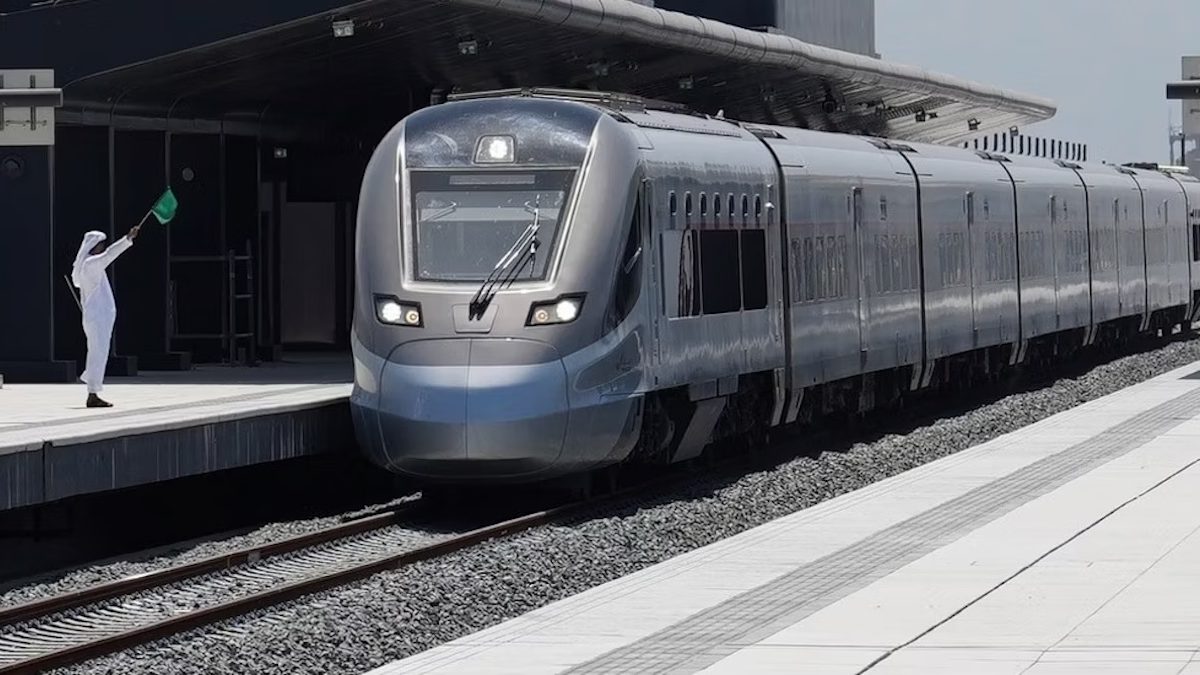
In June 2026, the UAE launched commercial passenger service for Etihad Rail, connecting Abu Dhabi and Fujairah. A full line from the Gulf of Oman to the Saudi border is scheduled to open by the end of 2026, construction of the UAE-Oman cross-border segment is well advanced, and the remaining member states – Qatar, Bahrain, and Kuwait – are in active planning and design for their sections. Early in 2026, the director of the GCC Rail Authority confirmed the overall project has reached 50% completion and remains on track to launch full operations by 2030.
When finished, the network will deliver the Gulf region’s first fully integrated cross-border rail system, stretching from Gulf of Oman ports all the way to Kuwait City. But the transformative potential of the project extends far beyond intra-GCC connections: planners are already developing extensions to link the network to major markets in Europe and Asia. Four primary routes to Europe are currently under consideration or early development: a northern corridor from Kuwait through Iraq and Turkey; a central route across Saudi Arabia through Jordan, Syria, and Turkey; a connection from Saudi Arabia through Jordan to the Israeli Mediterranean port of Haifa; and a southern link via Saudi Arabia’s planned Landbridge project to Red Sea ports, with onward sea connections through the Suez Canal.
For Asian trade, the network will connect Gulf countries to Indian Ocean and Arabian Sea markets via existing and expanded Gulf of Oman ports, including the UAE’s Fujairah and Oman’s growing Sohar port. This creates a critical alternative trade route that bypasses the Strait of Hormuz entirely during periods of crisis, eliminating the chokehold that conflict in the strait can hold over global energy and trade flows.
Multiple complementary corridor initiatives are already underway, backed by billions in investment from both regional and international stakeholders. These include the high-profile India-Middle East-Europe Economic Corridor, backed by India, the European Union, the United States, and multiple GCC states; Saudi Arabia’s Landbridge project, which has already finalized its design contract; and Iraq’s Development Road Project. In June 2026, Saudi Arabia and Turkey signed a memorandum of understanding to advance rail connectivity, including plans to revive and upgrade the century-old Hejaz Railway to reconnect Turkey, Saudi Arabia, and Jordan via Syria.
Beyond its role as alternative trade infrastructure, the GCC Railway and its extended connections carry profound political and social implications. The network will enable cross-border travel for tens of millions of business and leisure passengers, opening new opportunities for regional tourism by making it far easier for international visitors to travel across multiple Gulf states. These deepened people-to-people and economic connections also lay the groundwork for greater political stability and long-term development across the broader Middle East.
For example, Iraq’s Development Road corridor could redefine GCC-Iraq relations, shifting the dynamic from a focus almost entirely on countering Iranian influence and security concerns to a partnership centered on shared economic growth and interconnected supply chains. Similarly, deeper GCC integration could drive much-needed investment and economic recovery in post-civil war Syria. Closer economic ties between GCC states also reduce the risk of future intra-bloc conflicts, such as the 2017-2021 Qatar blockade that divided the alliance for years.
In the near term, GCC leaders view deepened economic and political cooperation through the railway as a strategic counterbalance to Iran. But over the longer term, the shared economic incentives created by the network could create new pathways to improved relations between Iran and GCC states.
Historically, large-scale rail networks have played transformative roles in nation-building and regional integration, from forging the transcontinental economies of the United States and Canada to binding European economies together and driving modernization in 20th century Japan and contemporary China. The GCC Railway fits squarely into this legacy: it is far more than concrete and steel rails. It represents a collective strategic effort to strengthen regional resilience to geopolitical shocks, deepen economic integration, reduce overreliance on the vulnerable Strait of Hormuz, and position the Gulf as a critical connected hub linking Asian, Middle Eastern, and European markets.
While railways cannot eliminate the risk of war or erase long-standing geopolitical rivalries, infrastructure projects gradually reshape the incentives and shared identities that drive political decision-making over time. For the Gulf, the GCC Railway could finally put meaningful, lasting regional cooperation on track. This analysis is by Stacy D. VanDeveer, professor of global governance and human security at UMass Boston, and Firmesk Rahim, PhD candidate at UMass Boston, republished with permission from The Conversation.