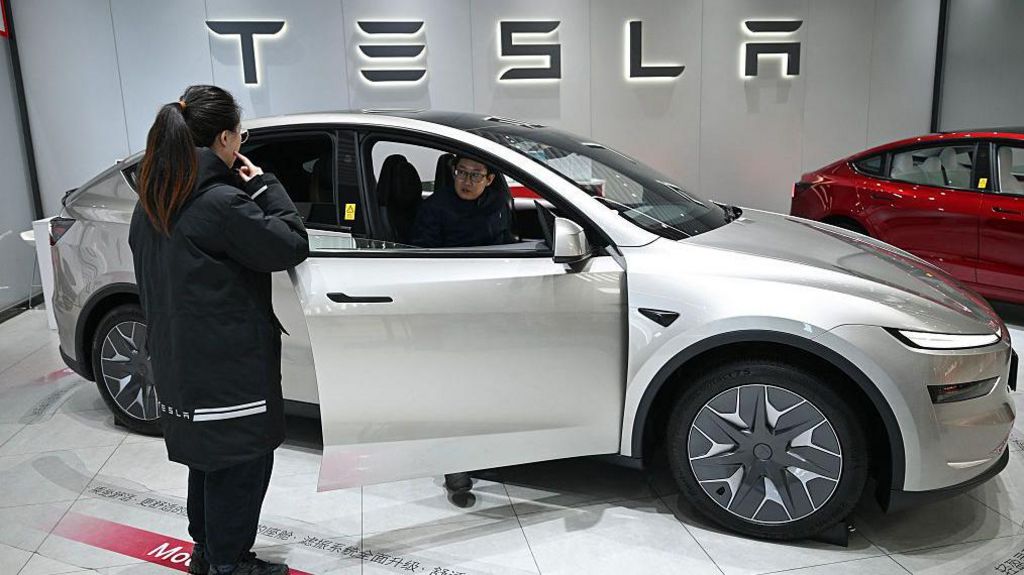
Concealed, flush-mounted car door handles, a design aesthetic first popularized globally by Elon Musk’s Tesla, have emerged as a focal point of global automotive safety debates after China launched the largest vehicle recall in the country’s history, impacting more than four million mostly electric vehicles (EVs) across multiple brands. The massive recall comes as China implements groundbreaking new regulations that will ban the sale of new EVs lacking dual mechanical door release mechanisms on both interior and exterior door panels starting in 2027, a policy shift spurred by mounting fatal incidents linked to electronic door handle failures.
First adopted by Tesla for its Model S sedan back in 2014, hidden door handles have become a ubiquitous design choice in the global EV industry, valued for their aerodynamic efficiency that extends driving range and sleek, minimalist exterior styling. Industry data shows that roughly 60% of China’s top 100 best-selling new energy vehicles – including both pure EVs and plug-in hybrids – currently feature this design. Yet growing reports of entrapment during accidents have turned this popular styling feature into a major public safety concern.
Shanghai-based automotive industry analyst Stephen Dyer, from global consultancy AlixPartners, told reporters that even experienced drivers often struggle to locate door release controls in unfamiliar vehicles equipped with hidden handles. Beyond usability confusion, safety experts warn that electronically operated hidden handles can fail completely after a crash when a vehicle’s electrical system is damaged, trapping occupants inside and delaying critical emergency rescue efforts.
“A door handle may seem like a trivial component, but it becomes safety-critical in the immediate seconds after a collision,” explained Lyu Chen, an associate professor at Nanyang Technological University specializing in automotive engineering. Chen added that the widespread shift to electronically controlled hidden handles has created tangible, underrecognized safety risks for drivers and passengers.
These safety concerns moved from abstract debate to urgent public scrutiny following two fatal 2025 crashes involving Chinese tech giant Xiaomi’s first electric vehicle, the SU7. Regional Chinese media, as cited by the *Global Times*, documented one fatal highway crash in Tongling, eastern China that killed all three occupants inside the vehicle. Family members of the victims reported that passengers were trapped after the crash because the electronic door handles failed to unlock, preventing escape and delaying rescue. At the time, Xiaomi stated that the SU7 was equipped with power-independent mechanical emergency releases located at the bottom of each door, and that the company was cooperating with police investigations. The brand has since updated newer SU7 models to include power-free manual door opening mechanisms, but has not responded to recent requests for comment on the recall.
Tesla, the brand that pioneered the design, has also faced legal action over its hidden door handle systems in the United States. The company is currently being sued by the sole survivor of a 2024 Cybertruck crash in California that killed three college students. Jordan Miller, the survivor, alleges that the Cybertruck’s door system – which relies on electronic buttons with no exterior mechanical release – trapped passengers inside the burning vehicle after the electronics failed, blocking escape and rescue. “When you design a vehicle with no mechanical way to open doors from the outside, you are gambling that electronics will work perfectly in every scenario, even a high-speed crash followed by a fire,” stated a legal representative from The Veen Firm, which is representing Miller. Tesla has denied all wrongdoing in court filings, noting that the Cybertruck meets all current U.S. federal safety standards. Additional reports from the U.S. have documented multiple other cases of passengers, including young children, being trapped in Tesla vehicles after sudden door handle electronic failures.
In February 2026, China made history as the first country in the world to officially ban non-compliant hidden door handles, with the new regulatory framework set to take effect on January 1, 2027. The rules require all new passenger vehicle designs to include fully functional mechanical door releases on both the inside and outside of every door, and mandate clear visible signage inside the cabin indicating how to operate emergency releases. Dyer notes that China’s move to regulate this safety issue ahead of the U.S. and European Union – regions that typically lead global automotive safety standard-setting – is largely driven by China’s status as the world’s largest EV market, with far more concealed-handle EVs on roads than any other country.
On August 21, China’s State Administration for Market Regulation (SAMR) announced the massive recall, covering vehicles from Tesla and major domestic Chinese EV makers including Xiaomi, XPeng, and Geely. Per SAMR’s order, manufacturers must add prominent warning labels inside vehicle doors to clearly identify emergency release mechanisms. For some affected models, manufacturers will also roll out software updates that automatically lower vehicle windows if a crash is detected, providing an alternative escape route if doors fail to open.
Of the 4 million-plus recalled vehicles, nearly 3 million are Tesla models. SAMR’s official recall notice cites two key defects: the emergency release handles on many recalled models are hard to identify because they match the color of interior trim, and the design can prevent quick door opening after electrical failure, slowing escape and hindering bystander rescue efforts. Xiaomi, XPeng, and Geely together are recalling more than 750,000 additional affected vehicles.
Even with the recall and new regulations in place, some safety and engineering experts argue that the current measures do not go far enough to address core safety risks. Lim Hong Wee, an engineering instructor at the National University of Singapore, points out that the recall fixes do not mandate adding exterior mechanical releases, which means emergency access still depends on functional electrical systems and working software. Gokul Krithivasan, a risk management specialist at Singapore-based consultancy SecureSafe, adds that the recall’s focus on warning labels is an insufficient solution. “When people are panicking after a crash, they rely on instinct, not reading small print in a dark, smoke-filled cabin,” Krithivasan explained. He also noted that current recall measures focus primarily on helping occupants escape, but do not create reliable access for first responders trying to enter a damaged vehicle.
Right now, it remains unclear whether similar recalls will be launched for affected vehicles outside of China. BBC reporting indicates that automakers have not yet notified U.S. regulators of plans for a matching recall, and the U.S. National Highway Traffic Safety Administration says it is still reviewing whether to mandate new emergency door exit requirements for all new vehicles. European regulators have already flagged the safety risks of concealed door handles and have drafted new standards requiring door operation even after total power loss, but have not announced large-scale recalls to date.
Automotive engineering experts note that while hidden door handles remain a common design choice for EVs, the new Chinese regulations are likely to shift global design standards, as most mass-produced vehicles are built for global distribution. “The core principle is unambiguous: emergency entry and exit must remain possible even if a vehicle loses all electrical power,” Lyu Chen said, predicting that China’s new safety rules will eventually be adopted by regulators around the world.