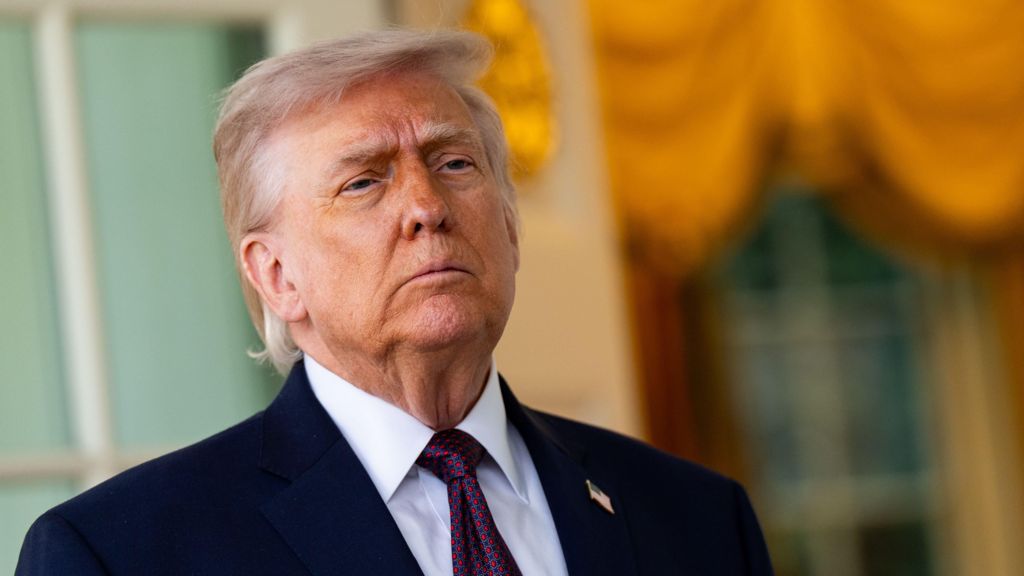
Tensions in the Persian Gulf region have escalated sharply after the Trump administration launched a full naval blockade of maritime traffic entering and exiting Iranian ports earlier this month, an operation that has already resulted in the interception and seizure of an Iranian-flagged cargo vessel.
In a public statement over the weekend, former President Trump confirmed that U.S. naval forces intercepted the cargo ship Touska in the Gulf of Oman, marking the first publicly disclosed seizure under the new blockade policy. U.S. Central Command (Centcom) later released footage showing U.S. Marine Corps rappelling from a military helicopter onto the deck of the intercepted vessel, confirming the boarding operation. This account contradicted an earlier social media post from Trump that claimed U.S. forces had disabled the ship by blowing a hole in its engine room.
The blockade was implemented just weeks after bilateral negotiations between U.S. and Iranian representatives failed to reach a permanent peace agreement to end the conflict that began on February 28. A temporary two-week ceasefire is currently in effect, but the new naval move has thrown that truce into serious question. Washington’s stated goal for the blockade is to cut off two key sources of Iranian revenue: the transit fees Tehran was charging ships to pass through the Strait of Hormuz after it closed the waterway in response to U.S.-Israeli strikes, and Iran’s critical oil export revenue. Trump framed the policy as an effort to force open the strategically vital strait, telling Fox News that the U.S. would not allow Iran to control access based on political preference, and that the ultimate goal is to restore free, unregulated passage for all vessels through the channel.
Under the terms of the current blockade, the U.S. Navy has said that only non-Iranian commercial traffic will be allowed to transit the Strait of Hormuz, and all ships carrying humanitarian aid including food and medical supplies will be permitted to pass after inspection. Centcom has confirmed that more than 12 warships and over 100 fighter and surveillance aircraft are assigned to the blockade operation. Satellite imagery analyzed by BBC Verify on April 11 placed the USS Abraham Lincoln aircraft carrier strike group at the eastern edge of the Gulf of Oman, approximately 200 kilometers off Iran’s southern coast – the closest the nuclear-powered carrier has been positioned to the Persian Gulf since the conflict began. Two guided-missile destroyers, part of the carrier’s escort group, were also spotted in the area. Military analysts note that U.S. forces are unlikely to position major warships close to Iran’s shore to avoid exposure to Iranian missile and drone attacks, so interceptions will mostly take place in international waters of the Gulf of Oman and northern Indian Ocean after ships leave Iranian ports.
International reaction to the blockade has been deeply divided, and the legality of the operation remains a point of fierce debate among legal experts. Iran has immediately condemned the move as an act of “state-sponsored piracy” and threatened to retaliate against Persian Gulf Arab states that support the operation by targeting their coastal port infrastructure. The International Maritime Organization, the United Nations body governing global maritime affairs, has stated that no nation has a legal right to block shipping in an international strait, with Secretary-General Arsenio Dominguez telling the BBC that even amid active conflict, there is no basis in international law to restrict transit through a key international navigation lane. However, Donald Rothwell, a leading professor of international law at the Australian National University, argues that under existing laws of naval warfare, the U.S. as a belligerent party in the conflict has the legal right to impose a blockade on enemy ports.
The blockade has already had tangible impacts on commercial shipping in the region. Centcom confirmed that as of mid-April, six merchant vessels linked to Iran have been ordered to turn around and return to Iranian ports, and ship tracking data analyzed by BBC Verify shows at least two Iran-linked vessels have altered course after transiting the Strait of Hormuz, consistent with U.S. orders. Many shipping companies have also begun using location spoofing to disguise the position of their vessels to avoid interception.
The strategic context for the current standoff dates back to earlier this month, when Iran announced it would reopen the Strait of Hormuz following a U.S.-brokered 10-day ceasefire between Israel and Lebanon. But Trump quickly announced the U.S. blockade would remain in place until a final comprehensive peace deal is reached, prompting Iran to reverse course and close the strait once again. Prior to the U.S. blockade, Iran continued to export oil through the closed strait, cashing in on skyrocketing global oil prices driven by the closure of the waterway, which carries roughly 20% of the world’s daily energy shipments. March 2026 marked Iran’s fifth-largest month for oil exports in the past 18 months. Approximately 82% of all fossil fuel exports leaving the Strait of Hormuz are bound for Asian markets, with China purchasing an estimated 90% of Iran’s current oil exports. Beijing has already labeled the U.S. blockade “dangerous” and “irresponsible”, and analysts widely view the policy as an effort to pressure China to take a more active role in pushing Iran toward a peace deal.
The potential consequences of a prolonged blockade are severe for both regional security and the global economy. Leading security analysts, including BBC security correspondent Frank Gardner, have highlighted two major risks: a further surge in already elevated global oil and gas prices, and the collapse of the current 14-day ceasefire, which would reignite full-scale conflict between the U.S. and Iran and put neighboring Gulf states including Dubai, Bahrain, Kuwait and Saudi Arabia at direct risk of escalation. The International Monetary Fund warned this week that a prolonged conflict and sustained high energy prices could push the global economy into recession, with the United Kingdom forecast to suffer the worst impact among all advanced economies. For Iranian civilians, the blockade also raises serious food security concerns, as Iran relies heavily on imported grain and wheat to feed its population.
Commercial shipping data shows that prior to the conflict, roughly 3,000 vessels transited the strait each month; that number has dropped to just a handful per day during the current hostilities, triggering a major fuel crisis across energy-dependent Asia. Many Asian governments have already implemented emergency measures to conserve fuel, including ordering remote work, shortening the national work week, declaring public holidays and closing universities early. The UK government has confirmed that British forces will not participate in enforcing the blockade, though Royal Navy minesweepers and anti-drone assets will continue routine patrols in the region. Trump has said other nations will join the blockade effort but has not named any contributing countries, and claimed that NATO has offered assistance to clear mines the U.S. accuses Iran of laying in the strait, with the goal of reopening the waterway to full traffic in the near term.