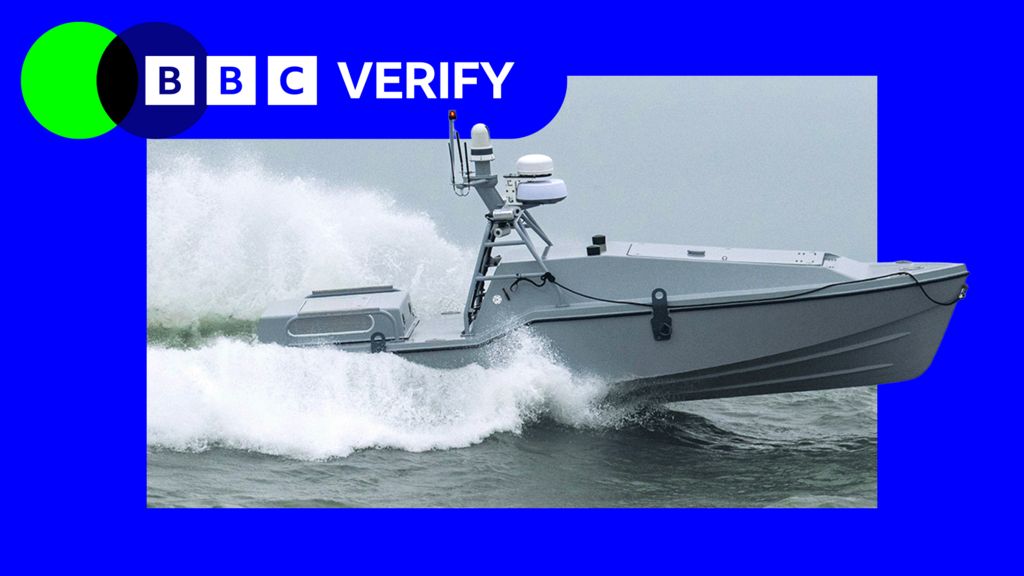
In a groundbreaking milestone for unmanned maritime technology, a US military sea drone has successfully carried out the first publicly documented rescue of surviving crew members from a downed military helicopter off the coast of Oman, US defense officials confirmed this week.
The incident unfolded near the Strait of Hormuz, a strategically critical waterway that has been largely closed to commercial shipping since the outbreak of open conflict between the US and Iran. US President Donald Trump stated that the downed Apache attack helicopter was shot down by Iranian forces in the contested region.
Following the crash, two American service members stranded in open water were pulled from the sea in approximately two hours, and are now reported to be in stable medical condition, according to US Central Command (Centcom), the military command overseeing operations in the Middle East.
The unmanned craft that completed the rescue is the Corsair sea drone, built by Texas-headquartered maritime drone manufacturer Saronic. Publicly available specifications from the company’s website outline that the vessel measures 24 feet (7.3 meters) in length, has a maximum payload capacity of 1,000 pounds (450 kilograms), and can reach top speeds exceeding 35 knots (40 miles per hour).
Bryan Clark, a naval drone specialist at the Hudson Institute think tank, described the Corsair as comparable in size to a small commercial fishing vessel, featuring a flat open purpose-built deck designed for flexible cargo loading. “It’s probably able to hold three to four people comfortably in an emergency scenario,” Clark explained. Beyond its carrying capacity, the drone is fitted with a full 360-degree camera array, long-range navigation radar, and electronic radio sensors for intelligence gathering and communications interception.
Stacie Pettyjohn, a defense analyst at the Center for a New American Security, noted that the Corsair platform is not a new prototype – the US Navy already operates a fleet of roughly 50 of the vessels. “They’re typically used for detecting mines or surveillance, but the Navy is still experimenting with the fleet in the strait to see what other capabilities it can deliver,” Pettyjohn said.
The rescue mission was executed by Task Force 59, the US Navy’s first operational unit dedicated exclusively to unmanned maritime systems, which was established in 2021 and began large-scale deployment of drone vessels in the Middle East this past March. This operation aligns with the Pentagon’s broader strategy to expand its fleet of autonomous and unmanned platforms; last year, the Navy awarded Saronic a $392 million production contract to scale up manufacturing of the Corsair autonomous vessels.
While the Corsair is capable of fully autonomous operation, both experts who spoke to BBC Verify agree that the vessel was almost certainly manually piloted for the high-stakes rescue. “In this mission it would have likely been controlled remotely by a person with a joystick to make sure they got to the exact location of the stranded crew,” Clark said. “It would have been directed straight to their known position, and the soldiers just clambered on board, just like they would getting onto any other boat at sea.”
Centcom spokesperson Captain Tim Hawkins explained that the Corsair was selected for the mission due to its proximity to the crash site and its unique operational capabilities. Pettyjohn noted that using an unmanned vessel eliminated the risk of additional casualties that would have come from sending a manned ship or helicopter into a hostile active combat zone. “Although rescue isn’t a core designed mission of the vessel, it was clearly well-suited for this dirty, dangerous mission,” she said.
The rescue operation concluded early Tuesday local time, at approximately 3:30 a.m. After the two soldiers were brought aboard the Corsair, the drone transported them to a pre-arranged rendezvous point in open water, where they were lifted by a manned helicopter for further transfer to medical care, Hawkins added.
Unmanned sea drones have seen rapidly expanding use in active conflicts over the past two years, most prominently in the war between Russia and Ukraine. As BBC Verify has previously reported, Ukrainian forces have repurposed smaller sea drones as explosive attack vessels to target Russian naval assets, but no public record exists of Ukraine using the platforms for search and rescue operations. Clark explained that most Ukrainian sea drones are far smaller than the Corsair, comparable in size to a jet ski, and lack the capacity to carry even one survivor.
Other non-state and state actors have also deployed sea drones in regional conflicts: Yemen’s Houthi rebels have operated explosive “kamikaze” drone boats, and Iranian forces have used the vessels to target shipping attempting to transit the Strait of Hormuz during the current conflict. Pettyjohn argues that recent innovations in conflict zones reshaped the US approach to the technology. “The Houthis and Iranians have had sea drones in the past, but Ukrainians really took it to the next level and showed what other countries could do,” she said. “The US expansion of its own sea drone fleet very much emerged off the back of the Ukraine war and seeing what they innovated.”
This successful rescue mission marks a paradigm shift in how unmanned maritime systems can be utilized, expanding their role beyond offensive operations, surveillance and mine clearance to include life-saving humanitarian and combat rescue missions in high-risk environments.