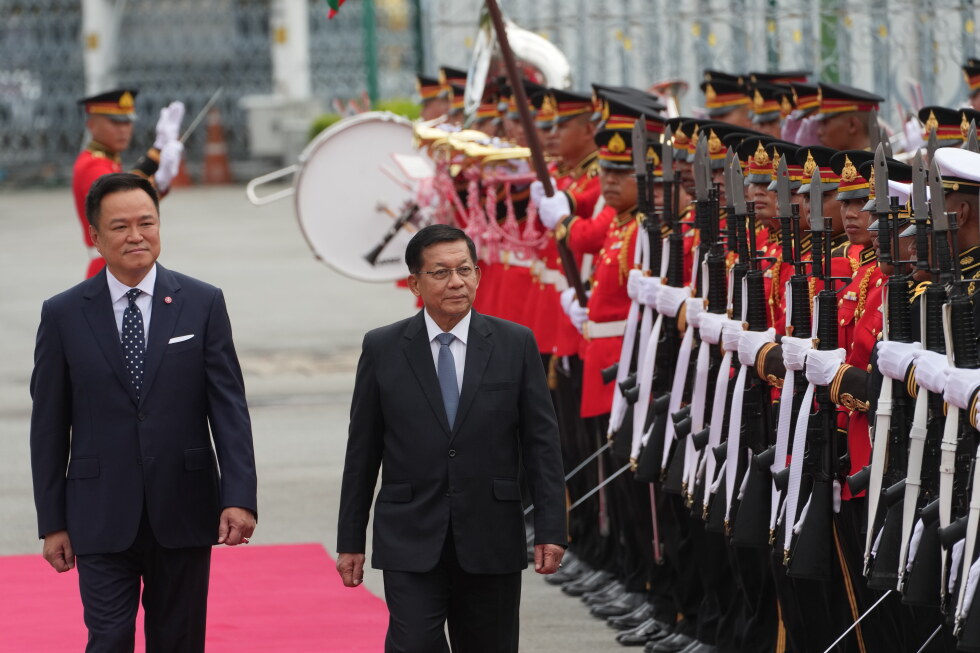
BANGKOK – More than five years after Myanmar’s military seized power from the country’s democratically elected civilian government, the head of the junta-backed administration has arrived in Thailand for a high-stakes official visit that marks one of his most prominent diplomatic pushes to secure international legitimacy for his regime.
Min Aung Hlaing, who was sworn in as Myanmar’s president in April following a staggered election held late last year and early this year that was widely dismissed as a fraudulent exercise to cement military control, is scheduled for a two-day itinerary of top-level talks. His agenda includes formal meetings with Thai Prime Minister Anutin Charnvirakul and other senior government officials at Bangkok’s Government House, where multiple bilateral memorandums of understanding are expected to be signed. After the closed-door discussions, the two leaders will also headline a joint Thailand-Myanmar Business Forum focused on deepening cross-border commercial ties.
This trip is the latest in a string of regional diplomatic engagements by Min Aung Hlaing since he took the presidency, part of a coordinated campaign to reverse years of international isolation that followed the February 2021 coup that ousted the elected government of Aung San Suu Kyi, when Min Aung Hlaing was still serving as Myanmar’s army chief. He has previously traveled to neighboring states including China, India and Laos, and maintains close strategic ties with Russia, but the junta leadership remains largely shunned by the global community, particularly Western powers that have imposed sweeping sanctions on Min Aung Hlaing and his inner circle over the coup and subsequent human rights abuses.
In the wake of the 2021 takeover, the junta launched a brutal lethal crackdown on mass pro-democracy protests, triggering a nationwide armed resistance movement that has devolved into an ongoing bloody civil war spanning large swathes of Myanmar. As of this week, an independent human rights monitoring group, the Assistance Association for Political Prisoners, which tracks war-related casualties and detentions, reports that more than 8,200 civilians have been killed by Myanmar’s security forces, with another 31,645 arrested since the coup.
Human rights advocates have roundly condemned Min Aung Hlaing’s visit to Thailand, arguing that it grants unwarranted credibility to a regime that continues to violence against its own people. Yanghee Lee, a senior spokesperson for activist group Justice For Myanmar, emphasized that the trip constructs a false narrative of legitimacy for Min Aung Hlaing and the ruling military clique. Chit Seng, a senior human rights specialist at regional watchdog Fortify Rights, noted last month that swapping a military uniform for a presidential robe after a rigged election does nothing to change the core nature of the junta, describing the administration as a brutal regime that targets its own population and should not receive international recognition.
In a parallel development framed by the junta as a conciliatory gesture to quiet global criticism, the regime this week allowed a representative from the International Committee of the Red Cross (ICRC) to visit detained former leader Aung San Suu Kyi. The visit marks the first confirmed contact between Suu Kyi, 81, and an independent international humanitarian organization since she was detained after the 2021 coup. The ICRC confirmed the meeting took place but declined to release any details on Suu Kyi’s health or the discussion held during the visit.
Suu Kyi was initially sentenced to 33 years in prison in late 2022 on charges that her supporters and independent rights groups universally denounce as politically motivated fabrications designed to bar her from returning to politics. In late April, the junta moved her from a prison facility to house arrest and commuted her sentence to 18 years, leaving her with more than 13 years of detention remaining. The United Nations, Western governments, and major international human rights organizations have repeatedly called for her immediate and unconditional release.
Min Aung Hlaing’s regional outreach campaign is centered on rebuilding his government’s standing within the Association of Southeast Asian Nations (ASEAN). Following the 2021 coup, the junta was barred from participating in top-level ASEAN summits after failing to implement a 2021 peace agreement designed to de-escalate conflict in Myanmar. Thailand, which has maintained consistent close relations with Myanmar’s military leadership, has emerged as the most prominent advocate within ASEAN for reengaging the junta.
Prime Minister Anutin defended Thailand’s approach during a recent visit to Indonesia this week, stating that a peaceful and stable Myanmar is an essential pillar of ASEAN unity and broader regional security. He explained that Thailand has pushed for a calibrated re-engagement strategy that keeps channels of dialogue open and accounts for on-the-ground realities in Myanmar, and argued that the recent ICRC access to Suu Kyi vindicates this approach of gradual engagement.
Thanida Piyachot, another human rights specialist at Fortify Rights, pushed back strongly against this framing. She argued that recognizing Min Aung Hlaing as a legitimate head of state, and what she described as shaking the bloodied hands of a war criminal, sends a dangerous message to the millions of Myanmar civilians suffering under the illegitimate military dictatorship. Thanida called on Thailand and the broader ASEAN bloc to abandon their reliance on the principle of non-interference as a shield for inaction, and take meaningful proactive steps to advance human rights and democratic rule in Myanmar.